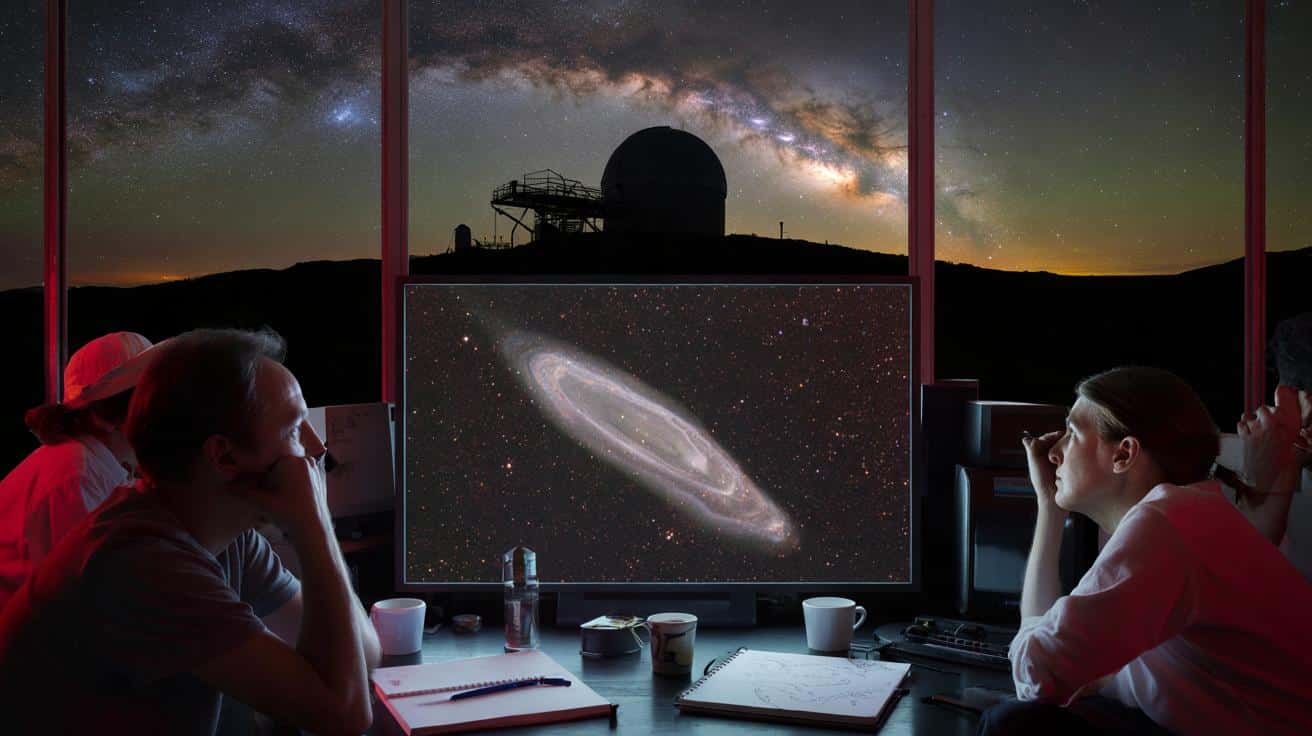
The lights are off at the small mountain observatory, except for the soft red glow washing over the control room. A handful of tired astronomers lean toward their screens, coffee cooling beside notebooks filled with messy equations. On the monitor: a grainy smudge, barely there, drifting against a sea of perfect pinpoint stars. Then the software cleans up the image, and the smudge sharpens into something with a tail, a shape, a direction. Someone exhales a low “wow” that cuts through the silence.
The new visitor has no idea we’re watching it.
When a stranger from another star system slips into view
Astronomers have been quietly buzzing for months about a ghostly traveler with a poetic name: 3I/ATLAS. It’s only the third-known interstellar comet ever spotted passing through our Solar System, and the newest images of it look nothing like the textbook comets we grew up with on posters.
Captured from a patchwork of observatories around the world and in space, these views show a shy, elongated object wrapped in a faint halo, its tail barely peeling away from the background. It feels less like a cosmic firework and more like a distant, cautious guest.
One night at the Pan-STARRS observatory in Hawaii, the team watched the data stream in, line by line. The comet’s motion was unmistakable: not looping along the familiar, closed curves of local comets, but carving a bold, open path through the Solar System.
A few days later, other observatories locked on. From the European Southern Observatory in Chile to the Gemini North telescope, and then space-based eyes like Hubble added their own frames. Each brought out different details — a twist in the tail here, a subtle asymmetry in the coma there — until scientists started stitching them together into a 3D-like portrait of this interstellar wanderer.
The reason these images are such a big deal is simple: 3I/ATLAS doesn’t “belong” here. Its orbit isn’t bound to the Sun. Instead, it’s on a hyperbolic trajectory, flying in from deep interstellar space and heading back out again, never to return.
By tracking how its brightness changes, and how its tail responds to sunlight, researchers can guess what kind of ice and dust survived the harsh journey between stars. That’s like getting a free sample of raw material from another planetary system, without sending a spacecraft. *For planetary scientists, this is as close as it gets to turning the universe into a natural laboratory.*
How you can really look at 3I/ATLAS, not just scroll past it
The raw telescope images of 3I/ATLAS look nothing like the glossy pictures you’ll see in news feeds. They start as black-and-white frames, faint streaks barely above the noise, recorded with long exposures. Teams then combine multiple images, align them on the comet’s motion, and enhance the contrast to draw out the tail and coma.
When they publish the color versions, those hues are often mapped to highlight different wavelengths — like infrared or specific chemical fingerprints — instead of what your eyes would see at the eyepiece. That’s why some images glow in surreal blues or toxic greens: they’re not fake; they’re translations.
➡️ A psychologist says: “This small change in how you think about people marks true emotional maturity”
➡️ This dinner comes together naturally, without overthinking
➡️ “I make this creamy oven dinner when I want consistency more than excitement”
➡️ If your bank card PIN is on this list, change it now: your account can be emptied
If you want to experience this comet for real, you don’t need a giant observatory, but you do need to manage expectations. Amateur astronomers using mid-sized backyard telescopes report 3I/ATLAS as a dim fuzz, more whisper than shout, best seen under truly dark skies. No Instagram-perfect tail streaking across the sky, just a subtle blur that moves a little each night.
We’ve all been there, that moment when you finally glimpse a “famous” object and feel a tiny flash of disappointment. Let’s be honest: nobody really does this every single day with saintlike patience. The magic comes when you step back and realize you’re tracking an object that was ejected from another star system eons ago.
Astronomers often warn against assuming that these new images are a finished portrait. They’re snapshots in a story that’s still unfolding, taken from different instruments with different sensitivities and quirks.
“Interstellar visitors like 3I/ATLAS remind us that our Solar System has neighbors,” says Dr. Elena Márquez, a comet specialist involved in one of the observing campaigns. “We’re seeing material that formed under a different sun, in a different cradle of planets. Every pixel in these images is a clue to how common — or rare — worlds like ours might be.”
To read those clues, researchers juggle several threads at once:
- Compare brightness over time to see how quickly the comet is losing gas and dust.
- Measure the shape of the tail to estimate how solar radiation and the solar wind are pushing it.
- Analyze spectra to pick out chemicals like water, carbon monoxide, or exotic organics.
- Model its orbit backward to guess where in the galaxy it might have started.
- Cross-check with older interstellar visitors like ‘Oumuamua and 2I/Borisov for patterns.
A comet as a quiet reality check about our place in space
There’s something oddly grounding about knowing that 3I/ATLAS doesn’t care about our headlines or trends. While we argue on Earth, this object just keeps sliding through the Solar System, following a path written long before humans built telescopes. The new images, stacked and sharpened from observatories in different time zones, feel like a collective act of curiosity.
They invite a slower kind of looking. Not just a quick swipe past a pretty picture, but a moment to sit with the idea that our planetary neighborhood isn’t a closed bubble. Stranger things really do pass through from time to time, carrying ancient dust from stars we’ve never seen up close.
| Key point | Detail | Value for the reader |
|---|---|---|
| Interstellar origin of 3I/ATLAS | Its hyperbolic orbit shows it came from beyond the Solar System and will never return. | Gives a rare, tangible glimpse of material from another star system. |
| Multi-observatory images | Data from ground and space telescopes were combined, each revealing different features. | Helps readers understand why the images look so detailed, colorful, and varied. |
| Scientific clues in the tail and coma | Brightness, tail shape, and spectra reveal the comet’s composition and history. | Shows how these photos turn into real knowledge about how planets and systems form. |
FAQ:
- Is 3I/ATLAS dangerous for Earth?Current orbital calculations show no threat to Earth. Its path takes it through the Solar System once on a wide, open trajectory, then back into interstellar space.
- Can I see 3I/ATLAS with the naked eye?No, not under normal conditions. It’s far too faint and requires at least a mid-sized amateur telescope and very dark skies to glimpse as a small fuzzy spot.
- What makes an interstellar comet different from a regular one?Regular comets orbit our Sun. Interstellar comets like 3I/ATLAS follow hyperbolic paths, arriving from outside the Solar System and not remaining gravitationally bound.
- Are the colors in the photos real?They’re real in the sense that they correspond to actual wavelengths of light, but they’re often enhanced or mapped to specific filters. What you see is a scientifically useful visualization, not exactly what the human eye would see.
- Will we ever send a spacecraft to an interstellar comet?Space agencies are seriously studying this idea. The challenge is speed: these objects cross the inner Solar System quickly. Mission concepts aim to have spacecraft ready to launch on short notice once a promising target appears.