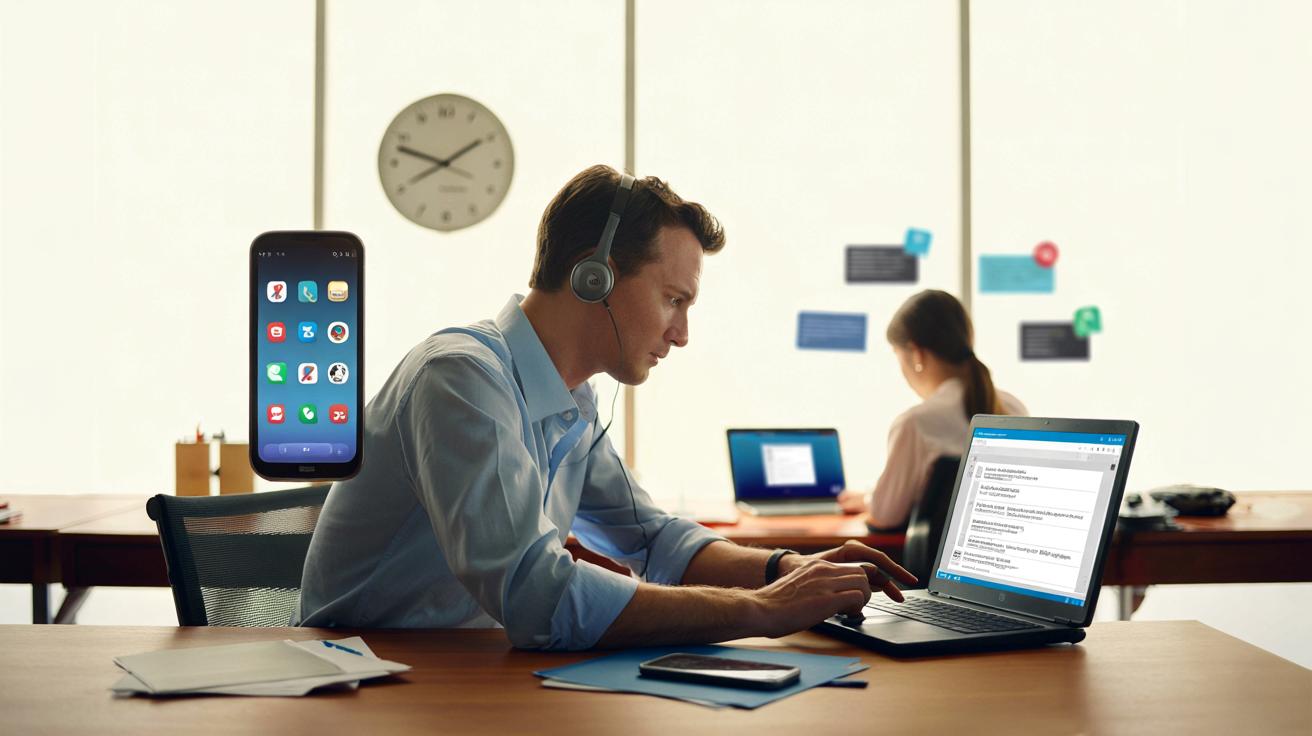
Someone’s name flashes. Your fingers move almost on their own. Three minutes later you’ve replied, checked two other apps, seen a breaking news alert and… completely forgotten what you were doing in the first place. Your to‑do list is still there, staring back at you, slightly accusatory.
This tiny interruption doesn’t feel like much. A few seconds, a quick glance, a harmless peek. Yet by the end of the day your mind feels shredded, like a browser with 37 tabs open and music playing somewhere you can’t locate. You go to bed with the nagging feeling you’ve been busy, but not with the things that mattered.
Here’s the twist: you don’t have to abandon your messages or become that person who “never replies”. You just have to change *when* you check them.
Why constant checking quietly wrecks your focus
Open-plan office, headphones on, you’re finally in the flow. Then: a soft buzz, a tiny red badge, the preview of a message half‑visible on your lock screen. You tell yourself you’ll just glance at it. Your brain, sensing novelty, drops what it was holding and chases the ping like a cat after a laser pointer.
By the time you’re back in your document or spreadsheet, the delicate thread of concentration has snapped. The work feels heavier now, like pushing a bicycle up a hill you’d previously been gliding down. Multiply that micro‑moment by 40 or 50 times a day and you start to see why your brain feels fried by 4 p.m.
One study from the University of California suggested it can take around 20 minutes to fully return to a task after an interruption. Not a dramatic emergency or a long meeting. Just a “quick check”. You might tap your phone for ten seconds, but your mind keeps wandering for far longer. Email, WhatsApp, Slack, Teams: each one is a small door out of the room where your real work lives. Open enough doors, and your day becomes a corridor.
What’s strange is that many of us are not being chased; we’re chasing ourselves. A lot of people don’t just respond to messages, they keep refreshing in case there *might* be one. This is the anxious scan you do in a queue, at traffic lights, on the sofa while the kettle boils. The fear is that if you don’t check now, something urgent will slip past and you’ll be the last to know.
In reality, your messages form a queue whether you’re watching them or not. They’re not fireworks going off once, never to be seen again. The urgent ones will still be there in five, fifteen, even thirty minutes. The brain, though, has been trained by years of instant replies and little dopamine hits to think, “If I don’t look, I’m missing life.” So you live at the surface of your attention, permanently skimming, rarely diving deep.
We end up designing our workday around the most nervous version of ourselves. That version expects disaster in every notification and wants every plate spinning at once. Yet when you talk to people who seem strangely calm and productive, they often share a quiet secret: they don’t check messages all the time. They’ve changed the timing, not the volume.
The simple shift: batching your check‑ins like a pro
The most practical move is astonishingly low‑tech: choose specific windows to check messages, and treat them like mini appointments. For instance, ten minutes at the top of each hour. Or three “message blocks” a day: late morning, mid‑afternoon, early evening. Between those windows, your messaging apps exist, but they’re not your boss.
➡️ What is the tiny hole in your nail clipper for – and how should you really be using it?
➡️ Got an Annoying Twitch? Here’s What to Consider Before You Think The Worst : ScienceAlert
➡️ Building Career Mobility In Technology Through Structured Support
➡️ How delaying decisions on purpose reduces regret later
➡️ According to psychology, very independent people often had to fend for themselves too early
You can start small: tell yourself, “I’ll do one deep‑focus sprint of 25 minutes, then a five‑minute message check.” Set an actual timer so you’re not secretly watching the clock. When the timer goes, you flip roles: now you’re fully “on” for messages, clearing, replying, forwarding. Then you step away again. Think of it like a train timetable: messages arrive any time they like, but departures only happen at scheduled times.
This doesn’t mean ignoring real emergencies. It means separating genuine urgency from the constant digital tapping on your shoulder. Many people keep one channel as the “red phone” – a call, or perhaps a specific contact who knows they can ring twice if it’s critical. Everything else joins the queue for your next check‑in. You’re not less available; you’re available on purpose.
Here’s how it plays out in real life. A project manager we’ll call Sam was drowning in Slack. Every ping felt like a tiny fire. They’d jump from board to chat to email, ending each day with 100 half‑finished tasks and a head full of static. Eventually, after a mild panic attack in the supermarket car park, Sam tried a different rhythm: Slack at 10:00, 13:00 and 16:00. Email twice a day. Phone on silent, but calls allowed through.
The first week was awkward. Sam kept feeling phantom vibrations and guilt. Colleagues were confused at first, then quietly envious. By the second week, Sam’s updates were clearer, projects moved faster, and evenings stopped bleeding into late‑night inbox clean‑ups. No one actually missed anything crucial. What changed was that the team started writing better messages, knowing they might wait a bit.
In one global company, a similar experiment showed that when staff limited email checks to three windows per day, reported stress dropped while measured output went up. People weren’t working harder. They were simply doing less mental gear‑shifting. That’s the hidden tax of constant checking: every time you switch, there’s a small cognitive toll. Batching your check‑ins means you pay that toll once, process a bunch of stuff, then close the gate again.
The logic behind this is unglamorous, but powerful. Focused attention works like a muscle; it tires with use, recovers with rest, and hates being yanked in too many directions. Message batching protects that muscle. Instead of thousands of micro‑flexes all day, you get stretches of solid work, followed by short bursts of communication. Both sides benefit: your replies are more thoughtful, and your deeper work actually reaches the finish line.
Some people worry this will make them seem slow or out of touch. The opposite tends to happen. Because your communication is gathered into defined slots, you actually respond more consistently. The random gaps disappear. You become the person who writes back reliably at 11:15 and 15:30, not the ghost who sometimes replies in 30 seconds and sometimes vanishes for hours.
There’s also a subtle psychological gain. When your brain learns that “messages get dealt with properly at set times”, it stops panicking about each ping. The background hum of anxiety lowers. You trust your own system. That trust is where real focus starts to grow.
Staying available without living in your inbox
Start by drawing a simple line: “focus time” and “response time”. You don’t need fancy software. A note on your desk or a calendar block works. During focus time, turn off banners and lock‑screen previews for messages. During response time, open the floodgates fully and give your inbox or chats your whole attention.
A practical pattern many people like is: 09:30–11:30 deep work, 11:30–12:00 messages, 14:00–15:30 deep work, 15:30–16:00 messages. Adjust the exact times to match your role and time zone. The key is consistency. Let colleagues know: “I check messages properly at these moments, so you’ll hear from me then.” That tiny sentence quietly rewires expectations.
On your phone, group all messaging apps into one folder and move it off the home screen. It adds a tiny bit of friction, just enough to stop the habitual thumb flick. Many people also change their notification sound to something neutral or turn it off entirely. The goal isn’t to wage war on your phone. It’s to turn it from a constant tap on the glass into a tool you pick up on purpose.
There’s a trap here: turning batching into a new form of self‑punishment. You swear you’ll only check messages twice a day, then “fail” by looking three times and feel like you’ve wrecked everything. That’s not how real change works. Expect some messy days. Notice the patterns instead of judging them. Was there a specific trigger that made you reach for your phone every ten minutes?
On a hard day, you might suddenly find yourself bouncing from app to app without even remembering why you unlocked the screen. Rather than scolding yourself, use that as a cue: put the phone in another room for ten minutes, or place it screen‑down behind your laptop. On a calmer day, try stretching your gap between check‑ins by five minutes, like gently extending a muscle.
On a human level, this is also about boundaries. If people are used to instant replies from you, the first time you take an hour they might worry, or push back. That doesn’t mean you’re wrong. It simply means they were benefiting from a system that slowly drained you. We have all already lived that moment where your weekend is eaten by “just one quick message”. You’re allowed to redesign that.
“The moment you stop treating every message like a fire alarm, your mind starts to remember what deep, uninterrupted work feels like.”
Some readers will want something tangible to keep near their desk or in their notes app.
- Pick your “red phone” channel – one way people can reach you instantly if something is truly urgent.
- Set 2–4 daily message windows and put them in your calendar as actual events.
- Silence non‑essential notifications during focus blocks, including those harmless‑looking previews.
- Create a one‑line status message: “In focus time, next checking messages at 3:30pm.”
- Review once a week what genuinely couldn’t wait, and adjust your windows if needed.
Soyons honnêtes : personne ne fait vraiment ça tous les jours, à la minute près. Life intervenes. Kids get sick, bosses change plans, trains get delayed. The point isn’t running a perfect schedule. The point is having a default that protects your attention, so on the messy days you at least know where to return.
A quieter phone, a louder mind
When you stop giving every ping front‑row seats in your mind, you start to notice what silence feels like again. That first half‑hour of uninterrupted focus can feel almost eerie, like walking into a library after weeks at a funfair. Then something clicks. Your thoughts stretch out again. You remember you can hold an idea in your head for more than a few seconds.
Shifting when you check messages is a small, almost invisible change from the outside. No one sees you toggling notifications, sliding apps off your home screen, glancing at the clock and thinking, “I’ll answer that at 11:30.” Yet inside, it reshapes your day. The frantic, twitchy energy sinks. Your replies get calmer. Your work feels less like firefighting, more like building.
This isn’t about becoming unreachable. It’s about choosing the moments where you open the gate, instead of leaving it swinging wide all day. People adapt faster than you think. Many will experience your new rhythm as a relief, a silent permission slip to step out of the constant‑checking race themselves.
You might start noticing unexpected side effects. Books become easier to finish. Walks feel less like “time away from the screen” and more like actual walks. That stubborn project that’s been half‑done for months suddenly moves forward because you’ve finally given it a proper, undisturbed hour. And when an urgent message does arrive, you meet it with a clear head, not a frayed nervous system.
The real experiment begins the day you pick one small change – one extra gap before you check, one new message window – and watch what it does to your focus. Maybe you’ll slip back into old habits the following day. Maybe not. Either way, you’ll have felt, even briefly, what it’s like to be the one choosing when your attention moves. That taste is hard to forget, and surprisingly easy to share.
| Point clé | Détail | Intérêt pour le lecteur |
|---|---|---|
| Changer le moment des vérifications | Passer de la consultation continue à des créneaux dédiés | Gagner en concentration sans ignorer les messages importants |
| Définir un “red phone” | Un seul canal réservé aux urgences réelles | Rester joignable en cas de besoin critique, sans être dérangé en permanence |
| Rituel hebdomadaire | Revoir ce qui était vraiment urgent et ajuster ses horaires de check | Adapter le système à sa vie réelle et non à un idéal théorique |
FAQ :
- Won’t I miss something urgent if I stop checking constantly?
You can keep one clear “urgent” channel open, like calls or a specific chat, and let people know that’s how to reach you quickly. Most messages are not truly time‑critical, and they wait just fine for your next check‑in.- How often should I check messages to stay responsive?
For many people, two to four dedicated windows per day strike a good balance. Try mid‑morning and mid‑afternoon first, then adjust depending on your role and how often real emergencies come up.- What if my job expects instant replies?
In that case, narrow your focus windows rather than eliminating them. Even 20–30 minutes of protected time, with a colleague covering or a status set, can significantly improve your ability to do deep work.- How do I handle the guilt of not replying straight away?
Notice the guilt as a habit, not a fact. Communicate your new rhythm to colleagues and friends, and watch how quickly they adapt. Consistent, thoughtful replies usually matter more than instant, distracted ones.- Isn’t this just another productivity trend I’ll drop in a week?
It might be, unless you keep it small and realistic. Start with one extra gap before checking, or a single daily message window, and let it evolve with your life instead of trying to overhaul everything overnight.