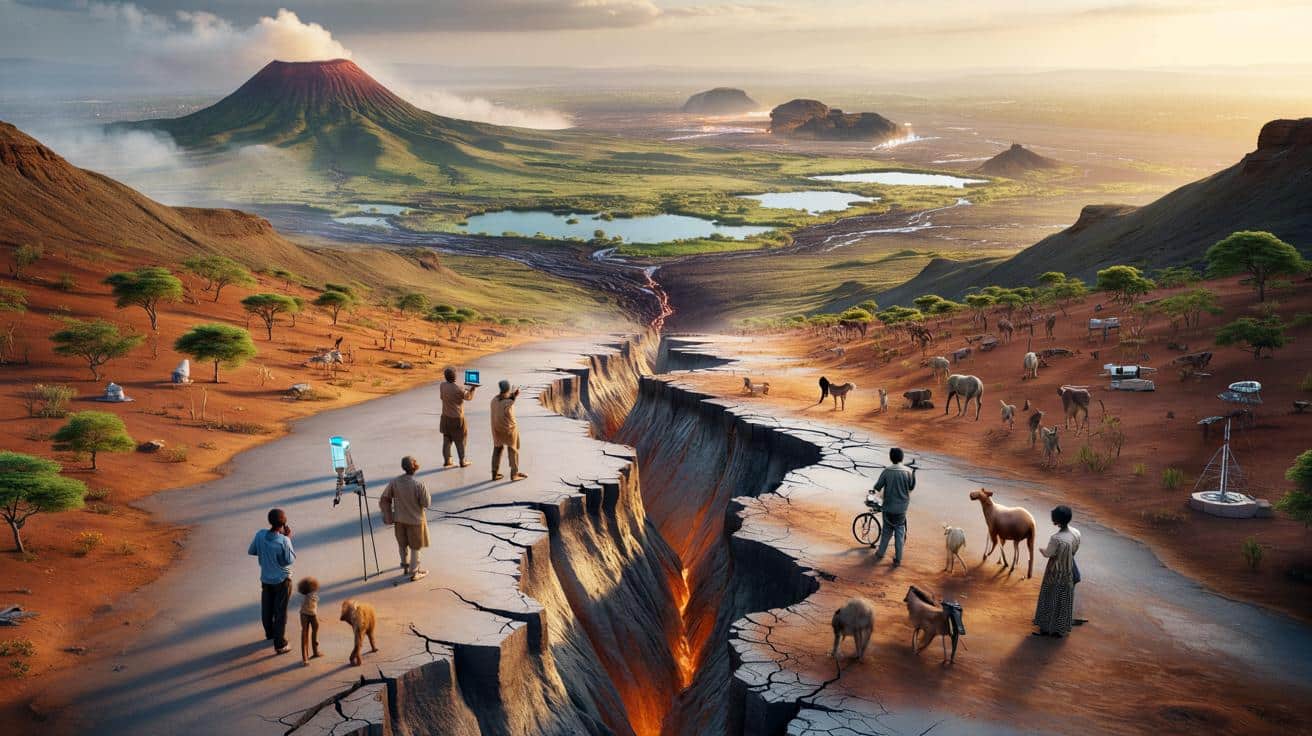
The first crack is so small you could almost miss it. A dusty line in the ochre earth of southern Ethiopia, snaking across fields and rough tracks, while children push bikes and herders guide goats as if nothing strange is going on beneath their feet. A few years ago, a viral video showed a gigantic rift opening in Kenya after heavy rains, swallowing part of a road and splitting farmland in two. Locals stared, phones out, half fascinated, half afraid.
Geologists watched the same images with a very different feeling. For them, that fracture wasn’t just a dramatic landslide. It was a tiny, visible piece of a colossal, hidden process: Africa, slowly stretching apart along a scar called the East African Rift.
Some scientists now say that, one day, a brand‑new ocean could fill the gap.
Africa’s slow crack: what we’re really seeing on the surface
Stand on the edge of the Afar Desert in Ethiopia and you’re standing in one of the most extreme “before” photos in Earth’s geological album. The ground here is torn, flat, almost lunar, with steaming vents and black lava fields. It feels like the crust has been unzipped. What looks like random chaos is actually a boundary: to the east, the Arabian Plate; to the west, the African Plate; right underneath, a deep plume of hot rock pushing everything apart.
That push is slow, painfully slow by human standards. A few millimetres a year. About as fast as your fingernails grow.
The 2018 video from Kenya’s Narok County became a kind of global wake‑up call. Overnight, the pictures flooded social networks: a gaping trench slicing through a busy road, cars stranded, families watching as the ground literally fell away. Comment sections exploded with talk of “Africa breaking in two” and end-of-the-world jokes.
Geologists on the ground pointed out the less viral truth. The road collapse was partly due to erosion and water, but the location wasn’t random. It sat right within the East African Rift system, a 3,000‑kilometre scar that runs from the Red Sea down through Ethiopia, Kenya, Tanzania, and beyond. The video was a messy, human‑scale glimpse of a tectonic process that’s been unfolding quietly for millions of years.
What’s really happening is a huge tug-of-war inside the planet. Deep beneath East Africa, hotter, lighter rock rises from the mantle like a slow-motion lava lamp. As it pushes upward, the crust above thins and stretches. Cracks form. Volcanoes appear. Some of the world’s most famous ones – Kilimanjaro, Nyiragongo, Erta Ale – sit right on this living fault zone.
This stretching doesn’t just create dramatic landscapes. It’s gently rearranging the map. Over tens of millions of years, the Nubian part of the African Plate and the Somali part could fully separate, pulling apart like two drifting rafts. Once that happens, seawater from the Red Sea and the Indian Ocean will have a ready‑made path inland.
From crack to coastline: how a new ocean is born
If you’ve ever watched bread dough rise and split in the oven, you already know the basic script. First, tiny fractures; then those fractures deepen; then the split fills with something new. Earth’s crust behaves the same way, just at a slower pace and on a far nastier temperature scale. At the Afar Triangle, scientists say we’re witnessing one of the rarest stages on the planet: continental rifting caught in the act.
➡️ This garden plant attracts snakes: why you should never grow it near your home
➡️ One sock is all you need: the grandma hack to clean blinds back to new with zero effort
➡️ No Vinegar, No Wax: The Easy Home Trick That Makes Hardwood Floors Shine Like New
➡️ If your bank card PIN is on this list, change it now: your account can be emptied
➡️ Why opening windows after showering matters more than extractor fans
➡️ How a single unclear expense category can throw off an entire monthly budget
They track it with a mix of GPS antennas, satellite radar, drones, and ground sensors. These tools measure movements of just a few millimetres, the tremors of small quakes, the inflation of magma chambers. It’s patient, obsessive work – the opposite of viral-video adrenaline – yet it’s building the real picture behind those dramatic clips.
One common misunderstanding is that one day, people in Nairobi will wake up to find a shiny new beach out their window. That’s not how it works, and deep down we all know that. Let’s be honest: nobody really expects a coastline to pop up in their lifetime.
Geologists talk on scales of 5, 10, even 20 million years. Over that kind of time, the East African Rift could widen, faults could deepen, and parts of present‑day Ethiopia, Somalia, Kenya and Tanzania might end up on a separate plate, drifting slightly east. Where the crust becomes thin enough, magma wells up and hardens as new oceanic crust – the same process that built the Atlantic floor. First you get a shallow basin, then lakes, then, eventually, encroaching seawater.
The most convincing evidence is already carved into the landscape. Long, straight valleys like the Gregory Rift in Kenya, chains of volcanoes lining up like stitches, huge lakes such as Tanganyika and Malawi filling young basins – all of this screams “rift in progress” to a trained eye. Satellite images reveal parallel fractures running for hundreds of kilometres, as if someone scored the continent with a giant knife.
Scientists explain it in plain terms: continental crust is thick and buoyant, but when it’s heated from below and pulled from the sides, it gives. First it sags, then it tears. *That tear is the first sketch of a future ocean.* And beneath Afar, seismic studies show something else: a spreading centre already forming, similar to what lies under the Red Sea and the Mid‑Atlantic Ridge. The seabed of tomorrow is being drafted today, under a desert that feels like the end of the world.
The viral “Africa splitting” videos: what they show, what they don’t
If you scroll through TikTok or YouTube and type “Africa splitting”, you’ll see the same images over and over: a yawning crack in a Kenyan highway, people jumping across, some drone shots of Afar’s scorched earth, maybe an animation of the continent tearing apart. Those videos are gripping, and they’re not fake – they’re just zoomed in on the most spectacular few seconds of a story that spans millions of years. The key is learning how to read them without getting lost in drama or denial.
Start with one simple habit: always ask where the footage was taken, and what geologists say about that exact spot. Place matters here more than ever.
The biggest trap is swinging between two extremes. On one side, panic: “Africa is collapsing, we’re doomed.” On the other, total shrug: “Just clickbait, nothing’s real.” Both miss the point. The Narok crack, for example, was amplified by rain and loose soil, but its alignment with known rift faults wasn’t pure chance. These events are like flares, lighting up the deeper processes we usually can’t see.
We’ve all been there, that moment when a sensational headline pulls us in and we only realise later we didn’t really understand what we’d just shared. The goal isn’t to become a geophysicist overnight. It’s simply to leave a video knowing whether you’ve seen a local landslide, a rift fault, or a bit of both.
Geophysicist Cynthia Ebinger summed it up bluntly:
“The East African Rift is real, and it’s active. The videos are not the whole story, but they are part of it.”
To sort through the noise, it helps to keep a tiny checklist in mind, like a mental box on your screen:
- Was the crack filmed in a known rift zone such as Kenya, Ethiopia, or Tanzania?
- Do local geologists or surveys mention existing faults in that area?
- Is erosion or heavy rain also clearly involved in the collapse?
- Does the video include context – maps, expert comments, or before/after shots?
- Are claims about “a new ocean tomorrow” clearly flagged as exaggeration?
This doesn’t kill the magic. It just anchors it. The wonder is still there, only sharper, and oddly more human when the hype falls away.
A continent in motion, and a future we’ll never fully see
There’s something humbling about standing on African soil and knowing it’s very slowly tearing apart, on a schedule that laughs at human calendars. Your feet feel solid, yet the GPS satellites say that ground is drifting, millimetre by millimetre, with each passing year. Cities like Addis Ababa and Nairobi are effectively riding tectonic rafts they’ll never see reach their final destinations.
Scientists sketch out wild maps of the future: a slim ocean arm cutting through East Africa, a new island‑continent carrying pieces of Ethiopia, Somalia, Kenya, Tanzania. These images won’t ever match our lived reality – they belong to a planet 10 or 20 million years away – but they still change how the present feels.
Look again at those viral clips of cracking roads and smoking deserts and you start to see something beyond disaster aesthetics. You see families adjusting paths around a new fissure, farmers rebuilding, engineers shoring up highways, researchers quietly placing instruments in the background. A living continent, adapting to a living planet.
The plain truth is that Earth has always broken its continents and stitched them back together. Pangaea split, the Atlantic opened, India slammed into Asia and raised the Himalayas. Africa’s future ocean would just be the next verse in that song. The only real question is how we choose to look at it, talk about it, and teach it, long before a single wave ever rolls into that future rift‑valley shore.
| Key point | Detail | Value for the reader |
|---|---|---|
| East African Rift in action | Africa’s crust is stretching along a 3,000‑km fault zone, measured in millimetres per year | Gives context behind dramatic images of cracks and road collapses |
| New ocean hypothesis | In 5–20 million years, parts of East Africa could separate and fill with seawater | Helps readers visualise how continents evolve over deep time |
| Reading viral videos critically | Check location, expert input, and role of erosion vs tectonics before sharing | Offers a simple method to avoid panic and clickbait around “Africa splitting” stories |
FAQ:
- Is Africa really splitting into two continents?Yes, the East African Rift shows that the African Plate is slowly breaking into a Nubian and a Somali part, separating by a few millimetres each year.
- Will a new ocean actually form in East Africa?Most geologists think so, but on timescales of millions of years, as the rift deepens, fills with magma, and eventually lets seawater flood in.
- Was the famous Kenyan road crack proof of the split?It was partly a landslide triggered by rain, but it happened along an active rift zone, so it highlights where the crust is already weakened and stretching.
- Is this dangerous for people living in East Africa now?There are risks from earthquakes, volcanism, and ground collapses in some areas, but no sudden continent‑breaking event is expected in any human timeframe.
- Can scientists really “see” the continent move?Yes, they use GPS, satellite radar, and seismic monitoring to measure the plates’ motion and track how the rift is slowly evolving year after year.