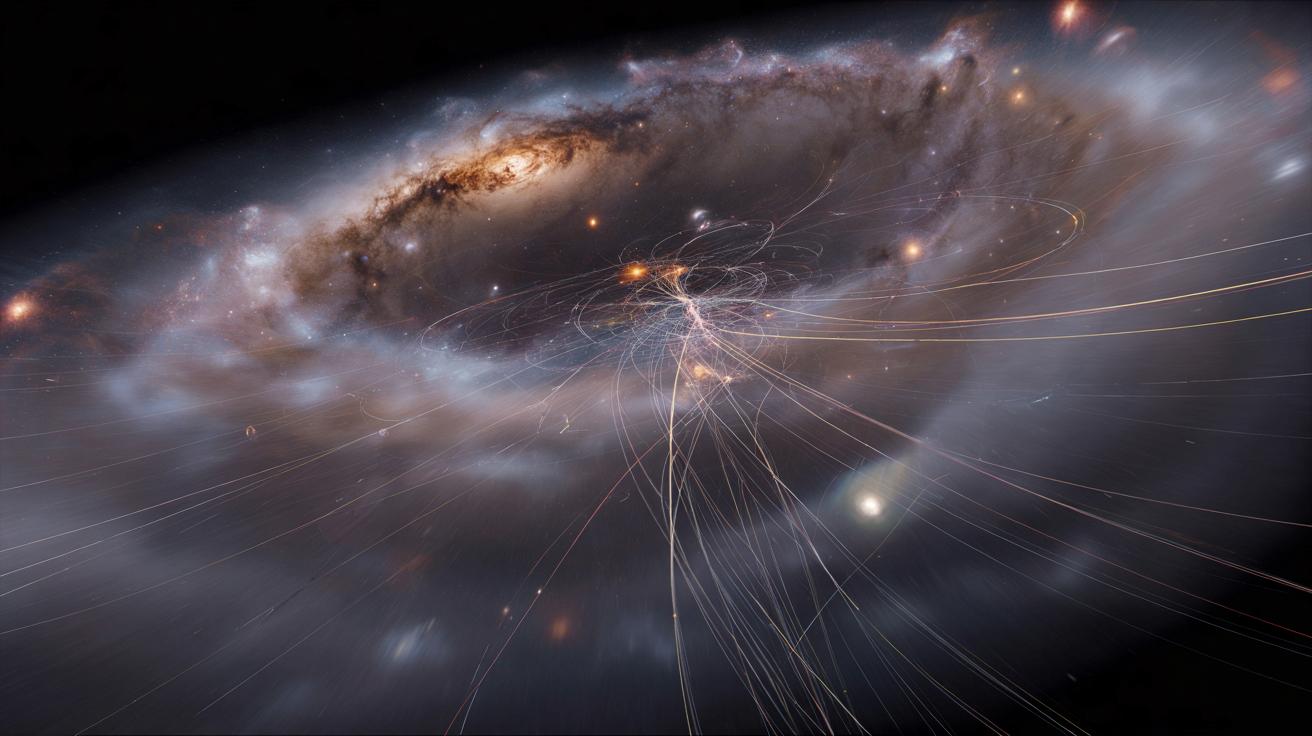
Researchers now suspect that dark matter and elusive neutrinos – often nicknamed “ghost particles” – might be colliding, very rarely but often enough to reshape how cosmic structures grow over billions of years.
The strange partnership shaping cosmic structure
In the current standard picture of the universe, known as the lambda cold dark matter model (lambda-CDM), dark matter and neutrinos barely acknowledge each other. Dark matter dominates gravity, while neutrinos stream through space almost without interacting with anything at all.
A new analysis, published in Nature Astronomy, suggests that this clean separation might be wrong. An international team studying several of the most precise cosmological datasets available found hints that dark matter and neutrinos could be exchanging momentum through rare collisions.
The data point to a universe where dark matter and ghostly neutrinos sometimes bump into each other, very slightly slowing the growth of cosmic clumps.
This subtle interaction could help resolve a long-standing mismatch between theory and observation: the cosmos today looks less “clumpy” than predicted from early-universe measurements.
Dark matter and ghost particles: what they are
Dark matter: invisible, yet everywhere
Dark matter makes up about 85% of all matter in the universe, yet nobody has seen it directly. It does not glow, reflect, or block light. Astronomers infer its presence from its gravity, which keeps galaxies from flying apart and bends light from distant objects.
Galactic rotation curves, gravitational lensing and the behaviour of galaxy clusters all point to a huge reservoir of unseen mass. The exact nature of dark matter – particle, field, or something more exotic – remains one of physics’ biggest open questions.
Neutrinos: the ultimate cosmic escape artists
Neutrinos are tiny, nearly massless particles produced in astonishing numbers. Nuclear reactions inside stars, supernova explosions and radioactive decays all generate neutrinos.
They barely interact with matter. Every second, around 100 billion of them zip through each square centimetre of your body without leaving a trace. Their ghostlike nature makes them valuable messengers of violent astrophysical events, but also notoriously hard to study.
➡️ How mental balance improves when expectations are simplified
➡️ The plant that perfumes the home and repels mosquitoes: why everyone suddenly wants it this spring
➡️ How a single unclear expense category can throw off an entire monthly budget
➡️ If you’re over 65, this gentle daily habit supports better digestion
➡️ From February 12, gas stations must display this new mandatory information
➡️ The emotional reason some people feel relief after crying
According to the standard model of cosmology, dark matter and neutrinos should barely interact at all – they occupy the same universe but live almost separate lives.
The ‘clumpiness’ problem that pushed physicists to look closer
For years, cosmologists have noticed a nagging tension between different ways of measuring how matter is distributed across the universe. Early-universe data, mainly from the cosmic microwave background (CMB), suggest that matter should have formed slightly denser clumps than we actually see today.
This discrepancy is often described with a parameter called S8, which captures the statistical “clumpiness” of matter on certain scales. Data from galaxy surveys and gravitational lensing tend to prefer a lower S8 than CMB-based predictions.
One of the study’s authors likened this not to galaxies suddenly looking different, but to a reduced efficiency in the growth of structure over time. Matter seems to have clumped up a bit less than expected as the universe aged.
If dark matter sometimes shares momentum with neutrinos, it effectively gets a gentle drag, making structure formation slightly less efficient and reducing clumpiness.
Weaving together multiple cosmic clues
The new study stands out because it knits together a wide range of observations, spanning almost the entire history of the universe.
- Early-universe signals: Temperature and density fluctuations in the CMB, measured by the Planck satellite and the Atacama Cosmology Telescope.
- Baryon acoustic oscillations (BAO): Ancient pressure waves now “frozen” in the large-scale distribution of galaxies.
- Galaxy surveys: 3D maps from efforts like the Sloan Digital Sky Survey and wide-field telescopes in Chile.
- Cosmic shear: Weak gravitational lensing data from the Dark Energy Survey, showing how massive structures subtly distort light from distant galaxies.
By feeding these datasets into detailed simulations, the team compared universes with and without dark matter–neutrino interactions. When they allowed for collisions and momentum exchange between the two, the simulated universe lined up more closely with the actual observations.
How strong is the evidence?
The signal for this interaction reaches around the “3-sigma” level, meaning there is about a 0.3% chance that the apparent effect is just a statistical fluke. In particle physics, firm claims usually require 5 sigma, a far stricter standard.
That said, 3 sigma is enough to get theorists and observers paying attention, especially when the potential payoff is a shift in our understanding of both cosmology and particle physics.
If confirmed, a dark matter–neutrino interaction would mark a fundamental breakthrough, opening a new window onto the unseen sector of the universe.
What this could mean for physics
Lambda-CDM has been remarkably successful. It describes the expansion history of the universe, the CMB pattern and the large-scale cosmic web with impressive accuracy. Yet tensions like S8 have prompted many ideas for gentle tweaks rather than full replacement.
Allowing dark matter to interact weakly with neutrinos is one such tweak. It keeps most of the successful framework intact but modifies how structures grow over time. In theoretical models, these interactions can arise from new force carriers or additional particles in a broader “dark sector.”
Crucially, this scenario ties cosmology to particle physics. Any proposed interaction has to fit not only astronomical data but also laboratory constraints from neutrino experiments, colliders and underground dark matter detectors.
| Aspect | Without interaction | With dark matter–neutrino interaction |
|---|---|---|
| Growth of structure | Faster, more clumpy | Slightly suppressed, less clumpy |
| S8 parameter | Higher, from CMB-only models | Lower, closer to galaxy and lensing data |
| Lambda-CDM status | Baseline model | Extended model with additional physics |
Next-generation surveys and the verdict ahead
The current hint rests on a careful but indirect reading of cosmic statistics. Upcoming sky surveys aim to push that much further.
In particular, observations from the Vera C. Rubin Observatory in Chile are expected to transform measurements of weak lensing and galaxy clustering. Its Legacy Survey of Space and Time (LSST) will repeatedly image large areas of the sky, tracking hundreds of billions of galaxies over a decade.
Combined with future CMB experiments, these data should sharpen estimates of S8 and test whether dark matter–neutrino scattering really occurs or whether some other modification – perhaps involving dark energy or spacetime physics – is needed instead.
Either the hint of interaction grows stronger with new data, or it fades, forcing theorists back to the drawing board with fresh ideas.
Key concepts worth unpacking
What is the cosmic microwave background?
The CMB is faint radiation filling all of space, released when the universe was about 380,000 years old. Before that time, matter and light formed a hot, opaque soup. As the cosmos expanded and cooled, atoms formed and light could finally travel freely.
Tiny temperature variations in the CMB reflect early density differences. These small ripples later grew into galaxies, galaxy clusters and the vast cosmic web. Matching those early ripples to present-day structures is at the heart of the S8 tension.
What does ‘3 sigma’ actually mean?
Scientists often express confidence in terms of sigma, a statistical measure related to how unlikely a result is if nothing new is going on. Roughly:
- 1 sigma: common fluctuation, expected often.
- 3 sigma: about a 1-in-300 chance of being a random blip.
- 5 sigma: about a 1-in-3.5-million chance – the usual threshold for a “discovery claim” in particle physics.
The new dark matter–neutrino result sits in the interesting-but-not-yet-settled range, which is why researchers are cautious but excited.
How scientists test these ideas in practice
Behind the scenes, the work relies heavily on numerical simulations. Teams run models of the universe on powerful supercomputers, starting from early conditions consistent with the CMB and evolving forward in time under different physics assumptions.
By adjusting how dark matter and neutrinos interact – from not at all to mildly – they can generate a whole family of possible universes. These are then compared statistically with actual maps of galaxies, clusters and gravitational lensing patterns.
If future data continue to favour models where the two invisible components occasionally collide, dark matter will no longer look quite as cold and aloof as once thought. Instead, it will appear as part of a more complex, interacting dark sector, one that could hold fresh clues for both cosmology and particle physics laboratories on Earth.