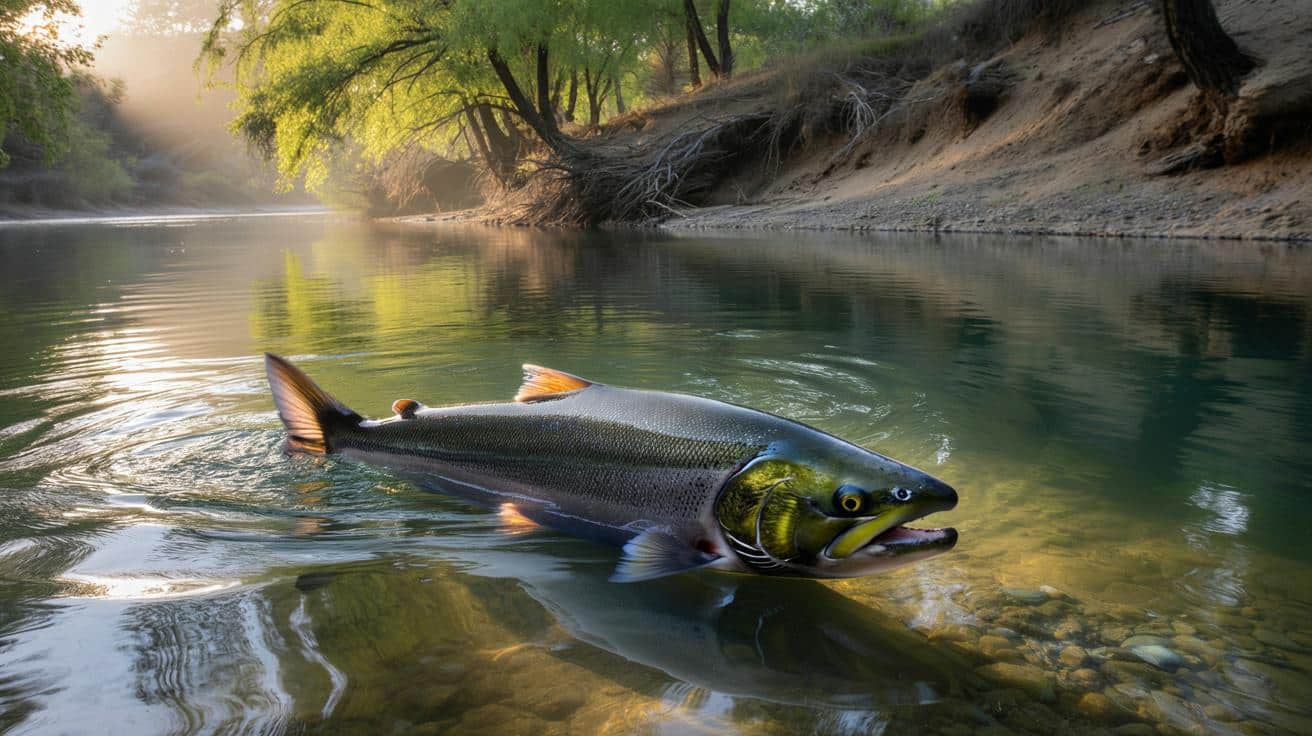
Just after sunrise, along a dusty sliver of river near Fresno, a small crowd stood in the cold watching a miracle flicker in the shallows. A ranger in a faded green jacket pointed, his voice dropping almost to a whisper. There, fighting the current with a stubborn, pulsing tail, a single chinook salmon held its ground against the flow of the San Joaquin River. The water here used to be bone-dry for long stretches, more memory than river. Yet this fish had done something no one alive had ever seen: it had come home, on its own, to a river its ancestors last spawned in roughly a century ago. Phones came out, boots crunched gravel, people forgot to talk.
For a moment, even the highway noise seemed to back off.
Something very old had just restarted.
A lone salmon that rewrites a river’s story
On the surface, it was just one fish. About 30 inches long, the familiar dark back and silver sides, spotted like old ash. Biologists saw more than that. They saw living proof that a river California had once treated as expendable could still carry life, and not just water, from the Pacific to the Central Valley. The chinook had traveled hundreds of miles, slipping past dams, predators, warm plumes of agricultural runoff. It ignored all the reasons not to be here.
The single salmon in the San Joaquin River instantly became a headline, a data point, and, for a lot of people watching, a small, unexpected jolt of hope.
This stretch of the San Joaquin had been written off for decades. Parts of it ran dry for 60 miles at a time, a sacrifice zone for irrigation canals and pumps feeding one of the most productive farm belts on Earth. Older residents remember kids racing dirt bikes on the exposed riverbed. When a massive restoration settlement in 2006 forced water releases and habitat work, critics scoffed. Billions of gallons just for “a few fish”?
Fast forward, and that “few fish” has turned into a century-breaking story. The returning chinook was not trucked here or dumped out of a hatchery truck at the last bend. It navigated, instinct first, all the way back to its natal river system, following faint chemical cues written into its body before it ever saw the ocean.
Biologists call this kind of return “natural-origin” spawning. It’s the gold standard in salmon recovery, the moment when human help steps back and the species’ own ancient programming takes over. The San Joaquin salmon wasn’t just a survivor, it was a signal that broken ecological circuits can be rewired. The fish’s journey stitched together ocean, delta, and river in a way that planners and engineers have been trying to replicate with meetings and legal briefs. Let’s be honest: nobody really does this every single day, stand at a riverbank and feel centuries of policy, drought, and concrete shake in their boots. Yet that’s what this one chinook quietly did.
How a dead river learned to carry salmon again
Restoring a river for salmon is less like flipping a switch and more like rehabbing a patient out of intensive care. First came the water: controlled releases from Friant Dam to reconnect dry reaches and lower summer temperatures. Then came the plumbing changes, rerouting or moderating some of the most aggressive diversions that had turned the San Joaquin into a patchwork of pools and dust. Crews dug side channels and carved shallow gravel bars where salmon could one day lay eggs.
On the banks, cottonwoods and willows were planted to shade the water and cool off the brutal Central Valley heat that can cook young fish before they ever reach the ocean.
At the same time, hatchery workers carefully tagged juvenile salmon, tiny silver smolts, and sent them downstream to the Pacific. Many never came back. Some were eaten, others stunned by warm water or sucked into pumps. For restoration teams, progress often looked like failure on a spreadsheet. Then word spread that a tagged adult had been detected heading up the system, then physically spotted in a restored reach. That moment—radio beeps turning into a thrashing, real fish—felt less like science and more like a comeback scene from a sports movie.
We’ve all been there, that moment when the long shot you half-stopped believing in suddenly lurches back to life.
Behind the emotion sits a gritty, unromantic reality: this recovery is fragile. One dry winter, one policy reversal, a few degree’s rise in river temperature, and the San Joaquin’s salmon story could snap again. The Central Valley’s farms still rely heavily on the same water the fish need. Urban growth leans on that water too. Yet the return of a natural-origin chinook forces a new question on everyone fighting over allocation charts: if a river can do this, what else are we willing to let it do? *The plain truth is that a single salmon has changed the tone of a 20‑year argument in a way no courtroom ever could.*
The fish became leverage, a reminder that the system is not as broken as many feared—and not as invincible as some would like.
What this means for rivers, readers, and the small choices we touch
You may never stand on the banks of the San Joaquin, and you might live thousands of miles from California. Still, this story reaches into your day more than it seems. Salmon are what scientists call a “keystone” and a “connector” species: their journey ties together oceans, rivers, forests, and communities. When they return, they drag marine nutrients upstream in their own bodies, feeding everything from insects to bears to the trees that hold riverbanks in place.
So when one chinook nose-taps its way into a long-dry reach, it’s not only a win for fish geeks. It’s a subtle nudge about how stitched-together our lives and landscapes really are.
There’s a temptation, with stories like this, to treat them as feel-good one-offs. Scroll, smile, move on. The bigger shift comes when people start connecting the dots closer to home. Maybe that looks like supporting local groups that rip out obsolete dams or daylight buried creeks under city streets. Maybe it’s as simple as paying attention to where your food and water come from, including the quiet streams and wetlands that rarely make headlines.
If you’ve ever felt powerless reading climate or biodiversity news, this salmon offers a different, stubborn kind of narrative: restoration doesn’t require perfection, it just requires not giving up when the river looks empty.
One of the biologists on the San Joaquin project said something that stuck:
➡️ This slow-simmered dinner feels richer with every bite
➡️ Designing Innovation Programs With Dual Impact Outcomes
➡️ No Vinegar, No Wax: The Easy Home Trick That Makes Hardwood Floors Shine Like New
➡️ Most people overlook this moment that shapes the rest of the day
➡️ Some people talk incredibly loudly: What that reveals about their character
➡️ How delaying decisions on purpose reduces regret later
“We weren’t trying to save this one fish. We were trying to give it the option to show up. The amazing thing is that it took us up on that offer.”
Inside that line is a small blueprint you can steal for your own relationship with the natural world. You don’t have to overhaul your life overnight. You can focus on giving your local place a chance to surprise you. That might mean supporting a restoration ballot measure, visiting a neglected urban river on weekends, or just telling this story to someone who’s convinced we’ve already lost.
- Back a local river or wetland project, even with a small recurring donation.
- Choose foods from producers who protect waterways rather than drain them.
- Spend time near real water—rivers, creeks, coasts—and pay quiet attention.
- Share recovery stories like this one to shift the online mood from doom to effort.
- Ask one annoying question when new development hits: what happens to the water?
A century-long detour, and what comes after one fish
The return of a chinook to its native California river after 100 years doesn’t fix dams, erase drought, or guarantee a thriving run of salmon. What it does is crack open the story line. A river once written off as “dead” has put a living, thrashing rebuttal on the record. That matters not just to scientists and farmers but to any of us trying to understand what recovery could look like in a century defined by loss. The San Joaquin salmon reminds us that nature’s timelines are longer and stranger than our patience.
The fish spent years in the ocean, then days and nights muscling back upstream, following a scent trail it had never consciously smelled before.
The next few seasons will tell us whether this was a lonely glitch or the first note of a new chorus. More fish might follow, or the river could fall quiet again if politics and weather align the wrong way. Yet something subtle has already changed for those who work and live along the banks. When kids see that photo of a salmon in their “dead” river, their baseline shifts. A world where chinook belong here becomes slightly more plausible than a world where they don’t.
That’s where the story loops back to you, reading on a phone somewhere between work emails, headlines, and daily noise.
The same way this salmon carried ocean nutrients upstream, stories like this carry a different nutrient into our feeds: evidence that repair, while messy and uneven, is not a fantasy. You don’t have to be a biologist or a policymaker to be part of that. You just have to treat your local river, pond, coastline, or even drainage ditch as something capable of surprising you again. **A century from now, someone else might stand on a bank you know, watching a species you helped give a second shot at coming home.** What feels like a small choice—a vote, a donation, a changed habit—can become a quiet current pushing in the right direction.
Somewhere, a fish you’ll never see might already be turning its body toward that faint, impossible scent of home.
| Key point | Detail | Value for the reader |
|---|---|---|
| Restored rivers can rebound | The San Joaquin, once dry and written off, now hosts a returning chinook salmon | Shows that damaged ecosystems near you may still hold real comeback potential |
| Policy and patience matter | Two decades of legal battles, water releases, and habitat work set the stage for this single fish | Highlights how long-haul efforts, not quick fixes, often unlock dramatic moments |
| Individual choices ripple outward | Local support for restoration, better water use, and informed food choices all feed into river health | Offers concrete ways to turn a distant news story into personal, practical action |
FAQ:
- Question 1How do scientists know this salmon returned to its native river and wasn’t just released nearby?They track tagged fish and use specialized monitoring stations that detect implanted tags as salmon move upstream, confirming where they came from and how far they traveled.
- Question 2Why is one chinook salmon such a big deal for the San Joaquin River?Because it’s a natural-origin adult returning on its own, proving that the river can now support the full life cycle of wild salmon after being functionally closed off for about a century.
- Question 3What made the river unsuitable for salmon for so long?Massive water diversions for agriculture, warm and shallow flows, long dry stretches, and habitat loss from levees, dams, and channelization blocked migration and ruined spawning grounds.
- Question 4Could climate change erase this progress?Warmer water, longer droughts, and more extreme swings in flow all threaten salmon, so ongoing adaptation—cooler flows, shaded banks, protected cold-water refuges—is crucial to keep the door open.
- Question 5Is there anything an ordinary person can do if they care about salmon and rivers?You can support local watershed or river groups, vote for policies that protect flows and wetlands, reduce water waste at home, and choose foods from producers who safeguard waterways rather than drain or pollute them.