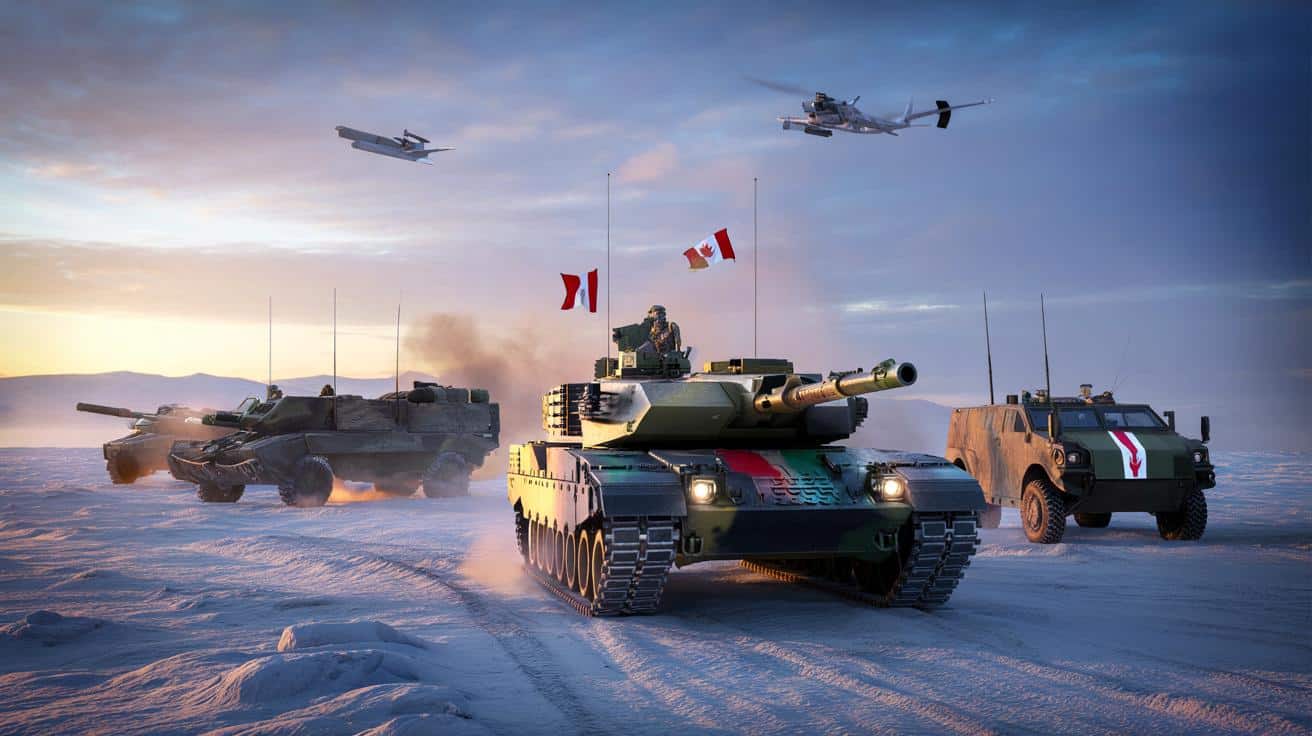
Ottawa has kicked off a radical overhaul of its armoured forces, betting on 250 new combat vehicles and a deep modernisation of its Leopard tanks. The goal is stark: ensure the country can hold ground against any sudden incursion on its territory, including a worst-case scenario involving its own southern neighbour.
Canada’s armoured gamble for an uncertain decade
The plan, already mapped out to 2040, amounts to the biggest land warfare retooling Canada has attempted since the Cold War. It is driven by three converging pressures: military build-ups in the Arctic, sharper competition with Russia and China, and a new layer of unpredictability in US politics.
Canada wants an army able to fight, survive and move in the Arctic while still deterring a surprise land grab anywhere along its borders.
Senior planners no longer see heavy armoured forces as a niche capability used only in overseas coalitions. Instead, tanks and tracked vehicles are being brought back to the centre of national defence, including for home-soil contingencies that used to be brushed off as “unthinkable”.
250 new armoured vehicles to reshape the cavalry
The core of the transformation sits in a major tracked armoured fighting vehicle (AFV) programme scheduled between 2029 and 2031. Canada intends to field around 250 new vehicles to form two so‑called “medium cavalry” battalions, known in planning documents as MEDCAV units.
Unlike the wheeled patrol vehicles that dominated post‑Afghanistan modernisation, these new AFVs are conceived as hard-hitting, tracked platforms built to keep pace with tanks and withstand serious punishment.
The future vehicles are expected to combine high mobility, modular weapons and STANAG 6 protection able to resist 30 mm rounds and nearby blasts.
Canadian officials are weighing several foreign designs, including BAE Systems’ CV90, South Korea’s Redback and Rheinmetall’s Lynx. All three are heavy tracked infantry fighting vehicles that various NATO armies are already evaluating or fielding.
What Ottawa wants from its new AFVs
Rather than buy a single-purpose vehicle, the army is pushing for a flexible platform that can be reconfigured for multiple roles. The same chassis could appear on the battlefield in several guises:
➡️ I replaced my afternoon coffee with this, and my energy levels finally stopped crashing
➡️ This small change in your cooking routine can make meals feel lighter and easier to digest
➡️ Designing Innovation Programs With Dual Impact Outcomes
➡️ Psychologists agree: “Life feels lighter the day you stop measuring your worth by this”
➡️ Building Career Mobility In Technology Through Structured Support
- direct fire versions with 30–50 mm guns or larger automatic cannons
- launch platforms for loitering munitions and “kamikaze” drones
- command and control vehicles with reinforced communications and sensors
- electronic warfare and short-range anti-drone variants
- armoured logistics and casualty evacuation models
This approach mirrors a broader trend inside NATO: fleets built around common hulls, but fitted with plug‑and‑play mission kits. That reduces training and maintenance costs while allowing a rapid shift from peacekeeping to high‑intensity combat scenarios.
Leopard 2 tanks: upgraded now, replaced next
In parallel, Ottawa is launching the Heavy Direct Fire Modernization (HDFM) programme focused on its Leopard 2 main battle tanks. Canada currently operates about 103 Leopards in several sub‑variants, from older A4 models used mainly for training to more modern 2A6M versions.
By 2033, Canada wants every frontline Leopard 2A6M fitted with updated optics, digital electronics and improved fire-control systems.
The plan runs in two phases. First comes a life‑extension effort: better sensors for long‑range targeting, upgraded computers, and integration with modern battlefield networks. That work is meant to keep the tanks credible for another decade.
Then, around 2030, the government intends to start a formal acquisition process for a new generation of main battle tank. For a period stretching toward 2037, ageing Leopards and their successor will operate side by side, giving crews time to transition while avoiding a capability gap.
Key milestones in Canada’s armoured roadmap
| Year | Planned step |
| 2024 | Support contract launched for existing Leopard 2 fleet |
| 2029–2031 | Delivery window for 250 new tracked AFVs |
| 2030 | Start of new main battle tank acquisition process |
| 2033 | Completion of Leopard 2A6M modernisation |
| 2035 | Gradual withdrawal of the remaining Leopard 2s |
| 2037 | New armoured structure declared fully operational |
Arctic front line: where the plan really points
Behind the spreadsheets and acronyms lies a very concrete theatre: the Canadian Arctic. Ice is retreating, new shipping lanes are opening and a region once seen as a frozen buffer is turning into a contested corridor.
Russia has rebuilt bases along its northern coast and stepped up Arctic exercises. China, calling itself a “near‑Arctic state”, has sent research vessels and signalled interest in polar sea routes. The United States, officially an ally, is reinforcing missile defences and long‑range strike assets in the region.
Canadian planners want vehicles that can start in minus 40°C, cross shattered tundra and still keep up with heavy tanks over vast distances.
On paper, Washington and Ottawa remain tightly aligned in NATO and NORAD. Yet Canadian officers involved in future‑war games are instructed to test their defences against a broad range of scenarios, including coercive actions or limited incursions by a technologically superior neighbour.
Wargames where the invader is American
One of the most striking elements of the new posture sits not in hardware, but in the scenarios being quietly studied. Within internal exercises, Canadian staff have run table‑top simulations of a surprise invasion or land grab by US forces.
Such wargames do not signal an expectation of open conflict with Washington. They reflect a pragmatic view: alliances can fray, and domestic turbulence in any country can produce abrupt policy swings. The Trump years, with talk about buying Greenland and revived doubts over defence commitments, left a mark in Ottawa’s threat assessments.
Canada has also floated the idea of sending troops to Greenland for joint drills with Denmark. That move would signal solidarity in the North Atlantic while giving Canadian units practice in terrain similar to their own Arctic flank.
Force 2040: a long-range vision of deterrence
The armoured revamp feeds into a broader concept known as “Force 2040”. It sketches an army with more professional soldiers, better integration between land, air, cyber and space assets, and a focus on rapid deployment in harsh environments.
The ambition is less about building a massive army, and more about fielding a compact force that hits hard and complicates any invasion plan.
That means tanks and AFVs are being treated as part of a layered defence: backed by drones, long‑range fires, and electronic warfare, rather than as lone steel beasts charging across the tundra.
What an invasion scenario could look like
Defence sources and open‑source wargames suggest a hypothetical surprise incursion would likely aim to seize infrastructure quickly: northern airfields, ports, communications hubs and key road junctions.
In such a case, Canada’s new armoured units would be tasked with:
- delaying and disrupting advancing formations at choke points
- protecting mobilisation of reserves and allied reinforcements
- shielding radar sites and long-range missile batteries
- maintaining control of at least one secure logistics corridor
A medium cavalry battalion with modern AFVs could blunt fast-moving mechanised columns, particularly if backed by precision artillery and drones striking supply lines. The aim would not be outright defeat of a stronger invader, but making any assault politically and militarily costly.
Terms and concepts that shape the plan
For non‑specialists, some jargon in Canada’s armoured plans can sound opaque. A few ideas matter more than others:
- STANAG levels: NATO standards that grade how much punishment an armoured vehicle can take from bullets, shells and blasts. Higher levels mean protection against bigger calibres and closer explosions.
- Heavy direct fire: Military shorthand for weapons like tank guns and large cannons that fire straight at targets, as opposed to artillery that arcs shells overhead.
- Medium cavalry: Units lighter than main battle tanks, but tougher and better armed than classic infantry. They scout, screen and strike where the enemy is weakest.
These concepts drive design choices. A vehicle optimised only for peacekeeping patrols in urban areas looks very different from one meant to fight Russian formations in snow or to slow down a surprise thrust over the US‑Canada border.
Risks, costs and what could go wrong
The timeline is tight and budgets are not infinite. Delays in choosing a tank successor or a fighting vehicle platform could lead to gaps where old equipment is worn out and new gear is still on paper. Supply chain problems or political changes in supplier countries might also push up costs.
Another risk is doctrinal. Buying advanced vehicles without updating tactics, training and command structures can leave armies with shiny kit they do not fully exploit. Force 2040 assumes deep changes in how Canadian brigades operate, from more joint exercises in the Arctic to better digital networks linking every vehicle, drone and gun on the battlefield.
If those softer reforms lag behind the hardware, Canada could end up with impressive brochures and underwhelming real‑world impact. If they keep pace, the combined effect of 250 new AFVs, upgraded or replacement tanks and Arctic‑ready doctrine will give any potential adversary reasons to think twice before testing Canada’s northern frontier—even in the most uncomfortable scenario, where that adversary sits just across the 49th parallel.