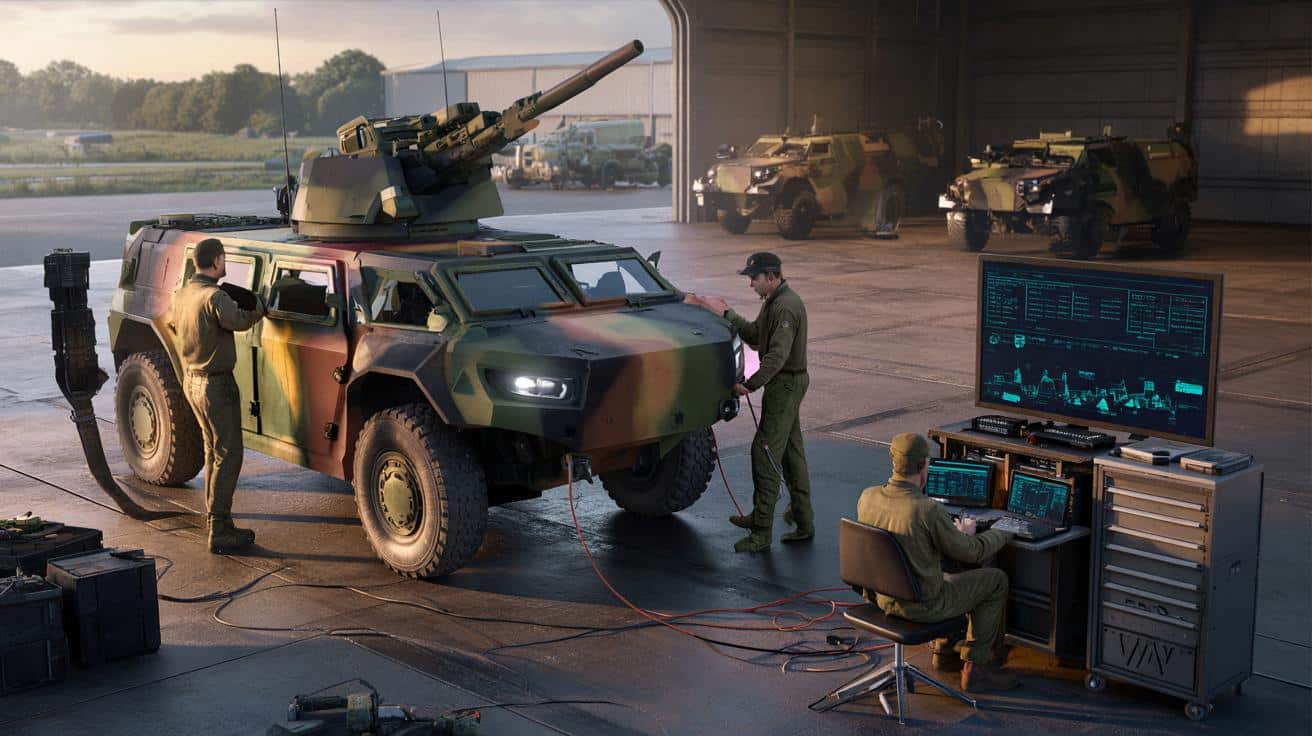
While headlines focus on tanks and missiles, Brussels has quietly approved a project that could matter just as much in a crisis. Instead of buying another high‑profile combat vehicle, Belgium is building an industrial machine designed to keep everything it already owns running, connected and ready to roll for decades.
The quiet revolution behind Belgium’s armoured forces
On 30 January 2026, the Belgian government validated a move that sounds administrative, but cuts straight to combat readiness. Three of the country’s defence heavyweights — John Cockerill Defense, FN Herstal and Thales Belgium — are merging part of their activities into a single joint venture.
The new structure is called Land Systems Logistic Support, or LS². The aim is blunt: fewer vehicles stuck in workshops, more available on the training grounds and in front‑line units.
LS² is designed as a single industrial “spine” for Belgium’s land forces, stretching from heavy armour to software and radios.
Belgian officials and industry executives are betting that the real bottleneck is no longer production, but support. Modern armoured vehicles fail as often on their electronics and data buses as on engines or transmissions. A glitch in an encrypted radio, a blocked cyber update, or a misaligned software patch can sideline a vehicle that is mechanically fine.
Instead of treating each problem separately, LS² will manage the fleet as one integrated system. The logic is to track configurations, anticipate recurring failures, and plan upgrades years in advance, not scramble every time a subsystem goes down.
One backbone, one contact, one chain of support
Traditionally, armed forces juggle a patchwork of contracts. One for the turret, another for the gun, a third for radios, a fourth for software. That mosaic often breeds delays and finger‑pointing. LS² is supposed to end that.
Under the new model, Belgium’s army will deal with a single industrial interlocutor for everything that moves, fires or communicates on land. Platforms, turret systems, onboard weapons, battlefield networks, command‑and‑control software: all come under the same support umbrella.
Instead of repairing “part by part”, LS² treats the whole vehicle as a living ecosystem whose health is managed over 20–30 years.
➡️ Gold bars discovered over a kilometer underground in what experts call a historic find
➡️ Psychology explains why some people always speak very loudly
➡️ The emotional reason some people feel relief after crying
➡️ The subtle difference between mental rest and mental avoidance
➡️ This small change in your cooking routine can make meals feel lighter and easier to digest
This is where the 20–30‑year horizon matters. The joint venture isn’t a quick technical helpdesk. It is a long‑term commitment to hold spare parts, preserve engineering skills and maintain digital know‑how for the entire lifespan of the new Belgian fleet.
Rocourt, Marche, Bourg‑Léopold: bringing the workshop to the unit
Centralisation on paper still needs spanners and laptops on the ground. Belgian planning documents highlight several key sites inside the country — including Rocourt, Marche and Bourg‑Léopold — as hubs for repair and maintenance activity.
The idea is to keep support close to units, not at distant mega‑depots. Each extra day a vehicle sits on blocks is a day of training lost and a gap in NATO commitments. For a small army, those gaps accumulate fast.
Rocourt, already a major maintenance centre, is expected to absorb growing volumes: more interventions, larger spare‑part flows and faster repair cycles. Workshop teams will be asked to cut “mean time to repair” while also feeding data back into LS²’s central system so patterns can be spotted early.
- Faster diagnosis thanks to shared technical data
- Shorter transport times with regional hubs
- Better stock planning using failure trends
- Closer contact between technicians and combat units
Three companies, three domains: how the workload is split
Behind the LS² logo sit three very different skill sets that cover almost the entire life of an armoured vehicle.
John Cockerill Defense: heavy metal and integrated turrets
John Cockerill Defense brings experience in combat vehicle architecture, turrets and heavy weapon integration. Its engineers deal with structural issues, power distribution, recoil forces and the way weapon systems interact with the chassis.
In practice, this means responsibility for keeping the “hard” part of the system reliable over years of use: stabilisation systems, turret drives, interfaces between guns and sensors, and the underlying mechanical backbone.
FN Herstal: weapons that stay safe and reliable under stress
FN Herstal, famous for small arms, will focus on the maintenance and long‑term safety of the weapons that ride on Belgian vehicles. That includes manuals, upgrades, barrel life management and compliance with safety standards.
Its job is not just to repair guns when they break. It is to monitor wear, track modifications over time and guarantee that each weapon, from remote weapon station to coaxial machine gun, behaves predictably after years of intense use.
Thales Belgium: radios, sensors and the fragile digital layer
Thales Belgium holds the keys to the invisible layers that now decide whether a vehicle is truly operational: radios, encrypted links, battle management software, digital sensors and onboard computing.
Modern fleets rise or fall on this layer. If radios fail or software versions clash, the vehicle may move, but it drops out of the network and becomes a liability. LS² treats these digital components as critical as armour plates or engines, with configuration management and software support built into the contract from day one.
The CaMo effect: new French‑built vehicles, new discipline
LS² comes online just as Belgium’s ground forces are transforming under the CaMo programme, the deep partnership with France. Through CaMo, Belgium is buying Griffon multi‑role armoured vehicles for troop transport and fire support, as well as Jaguar reconnaissance and combat vehicles.
Figures circulating in Brussels and Paris suggest close to 500 Griffons over several batches and around 60 Jaguars. The first Belgian‑assembled Griffons were presented in July 2025 in Staden, a milestone that marked the start of a genuinely modern, networked fleet.
These vehicles are less like old‑school armoured trucks and more like rolling data centres. They contain sophisticated sensors, internal networks and complex software stacks. Mechanics use military versions of diagnostic plugs alongside classic tools. Ignore version control and spare‑part compatibility, and units quickly slip into unhealthy habits like cannibalising one vehicle to repair another.
LS² is explicitly designed to prevent a “cannibalisation spiral”, in which fleets shrink as vehicles get stripped to keep a few runners going.
Data as the new fuel for readiness
One of LS²’s most strategic levers is data. The joint venture and the defence ministry will share information on breakdowns, repair times, spare‑part usage and software issues across the fleet.
This mirrors what commercial aviation has done for years: collect huge amounts of data, spot statistical anomalies, and act before faults cascade into failures. On land, that means recognising that a certain batch of sensors is failing earlier than expected, then pre‑positioning replacements before training seasons or major exercises.
It also means scheduling maintenance during planned pauses in activity instead of losing vehicles on the eve of a deployment because a hidden fault chooses the worst possible moment to surface.
Brussels and Brussels: when national plans meet EU regulators
Because LS² pools three dominant domestic suppliers, the deal went under the microscope in Brussels — the EU one. The European Commission cleared the joint venture on 14 January 2026 under its merger rules, using a simplified procedure.
EU officials concluded that the project does not distort competition in the European Economic Area. Translated into policy language, that means the benefits for continuity of supply and military resilience outweighed fears of market closure in this niche segment.
For Belgium, this green light removes legal uncertainty and sends a political message: Brussels is willing to accept tighter national industrial groupings when long‑term defence support and practical sovereignty are at stake.
What Belgium is really buying: availability as a service
Press releases speak about skilled jobs, domestic expertise and better performance of the land forces. Behind those phrases sits a harder reality. Belgium is trying to buy guaranteed availability, not just hardware.
In a crisis, it matters less how many vehicles exist on paper than how many roll out of the gate with all systems working. Hidden erosion — delays in maintenance, poor stock planning, vehicles cannibalised for parts — has undermined many fleets across Europe over the past decade.
By locking in an integrated support model with clear responsibilities, Belgium wants to stabilise its armoured forces over a 20–30‑year period. That long horizon is unusual in a political environment dominated by short budgets and annual reviews.
Key milestones for Belgium’s land support overhaul
| Date / period | Event | Impact on availability |
| 26 Oct 2018 | Initial CaMo launch and orders | Creates a long‑term obligation to sustain Griffon/Jaguar fleets |
| 15 Jul 2025 | First Griffon rolls out in Belgium | Start of modern fleet that needs advanced diagnostics and software support |
| 4 Dec 2025 | New Griffon/Serval order announced | Raises pressure on workshops, spares and planning |
| 14 Jan 2026 | EU Commission approves LS² | Removes regulatory risk, enabling full implementation |
| 30 Jan 2026 | Belgium confirms LS² launch | Switch to a fully integrated support framework |
| Early Feb 2026 | New CEO takes over LS² | Operational set‑up of processes and priorities begins |
Why logistics can decide the next crisis
Recent wars have shown that the side with deeper repair capacity often outlasts the side with more impressive equipment on paper. Artillery wears out. Turrets need recalibration. Electronics misbehave after dust, cold or heat. Without a disciplined support framework, small losses snowball into serious capability gaps.
Belgium’s approach hints at a broader shift in NATO thinking. Rather than chase every new platform, mid‑sized countries are investing in what keeps fleets alive: spare‑part pipelines, local workshops, digital maintenance tools and long‑term contracts that preserve skills.
Some terms and scenarios that bring LS² into focus
Two notions underpin this project and are worth unpacking.
“Predictive maintenance” means using data to repair before a failure occurs. Sensors measure temperature, vibration or error codes. Algorithms flag components that are trending towards failure. Workshops schedule an intervention early, ideally when a unit is rotating out of the field.
“Cannibalisation” describes the practice of stripping parts from one vehicle to repair another. It feels like a quick fix but reduces the total fleet, complicates records and can create safety issues. LS² aims to keep this as a rare last resort by improving stock planning and giving engineers a clearer picture of the entire fleet’s health.
Picture a brigade preparing for a large NATO exercise. Under the old model, commanders might learn days before departure that several vehicles are down for lack of a specific sensor or software key. Under LS², the joint venture’s data systems should highlight those weak spots months earlier, triggering bulk orders and targeted repairs at Rocourt or Bourg‑Léopold well before units load onto trains.
The same logic applies to a sudden crisis on NATO’s eastern flank. Belgium will never field thousands of tanks. Its contribution will be measured in fully equipped, fully functioning units that arrive on time. In that context, the country’s newest “weapon” is not a bigger gun, but an industrial and digital backbone designed to keep steel, silicon and software working together when it matters most.