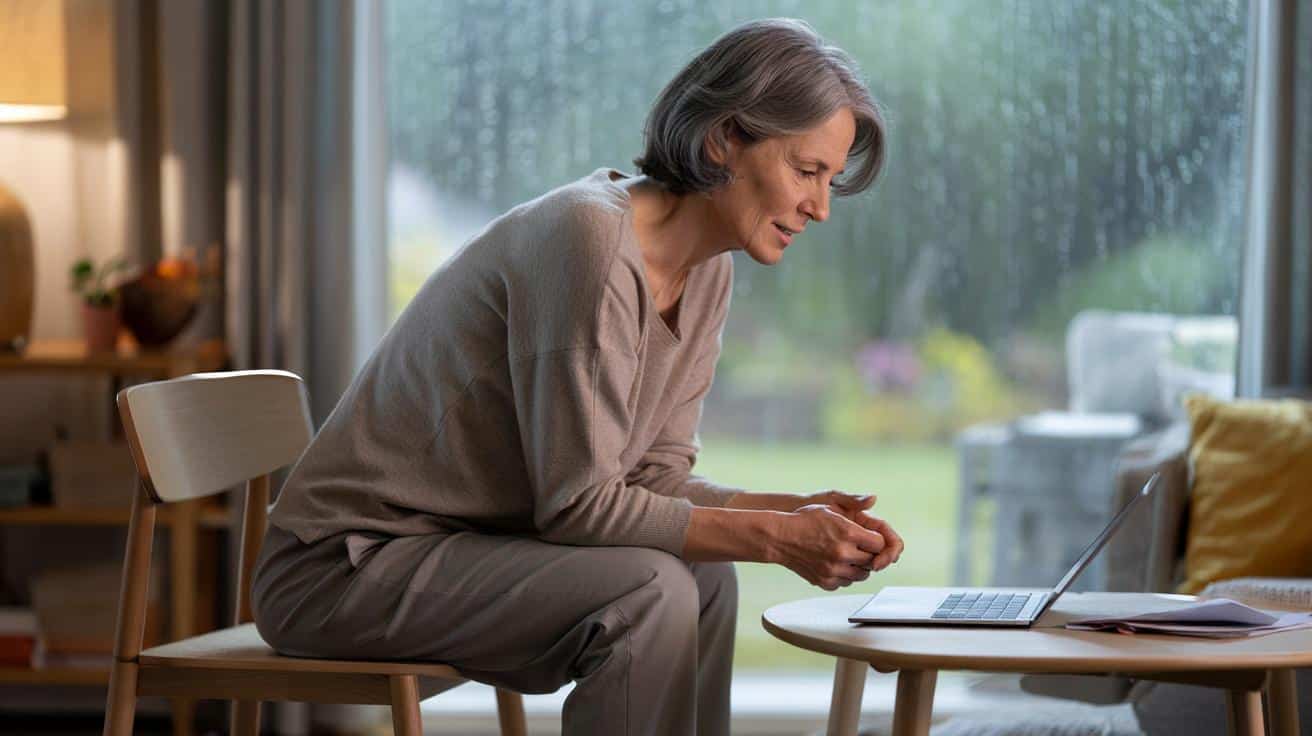
On a rainy Tuesday afternoon, Marianne realized her body had quietly changed the rules. She was 62, sat down to pay a few bills, and by the third email her lower back lit up like someone had slipped a stone under her spine. Standing felt fine. Walking the dog, fine. But sitting? Sitting had become the enemy.
She tried all the classics: extra cushion, no cushion, dining chair, office chair, even the expensive ergonomic throne the salesman swore by. Twenty minutes later, the same dull ache crept back, spreading across her lower back and into one hip. She started to dread simple things: a family lunch, a train ride, a video call.
The turning point came with one tiny posture fix she had never been taught at school, at work, or even in physical therapy.
It had less to do with the chair, and more to do with what she did with her ribs.
“I’m over 60 and sitting hurts my back”: what’s really going on
If you’re over 60 and every chair feels like a trap, you’re not imagining it. The body you sit down with at 62 is not the one you had at 32. Joints are stiffer, muscles are thinner, and the spine has less natural padding. So the old “sit up straight” advice suddenly feels like punishment.
What often happens is a quiet collapse. The pelvis rolls back, the lower back flattens, the shoulders slump, and the head slides forward. You don’t notice it in minute one. By minute fifteen, your back is doing all the work your deep muscles stopped doing years ago.
Pain becomes the only language your body has left to say, “This system isn’t working anymore.”
Think about your last long meal or phone call. You probably started upright, reasonably aligned, maybe even “properly” seated. Ten minutes later, you were leaned on one elbow, or twisted toward the screen, or half-sliding down the chair.
One retired accountant I interviewed, Gérard, 68, described it perfectly: “I sit fine at breakfast. By the time I’ve read the headlines, I look like a question mark.” His doctor told him his scans “weren’t too bad for his age,” yet he could barely finish a TV episode without needing to stand.
Research on aging shows that after 60, we lose muscle and joint mobility faster when we’re inactive. Long sitting sessions are like slow-motion stress tests for a back that’s already negotiating with gravity. The interesting part is where the stress lands: not always where we think.
The usual theory says bad chairs cause bad backs. That’s only half true. The deeper problem is that many of us try to “fix” our posture with brute force. We arch the lower back like a soldier. We pin the shoulders back. We suck in the belly. That posture can look impressive in a mirror, but it’s unsustainable.
What the spine really wants is a shared workload. Pelvis, ribs, and head stacked gently, so no single area is on overtime. As we age, the nervous system becomes less tolerant of extremes: extreme slouching, extreme stiffness, extreme stillness.
The posture fix that helped Marianne most was not sitting taller. It was learning to let her ribs float over her pelvis, so her spine could stop fighting and start balancing.
The small posture fix that changes everything when you sit
Here’s the exact adjustment that changed sitting for many people I’ve spoken with over 60. Sit on a chair with your feet flat. Scoot forward so you’re not leaning on the backrest yet.
First, gently tilt your pelvis forward and back a few times, like a slow rocking chair. Find the point where you feel your weight on your “sit bones” — those bony points under your buttocks — not on your tailbone.
Now, place one hand on your chest, one on your lower ribs. Imagine those ribs are a light balloon resting above your pelvis, not collapsing backward, not pushed forward like a proud pigeon. Let your ribs float over your sit bones. The back muscles should feel less clenched, the belly less sucked-in.
That’s the new “neutral” you’re aiming for, not the military version of sitting straight.
Many older adults try to correct years of slouching in a single day. They sit bolt upright, muscles shaking, then collapse into an even deeper slump. It feels like there are only two options: pain from effort or pain from sagging.
The trick with this rib-over-pelvis posture is micro-adjustments, not heroic efforts. Try it for two or three minutes while reading. Then relax. Then come back to it. Let it be a position you visit often, not a prison you get locked into.
Let’s be honest: nobody really does this every single day from morning to night. The wins come from frequency, not perfection. A few seconds of awareness, many times a day, slowly rewires how your body chooses to sit.
*“The day I stopped forcing my shoulders back and started feeling where my ribs sat, my back finally stopped yelling at me,”* Marianne told me. “It wasn’t magic. It was like I’d been trying to carry a bookshelf alone, and suddenly the rest of my body picked up the other side.”
She keeps a simple mental checklist next to her computer, scribbled on a sticky note:
- Feet flat, not tucked under
- Weight on sit bones, not on tailbone
- Ribs floating over pelvis, not slumped behind it
- Head gently stacked, eyes level (not chin up)
- Stand up at least once every 20–30 minutes
Those five lines did more for her than the fancy lumbar cushion. **The plain truth is, your posture fix lives in your body, not in the accessories aisle.** When your ribs and pelvis learn to share the load, every chair in your house becomes less of a threat.
Living with a back that doesn’t love chairs anymore
Once you start noticing this rib-over-pelvis alignment, it pops up everywhere. In the car. On the sofa. At the dentist. You might catch yourself halfway through a TV show, ribs collapsed, tailbone tucked, back quietly complaining. Gently restack, feel your sit bones again, and give your spine a second chance.
It’s not about policing yourself. It’s about forming a new small habit, the way you once learned to look both ways before crossing the street. At first, you’ll remember late. Over time, your body starts reminding you earlier. The ache becomes a whisper, not a shout.
➡️ I made this cozy bowl-style dinner and it felt incredibly satisfying
➡️ Psychology explains why emotional states can shift without obvious reasons
➡️ According to psychology, why you feel exhausted even when you’re doing nothing
➡️ Ways to organize your closet so that getting dressed in the morning feels effortless and saves time
➡️ The United States Wants To Use A Supersonic Jet Turbine To Power Its Data Centres
➡️ You don’t realise it, but these 5 habits secretly make you seem unlikeable
This tiny posture fix doesn’t erase arthritis or undo decades of sitting at a desk. It won’t replace a doctor, a physio, or a good walk in the fresh air. What it does is change the daily background noise of your life. Pain that once felt like an inevitable tax on aging becomes something you can negotiate with.
Some readers will tweak the method to suit their stiff hips or replaced knees. Others will add a short stretching routine, or swap one long TV block for two shorter ones. **The posture is the base, the rest is personal customization.**
The most surprising part is not that it works. It’s that nobody taught us this when we first learned how to sit in a classroom.
| Key point | Detail | Value for the reader |
|---|---|---|
| Find your sit bones | Rock the pelvis until weight rests on the bony points under the buttocks | Reduces strain on the tailbone and lower back |
| Float ribs over pelvis | Lightly stack the ribcage above the pelvis without arching or slumping | Shares the load across the spine, easing chronic sitting pain |
| Use short, frequent resets | Return to this posture for a few minutes, many times a day | Makes the habit realistic and sustainable for people over 60 |
FAQ:
- Question 1Does this posture fix work if I already have arthritis in my spine?
- Question 2How long should I be able to sit like this without pain?
- Question 3Can I use a cushion or lumbar roll with this method?
- Question 4What if my hips are too stiff to sit on the edge of the chair?
- Question 5Is it still worth trying this if my doctor says my back is “just worn out with age”?