You walk through the door already late, keys still in your hand, the sky outside not quite dark yet and somehow the day feels unfinished. The grocery bags you meant to buy are still in your imagination, not on your counter. The fridge light hits you with that familiar glow of half-ideas: a sad carrot, a leftover piece of chicken, some wilting herbs you’d sworn to use. Your brain starts doing that anxious inventory, as if dinner is an exam you forgot to study for.
Then, something strange happens.
Your hands reach for a pan, not a recipe. You slice, toss, taste. The room fills with the smell of garlic, the sound of oil meeting vegetables, the soft clink of plates. For once, you don’t overthink it.
Dinner almost makes itself.
And suddenly, you feel a little more like someone who has their life together.
Almost.
This is the dinner your real life actually allows
There’s the fantasy dinner, and then there’s the 7:42 p.m. dinner that actually hits the table. The fantasy one has fresh flowers, perfect timing, and a playlist someone thought about earlier. The real one often happens while one person answers an email, another empties a backpack, and someone else is asking where the clean forks went.
The thing is, the real dinner can be better.
When you stop aiming for a “proper meal” and start aiming for “edible, warm, and shared,” something relaxes inside the room. You stop being the unpaid restaurant and become the person who throws together food that fits the day that really happened.
Picture this.
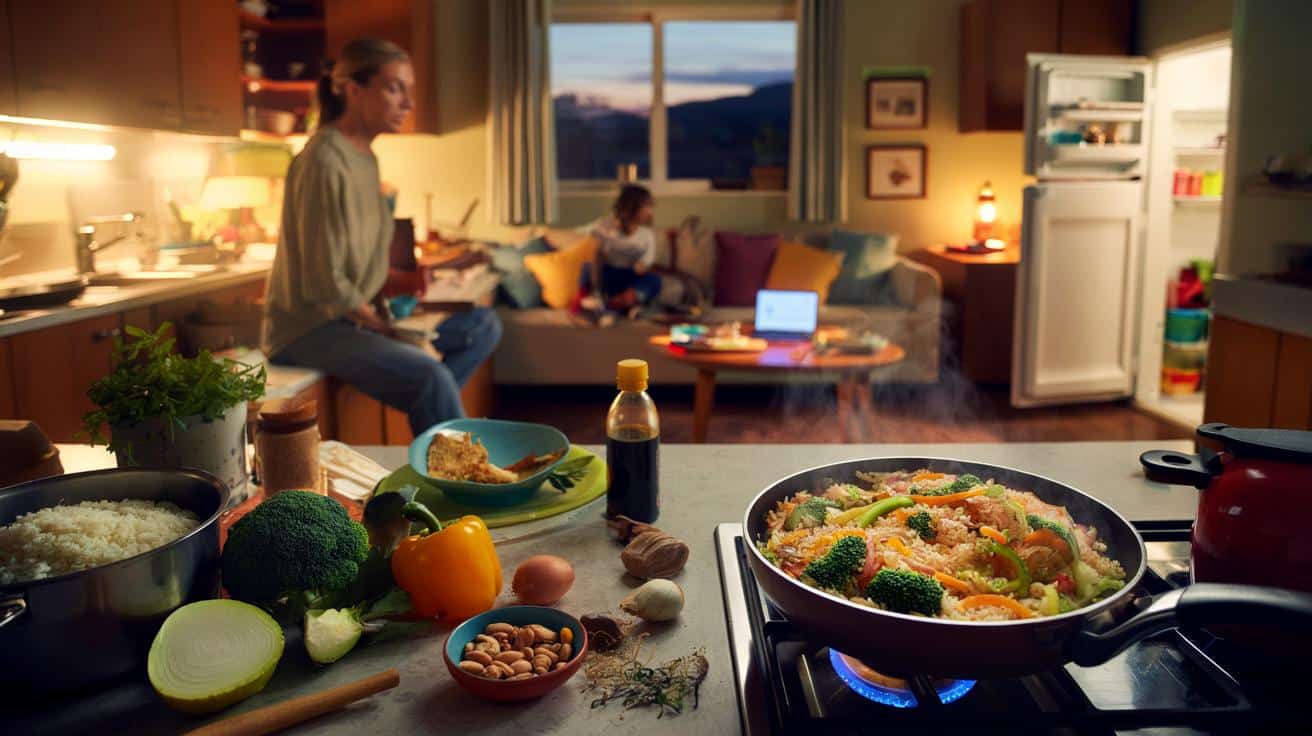
There’s a pot of rice from last night, cold but perfectly fine. Half a head of broccoli, a lonely bell pepper, an onion rolling dangerously close to the edge of the counter. You heat a pan, splash in some oil, add chopped onion and garlic. The vegetables follow. Soy sauce, maybe a squeeze of lime, that random handful of peanuts from the back of the cupboard.
Ten minutes later you have a big pan of smoky fried rice.
No printed recipe, no exact measurements, just instinct and what you had. You eat it from bowls on the couch, someone balances their bowl on a stack of magazines, and everyone takes seconds.
That’s dinner. No one even mentions the word “recipe.”
What happens here isn’t laziness. It’s fluency.
Once you know a few basic combinations—heat, something starchy, something fresh, something salty—dinner stops being a puzzle and starts being a pattern. Your brain recognises the shapes: pasta plus vegetables plus cheese; grains plus roasted things plus a punchy dressing; eggs plus anything.
You’re not following strict rules, you’re riffing on a theme.
*This is where cooking shifts from performance to conversation.* And conversations don’t need scripts. They just need a place to start and a reason to keep going.
How to let dinner “make itself” without losing your mind
Start with one fixed piece of the puzzle.
Not the whole dish, just an anchor. It might be a tray of roasted vegetables you toss in the oven whenever you’re home for an hour. It might be a pot of grains—rice, quinoa, couscous—cooked on autopilot while you answer messages. Or a pack of frozen dumplings that live in the freezer like your personal emergency contact.
Once you have that anchor, everything else is lighter.
Your job becomes adding contrast: something crunchy, something creamy, something bright. Yogurt with roasted vegetables. A fried egg on top of leftover rice. A handful of salad leaves over last night’s chicken. Suddenly it looks intentional.
The biggest trap is thinking dinner has to justify itself. As if every plate needs a protein sermon, three sides, and a theme. That’s the kind of thinking that leaves you scrolling recipes at 8 p.m. and still not eating.
Let’s be honest: nobody really does this every single day.
Most people rotate between four or five basic moves and dress them up differently. Scrambled eggs become a “bowl” with rice and greens. Tortillas turn leftovers into tacos. Toast plus whatever’s in the fridge magically ranks as a “smörgåsbord.”
You’re not cheating when you simplify. You’re just admitting you live in a world where days go fast and hunger doesn’t wait for you to find your measuring spoons.
Sometimes the most generous dinner is the one you can actually pull off, with the energy you really have, on the day you actually lived.
- Keep three “lifeline” ingredients at home: eggs, some kind of noodle or grain, and something salty or punchy (cheese, soy sauce, olives, pesto).
- Think in formulas, not recipes: “Base + Veg + Protein + Sauce + Crunch” works for bowls, salads, sandwiches, and pastas.
- Say yes to shortcuts: pre-cut veggies, frozen peas, rotisserie chicken, jarred sauces. **These are tools, not failures.**
- Plate like you care, even if it’s simple: a squeeze of lemon, a drizzle of oil, a twist of pepper. Tiny effort, huge optics.
- Set one tiny ritual: a candle, a shared salad bowl, phones off for ten minutes. **The ritual makes it feel like dinner, not refuelling.**
When you stop overthinking, dinner becomes a place, not a performance
There’s a quiet relief in realising dinner doesn’t need your perfection, only your presence. That bowl of pasta eaten straight from the pot at the counter can hold as much comfort as a carefully planned roast, if your brain isn’t busy grading itself.
We’ve all been there, that moment when the day feels frayed and you still have to feed everyone, including yourself. That’s exactly where this “natural” dinner slips in. The one that borrows from yesterday, steals from the pantry, and arrives a little uneven but fully sincere.
You might start to notice that the conversations are warmer when the cook is less stressed. That people linger longer over a simple stew than a show-off main course. That kids eat more when they helped crack the eggs or shake the salad dressing in a jar.
This kind of dinner doesn’t pretend life is tidy. It just says: today was a lot, let’s eat anyway.
| Key point | Detail | Value for the reader |
|---|---|---|
| Start from an anchor | Use one base element (grains, roasted veg, eggs, frozen staples) and build around it | Reduces decision fatigue and speeds up dinner on busy nights |
| Think in formulas | Apply simple patterns like “Base + Veg + Protein + Sauce + Crunch” instead of strict recipes | Makes it easy to improvise with what you already have |
| Lower the bar, raise the ritual | Keep the food simple, but add a small shared ritual or finishing touch | Turns even modest meals into moments that feel like real dinners |
FAQ:
- Question 1What if my fridge really is almost empty?
- Answer 1Lean on true pantry meals: pasta with garlic and oil, scrambled eggs on toast, rice with frozen vegetables and soy sauce. **A couple of shelf-stable staples quietly rescue more dinners than you’d think.**
- Question 2I’m bad at “improvising” in the kitchen. Where do I start?
- Answer 2Pick one formula—like “roasted veg + grain + topping + sauce”—and repeat it every week with tiny variations. Over time, your hands learn the moves before your brain starts panicking.
- Question 3How do I stop feeling guilty about not cooking “proper” meals?
- Answer 3Define “proper” as “food that feeds the people here today.” That might be soup from a carton plus a grilled cheese. Your worth is not hiding in a homemade stockpot.
- Question 4What can I prep ahead without spending a whole Sunday cooking?
- Answer 4Choose just one or two things: a tray of roasted vegetables, a pot of grains, or a vinaigrette in a jar. Those small building blocks quietly transform random leftovers into something that feels intentional.
- Question 5How do I bring this approach into hosting friends?
- Answer 5Serve one big, generous thing—like a pot of chili, a build-your-own taco spread, or a giant salad with good bread. Tell people it’s casual. They’ll relax, and so will you.