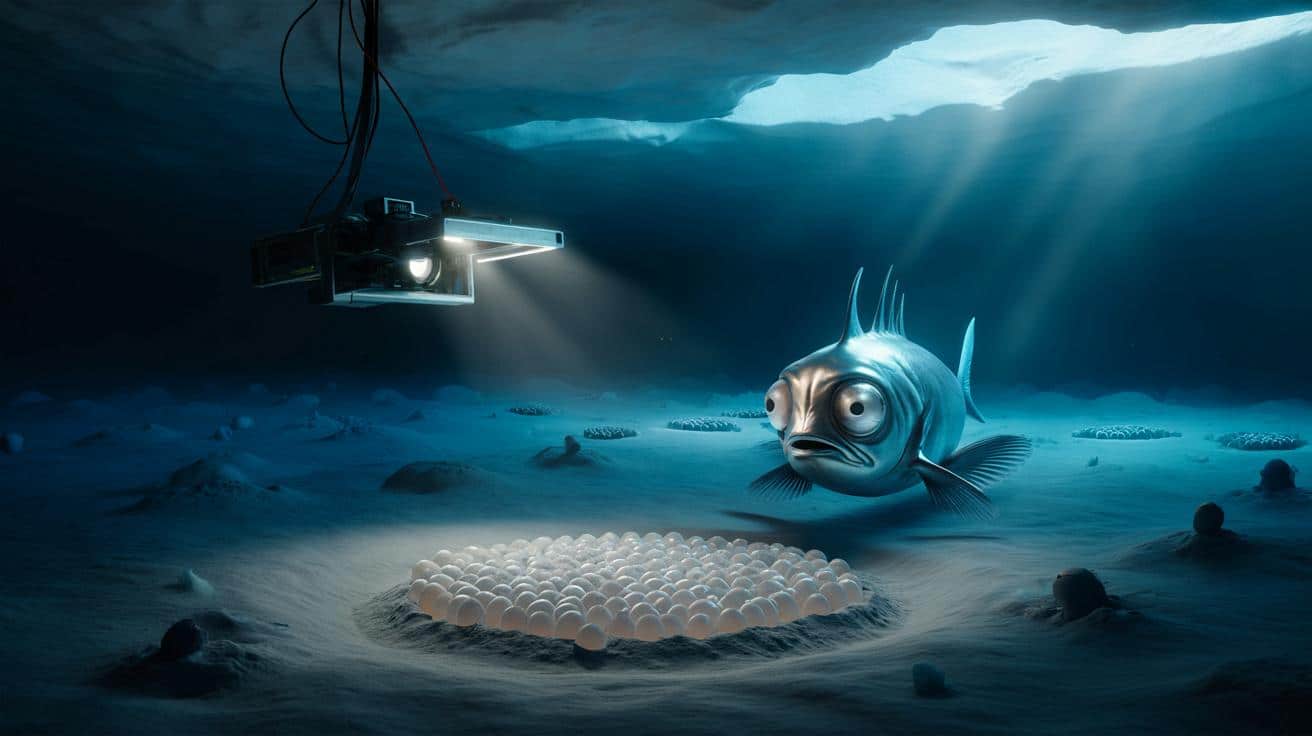
The camera hangs in the dark water like a curious eye, drifting under a lid of Antarctic ice that never melts. Its light cuts through the gloom, sweeping over a seafloor that should be empty. Instead, the screen suddenly fills with perfect circles, one after another, stretching out of frame. Each circle is a fish nest, guarded by a pale icefish with big, startled eyes, like a parent caught awake at 3 a.m. in a neon-lit kitchen.
On the research ship above, scientists cheer. They’ve stumbled on the largest known breeding colony of fish on Earth: an estimated 60 million nests, all pulsing quietly beneath the ice. The mood is electric, the kind of high you only get once or twice in a career.
A few weeks later, that same discovery is at the center of a storm. And the question hanging over the frozen sea is suddenly much darker.
Under the ice, a nursery the size of a country
Imagine flying a drone over a city at night and realizing every light you see is a cradle. That’s roughly what the German research team from the RV Polarstern felt when they started mapping the icefish colony in the Weddell Sea. What first looked like a handful of nests turned into a vast grid, stretching for hundreds of square kilometers beneath the ice shelf.
Each nest is a shallow bowl in the seafloor, filled with thousands of translucent eggs. A single fish hovers above, fanning them gently with its fins to keep them oxygenated. Multiply that by tens of millions. You start to understand why seasoned polar scientists fell silent watching the sonar feed. They weren’t just seeing fish. They were seeing a planetary-scale nursery that nobody knew existed a year ago.
The numbers came later, once the data was crunched. Roughly 240 square kilometers of nests. Up to 16,000 nests per square kilometer in some hot spots. Together, those parents and eggs may represent the beating heart of the Antarctic toothfish food web, feeding seals, penguins, whales. A hidden engine of life, buried under ice that most of us will never see with our own eyes.
Glory, grants and a fragile frontier
The moment the discovery hit headlines, the tone shifted. Marine biologists applauded. Conservation groups rushed in, urging rapid protection. And then the critics arrived, asking an uncomfortable question: are scientists so eager to find the next big thing that they’re willing to poke at one of the last untouched ecosystems on Earth?
It’s not a random fear. Antarctica is the kind of place where one bad move echoes for years. Heavy research equipment can scar the seafloor. Noise can disturb sensitive species. A submersible that malfunctions can leak contaminants into waters that have been chemically stable for centuries. Even just returning, year after year, to the same breeding ground to “study” it can slowly change behavior.
The accusation from some environmental voices is raw: that research ships are turning the Southern Ocean into a stage set, where the audience is the global media and every new discovery needs to trend. That the race for spectacular data and publications risks pushing fragile species closer to the edge. And that under the polite language of “advancing knowledge”, there’s an unspoken competition for prestige, grants, and career-making headlines.
How close is too close to a nest of 60 million?
On board the Polarstern, the story looks different. Cameras were lowered from holes in the sea ice, not from trawlers ripping nets along the bottom. The team used a towed camera system, OFOBS, that glided a few meters above the seabed, trying not to touch anything. They logged coordinates, temperatures, currents. They watched, then moved on.
➡️ Some people talk incredibly loudly: What that reveals about their character
➡️ I realized my home needed fewer rules, not more cleaning
➡️ Most people overlook this moment that shapes the rest of the day
➡️ What are the health benefits of cucumber?
The lead scientists stress that they followed strict Antarctic Treaty rules, which are some of the toughest environmental standards on the planet. No collecting adult fish from the colony itself. No dredging. Limited lighting. Short passes. Just enough presence to map and document. From their point of view, walking away without a full understanding of the colony would have been the irresponsible choice.
Still, the question lingers: when does “minimal disturbance” quietly slide into intrusion? Let’s be honest: nobody really does this every single day at that scale without learning to tune out the small compromises. One extra pass with the camera. One more sample “for safety”. One more season returning to the same nesting ground. Each step seems tiny. The sum of them can rewrite an ecosystem.
Between alarm and trust: what critics get right
If you spend time with people who fight for the Antarctic, a pattern appears. They’re not angry at science. They’re scared of a slippery slope. Today, it’s cameras and sensors. Tomorrow, it could be commercial fishing fleets arguing that if scientists can work in these waters, so can they. Once a place is on the map, it’s rarely forgotten again.
One veteran campaigner told me that every new research hotspot becomes a political hotspot a few years later. Countries use scientific presence to back territorial claims. Industry uses “data gaps” to justify exploratory activity. A giant fish nursery is a dream come true for ecologists. It’s also a neon sign flashing “resource” in the language of geopolitics.
*We’ve all been there, that moment when something beautiful we share suddenly feels exposed to the wrong kind of attention.* That’s what many critics mean when they warn that scientists might be putting fragile life at risk “for glory”. Not that all researchers are careless. But that some seem naïve about how quickly a pure discovery can be weaponized once it enters public and diplomatic arenas.
Precaution isn’t passive: what responsible research looks like
The hardest thing to accept is that protecting a place like the Weddell Sea often means doing more, not less. **Responsible Antarctic science is almost obsessively planned**. Before a ship even leaves port, projects go through environmental assessments. Routes are negotiated. Gear is tested so it won’t gouge the seafloor or leak oil in sub-zero water.
On the ground, or rather on the ice, good teams work like cautious guests in someone else’s house. They map a corridor, collect what they need, then pull back. They share data so other groups don’t duplicate disturbing the same colony. They train students not just to handle equipment, but to notice when “just one more” measurement crosses a line.
The strongest moves often happen after the cameras are turned off. The icefish discovery helped fuel a push for a large Marine Protected Area in the Weddell Sea, with strict limits on fishing and industrial activity. That kind of protection only exists because **someone went there, saw what was hidden, and brought proof home**.
“Science in Antarctica is not neutral,” one polar policy expert told me. “Every expedition is either opening the door to exploitation or closing it a little tighter behind solid evidence.”
- Early mapping of sensitive sites can become legal arguments for future bans on drilling or fishing.
- Transparent methods build public trust and make it harder for industry to twist data.
- Fast communication of threats lets conservation catch up before damage is baked in.
- Shared global databases reduce repeat disturbance of the same fragile spots.
Living with the discomfort of discovery
There’s no tidy answer to the storm swirling over those 60 million Antarctic fish nests. Without the scientists, we’d still be blind to one of Earth’s biggest nurseries. With them, the colony steps onto the human stage, with all the risk and noise that brings. Some people will only see hubris in lowering cameras into such a place. Others will only see a duty to witness what’s there before it changes forever.
Maybe the most honest position sits uncomfortably in the middle. Accepting that curiosity and care can clash in the same expedition. Admitting that even well-intentioned research leaves footprints on a seafloor that never asked for our presence. But also recognizing that silence is not a shield in a warming world where ice melts whether we watch it or not.
The plain truth? The moment those nests appeared on a scientist’s screen, we became part of their story. The real test now is what we do with that knowledge, and whether we let wonder push us toward protection, or toward one more excuse to take.
| Key point | Detail | Value for the reader |
|---|---|---|
| Hidden mega-colony | Discovery of ~60 million icefish nests across 240 km² under Antarctic ice | Grasp the sheer scale and fragility of this little-known ecosystem |
| Ethical tension | Debate over whether research ships disturb a pristine nursery “for glory” | Understand why even good science can spark real environmental concern |
| Protection pathways | Data from the colony feeds arguments for new Antarctic Marine Protected Areas | See how discovery can become a tool to defend, not just expose, wild places |
FAQ:
- Question 1Are scientists physically damaging the fish nests when they study them?Most teams use non-contact camera systems that hover above the seafloor, so they’re not touching the nests directly. The concern is less about broken eggs and more about repeated disturbance, noise, light, and the long-term impact of regular human presence in such a concentrated nursery.
- Question 2Why can’t we just ban all research in sensitive Antarctic areas?A total ban would leave huge blind spots. Without data, it’s far harder to argue for legal protection, track climate impacts, or stop industrial expansion. The current approach tries to limit and tightly regulate research rather than shutting it down entirely.
- Question 3Are commercial fishing fleets already targeting this icefish colony?Not directly, based on current public information. The area is remote, hard to access, and under strict Antarctic regulations. That said, critics worry that mapping such colonies could tempt future fishing interests if protections aren’t locked in quickly.
- Question 4Who decides what kind of research is allowed in the Weddell Sea?Activities are governed by the Antarctic Treaty System and bodies like CCAMLR (Commission for the Conservation of Antarctic Marine Living Resources). Countries propose projects, and these are evaluated under environmental and scientific guidelines before going ahead.
- Question 5As a non-scientist, does this really affect my life?Yes, though it feels far away. Antarctic ecosystems help regulate global oceans and climate. The way we treat places like this—what we disturb, what we protect—shapes biodiversity, weather patterns, and even future food security. The story under the ice is tied, quietly, to the world above it.