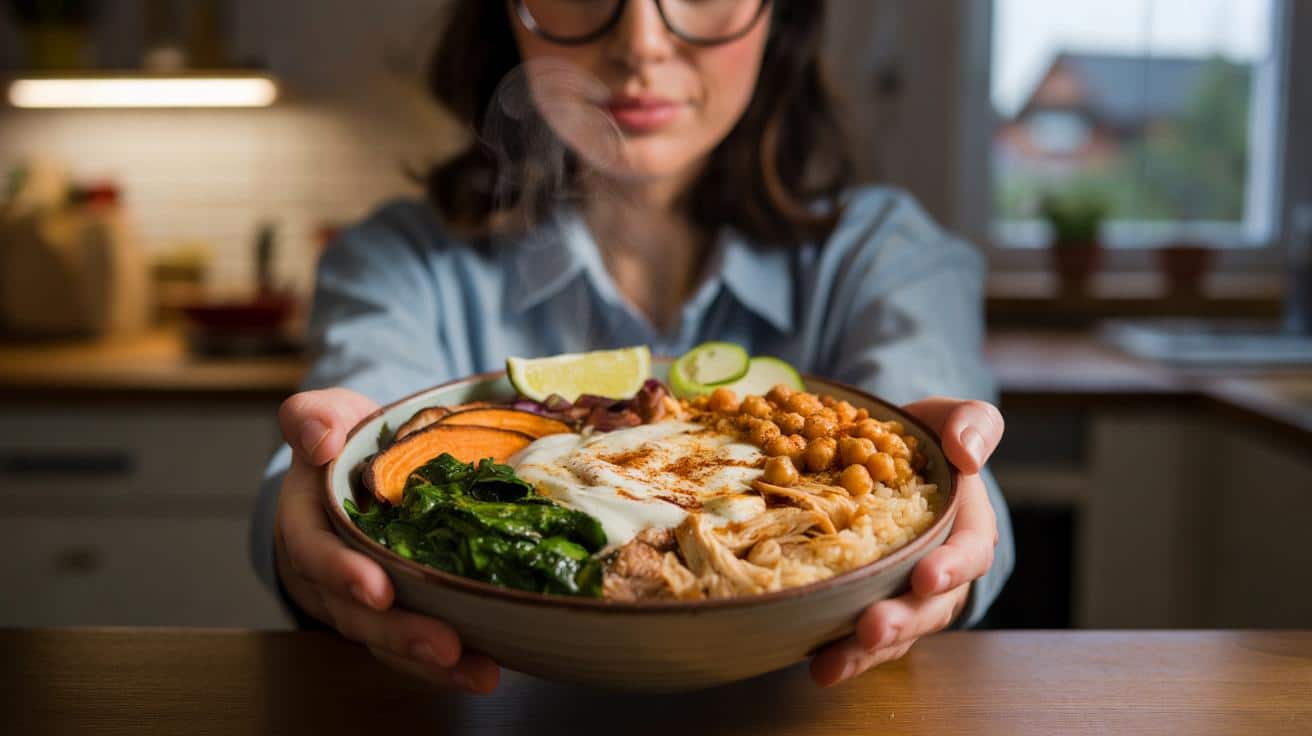
By the time I closed my laptop, the sky outside the kitchen window was already that deep, tired blue that means you’re eating late again. My brain wanted a giant pizza. My body wanted… not to hate me tomorrow. I opened the fridge and just stared at the chaos: half a roasted sweet potato, some sad greens, a forgotten jar of tahini, leftover chicken, a wedge of lime. Nothing looked like dinner, but together they suddenly made sense in my head.
Twenty minutes later, I was at the table with a big warm bowl between my hands, steam fogging my glasses. I took the first bite and felt my shoulders actually drop. Quiet, grounding, like someone had turned down the volume on the whole day.
It was just a bowl. But it hit different.
The strange comfort of eating from a bowl
There’s something oddly reassuring about a bowl-style dinner. Plate meals feel formal, gently asking you to sit up straight and use your knife properly. A bowl invites you to curl up on the couch, tuck your feet under you, and eat with one hand while scrolling with the other. The food piles up instead of spreading out, which somehow makes everything feel more abundant, even when you didn’t cook much.
That night, my bowl was simple: warm rice, crispy chickpeas, roasted sweet potato, a few slices of leftover chicken, and an embarrassing amount of garlicky yogurt sauce. I mixed a bite absentmindedly and, suddenly, my day didn’t feel so heavy. It felt… held.
Food psychologists talk about how we eat with our eyes first, but I’m convinced we eat with our hands too. Not literally, but in the way a bowl sits in your palms, almost like a hot-water bottle you can eat. The edges keep everything close together, so every forkful can pick up a bit of this, a bit of that. Little flavor collisions that keep surprising you.
We’ve all been there, that moment when you’re too tired to cook and too hungry to skip it. A bowl dinner squeezes itself right into that gap. It doesn’t ask for perfect timing on three pans at once or restaurant-level presentation. It just says: throw things together, warm them up, and eat them in one place. Comfort, no questions asked.
There’s a quiet logic behind why this feels so satisfying. You get layers: a base that fills you up, colorful vegetables that trick your brain into feeling virtuous, protein that steadies your energy, a sauce that ties the whole story together. It’s like building a mood, ingredient by ingredient.
On a plate, it might look disjointed or “leftovers-y”. In a bowl, it reads as intentional. Your mind translates “pile of stuff” into “cozy, composed meal” and signals that you’re eating something whole, not just grazing. *That tiny shift is often enough to make dinner feel like you actually took care of yourself, not just silenced your hunger.*
How I built the bowl that finally hit the spot
The magic started with the base. I grabbed a cup of cooked brown rice from the fridge, splash of water, quick reheat in a pan until it went from sad and stiff to warm and fluffy again. You could use quinoa, couscous, lentils, noodles, even leftover roasted potatoes. The key is: something warm, soft, and comforting underneath.
➡️ How to permanently block cold calls on your Android phone
➡️ February feeders place this cheap treat to ensure birds return every morning
➡️ One sock is all you need: the grandma hack to clean blinds back to new with zero effort
➡️ Goodbye hair dye for grey hair, this simple conditioner add-in restores natural colour
➡️ Do You Always Wake Up Between 2 And 4 A.m.? This Hormone Might Be To Blame
➡️ Psychology explains why some people always speak very loudly
Then I added texture. I drained a can of chickpeas, tossed them with olive oil, salt, smoked paprika, and slid them into the oven for 10 minutes. Nothing fancy, just enough time for them to go golden and a bit crunchy at the edges. That contrast between soft base and crispy bites is a quiet thrill in every spoonful.
From there, it turned into a small fridge rescue mission. Half a roasted sweet potato from two days ago? Sliced and warmed in the pan next to the rice. A handful of spinach that looked a little tired? It wilted beautifully in the same pan, suddenly glossy and bright. Leftover chicken breast? Shredded and reheated gently, so it stayed tender.
This is the secret of bowl dinners: you don’t need matching ingredients, only ingredients that taste good side by side. That lonely cucumber at the back of the drawer, the last spoonful of hummus, a soft avocado, even a few pickles: they all have a place. The bowl format forgives everything and somehow turns “random odds and ends” into a meal that feels almost curated.
To tie it together, I mixed a quick sauce straight in a mug: a generous spoonful of Greek yogurt, a drizzle of tahini, squeeze of lemon, pinch of salt, minced garlic. I thinned it with a little water until it could pour. That sauce was the deal-maker. It soaked into the rice, clung to the chickpeas, and wrapped the chicken and sweet potato in this nutty, tangy richness.
Let’s be honest: nobody really does this every single day. Some nights it’s cereal, some nights it’s toast over the sink. This bowl wasn’t about perfection. It was about giving that specific Tuesday night just enough love so it didn’t blur into all the others. That’s what made it feel deeply, almost unexpectedly, satisfying.
Turning “whatever’s in the fridge” into a ritual
If you want to recreate that feeling, start with a simple method: think in four layers. Base, plants, protein, sauce. That’s it. Ask yourself, “What do I have for each line?” instead of “What recipe am I following?” Suddenly, your random leftovers start categorizing themselves into a real meal.
Maybe your base is leftover pasta. Your plants are cherry tomatoes and frozen peas. Your protein is canned tuna. Your sauce is olive oil, lemon, and a bit of grated cheese. Tossed into a bowl, it stops being “fridge roulette” and becomes a cozy pasta bowl that tastes like you had a plan all along.
A common trap is thinking the bowl has to look Instagram-perfect or packed with superfoods. That pressure kills the quiet pleasure of it. Your bowl doesn’t need seven toppings and three seeds to count. It can be rice, frozen vegetables, a fried egg, and soy sauce. It can be instant noodles with sliced carrots and a spoon of peanut butter turned into a quick satay-ish situation.
Another mistake is going all one-note: all soft, all salty, or all beige. If you feel bored halfway through eating, you’ll walk away unsatisfied. Aim for one crunchy thing, one fresh thing, one creamy thing. Even a handful of nuts, a squeeze of lime, or a spoonful of salsa can change the whole mood of the bowl with almost no effort.
Sometimes, while stirring everything together, I catch myself thinking: this isn’t just dinner, it’s a small act of self-respect. Not impressive to anyone else. Deeply nourishing to me.
- Play with temperature – Warm base, room-temp toppings, cold sauce. That contrast gives the bowl a “restaurant” feel with zero extra work.
- Add one bright note – A squeeze of citrus, chopped herbs, pickled onions, or a drizzle of hot sauce wakes up even the laziest combination.
- Keep a “bowl box” in the pantry – Canned beans, grains, jarred pesto or tahini, nuts and seeds. These shelf-stable basics quietly guarantee you a decent bowl on any chaotic night.
- Respect the vessel – A wide, deep bowl helps you layer and mix easily. It’s a tiny detail that makes the whole thing feel more intentional.
- Repeat your favorites – When a combo hits, write it down in your notes app. Future-you, standing in front of an open fridge at 9 p.m., will be grateful.
Why this kind of dinner stays with you
That bowl-style dinner didn’t feel memorable because it was gourmet. I’m not about to pitch it to a food magazine. It stayed with me because it took a day that could have ended in mindless snacking and gave it a softer landing. There was heat, color, weight in my hands, a sense of “I made this for myself” that doesn’t come from tapping a delivery app.
When you build a bowl, you’re not just feeding hunger. You’re quietly answering a few deeper questions: Did I take a second to notice what I need tonight? Do I want comfort, freshness, a little spice, something grounding? That tiny pause, that bit of choosing, turns dinner into a small check-in instead of a background task.
You don’t have to get it right every evening. Some nights will still be crackers and cheese. Yet every time you stand in front of your fridge and think “bowl”, you give yourself another chance to turn random ingredients into a moment that feels whole. And that feeling – sitting with a warm bowl, exhaling for the first time all day – is the kind of quiet satisfaction that’s hard to forget, and strangely contagious. It might even be the nudge someone else needs when they see your not-quite-perfect, very real bowl shared on their screen.
| Key point | Detail | Value for the reader |
|---|---|---|
| Four-layer method | Think in base, plants, protein, sauce instead of strict recipes | Quickly turns random leftovers into a balanced, satisfying bowl |
| Texture and contrast | Mix soft, crunchy, fresh, and creamy elements | Prevents “boring halfway through” meals and boosts enjoyment |
| Emotional payoff | Bowl dinners feel cozy, intentional, and grounding | Transforms rushed evenings into small self-care rituals without extra effort |
FAQ:
- Question 1What can I use as a base if I don’t want rice or pasta?
- Question 2How do I keep my bowl dinners from feeling too heavy?
- Question 3Is it okay to use mostly frozen and canned ingredients?
- Question 4What’s a quick sauce I can throw together when I’m exhausted?
- Question 5How do I turn this into a habit without getting bored of the same bowl?