The bright velvet patches may seem charming at first, until you realise the grass underneath is thinning and the mower is clogging with slime. Across the UK and US, more home gardeners are turning away from harsh chemicals and asking a simple question: can you control moss while still caring for the planet?
Why moss takes over your lawn
Moss is not a weed in the traditional sense. It’s a bryophyte, a primitive plant without true roots, flowers or seeds. That gives it a big advantage in difficult conditions.
It thrives in damp, compacted and shaded areas where grass struggles. Under trees, along fences, at the foot of slopes where water collects – that’s moss territory. Once conditions suit it, it spreads in a dense carpet and crowds weak grass out.
Moss is less a cause of lawn problems than a symptom that your grass is under stress.
Several factors tend to favour moss over grass:
- Acidic soil (low pH) that discourages many lawn grasses
- Poor drainage, with water lingering after rain
- Heavy shade from trees, hedges or walls
- Scalped mowing that cuts grass too short and weakens it
- Nutrient-poor soil with little organic matter
- Compacted ground that blocks air and root growth
So while it’s tempting to focus on scraping or spraying away the moss, the real battle happens deeper: in the soil and the way the lawn is managed.
Four natural tactics for a tougher, moss-resistant lawn
1. Rethink how you mow
Mowing is the quiet force that shapes every lawn, for better or worse. Cutting grass very short – below about 4 cm (1.5 inches) – stresses it heavily. The plant has less leaf area to photosynthesise and repair itself. Moss, which doesn’t mind being close to the ground, simply takes the space.
Gardeners aiming for a natural, resilient lawn usually follow two simple rules:
- Keep grass a little higher, especially in shade or during dry spells
- Mow regularly, removing smaller amounts each time
A sharp mower blade and a slightly higher cut can do more against moss than a shelf of chemical products.
➡️ This small change in your cooking routine can make meals feel lighter and easier to digest
➡️ According to psychology, very independent people often had to fend for themselves too early
➡️ If, Between 65 And 80, You Still Do These 9 Things, You Really Are One Of A Kind
➡️ What the sound of your own chewing can teach you about mindfulness and portion control during meals
➡️ What it reveals psychologically when you feel uncomfortable receiving compliments
A clean cut heals faster and reduces disease risk. Blunt blades tear grass, creating brown tips and extra stress, which again opens the door for moss.
2. Feed the soil with organic fertilisers
A hungry lawn is an easy target. Grass with poor access to nutrients becomes thin and patchy, leaving bare soil that moss quickly colonises. Instead of synthetic fertilisers, many gardeners now choose organic products.
These options – such as composted manure, pelleted poultry manure, or plant-based fertilisers – release nutrients slowly. They also feed the invisible life in the soil: fungi, bacteria and micro-organisms that improve structure and help grass roots reach water and minerals.
| Organic option | Main benefit | Typical use |
|---|---|---|
| Home compost | Improves structure and moisture retention | Thin layer spread in spring or autumn |
| Pelleted manure | Slow-release nitrogen for growth | Applied before rain or light watering |
| Seaweed-based feed | Trace elements and stress resistance | Liquid feed during active growth |
Well-fed grass thickens, knits together and shades the soil surface. That makes life much harder for moss, which relies on exposed, wet ground.
3. Let your lawn breathe: aeration and drainage
Compacted soil is a common, often invisible trigger for moss. Constant foot traffic, children playing, dogs running and even heavy mowers all press soil particles together. Air pockets vanish. Roots struggle. Water sits on the surface.
Aeration tackles this problem directly. It creates holes in the lawn so air, water and nutrients can move down into the root zone.
A simple round of aeration can transform a spongy, mossy lawn into ground where grass can actually breathe again.
There are several low-tech ways to do it:
- Walking over the lawn with spike shoes
- Using a manual or mechanical hollow-tine aerator to pull small plugs of soil
- Poking deep holes with a garden fork in heavy-traffic zones
On waterlogged ground, aeration combined with a thin layer of sand or compost brushed into the holes can slowly improve drainage. Over time, earthworms and soil organisms keep those channels open.
4. Scarifying: the controlled clean-up
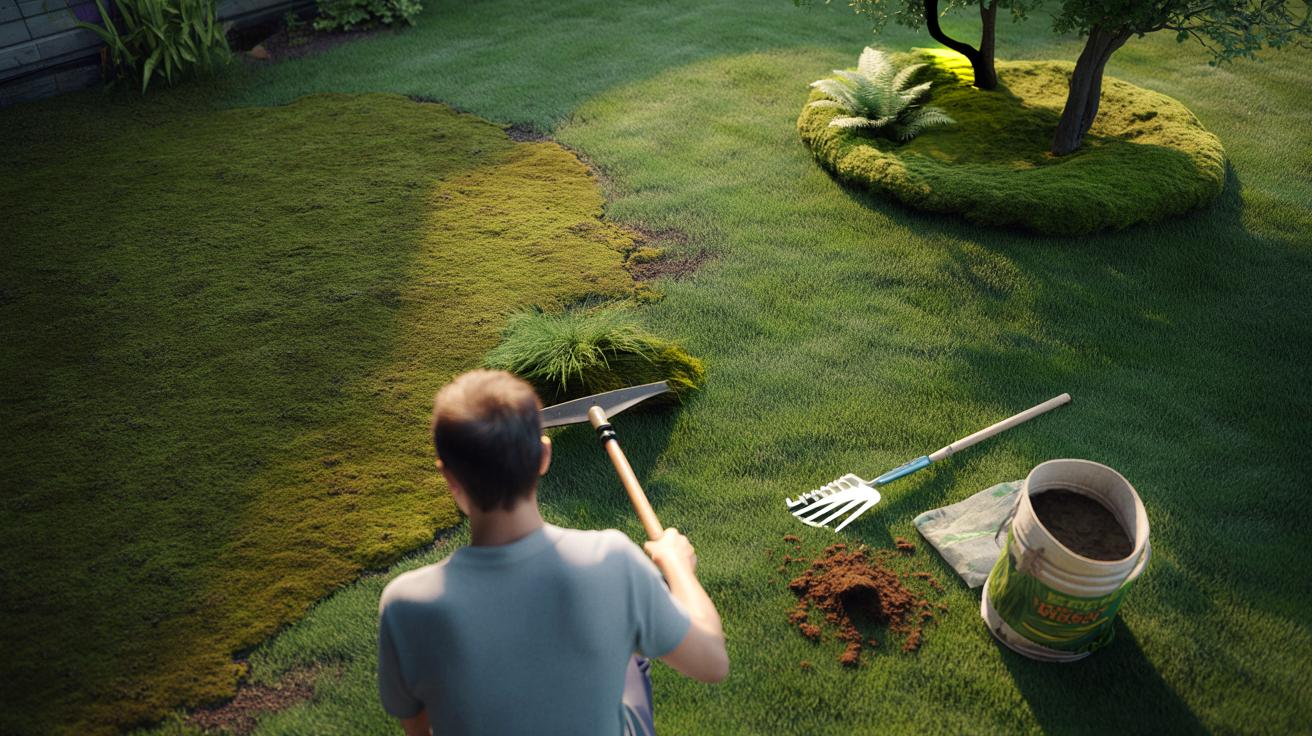
Scarifying is the gentle but firm clear-out your lawn often needs. It means raking or using a scarifier to scratch the surface, removing moss and “thatch” – the layer of dead grass and debris that builds up over the years.
Done at the right moment, usually in spring or early autumn, scarifying helps light and air reach the soil surface. It also creates tiny grooves where new grass seed can settle.
Think of scarifying as peeling off an old, suffocating layer so the lawn underneath can breathe and regrow.
After scarifying, the lawn can look severely battered for a couple of weeks. That’s normal. Pair the operation with overseeding and light fertilising, and the lawn usually comes back thicker and more competitive against moss.
Balancing neat lawns and living gardens
Behind the frustration with moss lies a bigger shift in gardening culture. For decades, the ideal lawn was a near-perfect green sheet with no clover, no daisies, no moss. Today, more people question whether that goal makes sense in a warming climate and a biodiversity crisis.
Moss, in small quantities, is not a threat. It can offer shelter for insects and tiny invertebrates. Birds sometimes pick at it for nest material. On north-facing edges or under deep shade where grass will never thrive, a moss patch can even be an attractive, low-maintenance groundcover.
A lawn with minor moss patches is not a failure; it can be a sign that nature still has a seat at the table.
Some gardeners now keep a central, well-maintained lawn for play and gatherings but accept wilder edges. There, moss, clover, violets and other small plants share the space, providing nectar, habitat and visual interest across the year.
Going chemical-free: what you gain, what you avoid
Traditional moss killers often rely on iron sulphate or other active ingredients that blacken moss quickly. They may work fast, but they don’t solve the underlying conditions favouring moss. Repeated use can harden soil or affect nearby plants and soil organisms.
A natural strategy is slower but adds long-term benefits:
- Healthier soil life, which supports all plants, not just grass
- Better water management, with less runoff and fewer puddles
- Reduced risk for pets and children who play on the lawn
- More resilience during heatwaves, droughts and heavy rain
There are homemade remedies often shared on social media – such as pouring vinegar or salty water onto moss. These can damage soil structure and nearby plants, and frequently leave you with bare patches that moss simply recolonises. Targeting the habitat, not just the plant, remains the more sustainable route.
Practical scenarios for different gardens
Small urban lawn with deep shade
For a city garden shaded by tall buildings or large trees, grass will forever fight an uphill battle. In such a case, partial redesign can be smarter than constant moss removal. You might keep a sunlit strip as lawn while turning the shadiest section into a moss-friendly area with stepping stones, ferns and shade-tolerant groundcovers.
Family lawn under heavy use
Where children, pets and sports dominate, compaction is inevitable. A yearly routine of aeration, followed by compost topdressing and overseeding, can keep moss in check. Keeping the mower set higher protects the grass from constant stress. Accepting small mossy corners near fences or under swings takes pressure off the rest of the lawn.
Key terms gardeners often mix up
Two words often cause confusion: “aeration” and “scarification”. They sound technical yet refer to different actions.
- Aeration focuses on the soil. It creates holes to allow gas exchange, water flow and root expansion.
- Scarification focuses on the surface. It removes moss and thatch to open the way for new growth.
Used together, they form a powerful duo. Aeration tackles the deeper causes of moss, while scarification clears what you can see on top. Add organic feeding and gentler mowing, and moss loses much of its advantage.
Over time, many gardeners find their attitude shifting. The goal stops being “eradicate every scrap of moss” and becomes “grow a lawn that is dense, healthy and still part of a wider living garden”. That change alone often brings less frustration, more birds and insects, and a lawn that fits the 21st century rather better than a sterile green carpet.