The first white hair never arrives politely.
It shows up in a bathroom mirror on a Monday morning, just when you’re already running late, catching the light like a tiny piece of tinsel you didn’t order. You pull it out, of course. Then a few months later, there are three. A year later, your roots seem to grow faster than your patience.
One woman I spoke to described that monthly ritual at the sink: gloves on, sharp smell of ammonia, towel she doesn’t mind ruining. She called it “my recurring tax for looking like myself.”
But what happens when that “tax” suddenly isn’t needed anymore?
Grey hair is not the problem. The upkeep is.
Walk into any pharmacy and the hair dye aisle feels like a confession booth. Rows of boxes show glossy 28-year-olds promising to turn back time for your hair. Yet the real issue isn’t so much the grey itself, it’s the exhausting treadmill of colouring, re-colouring, and touching up roots that never stop growing.
A lot of people are not trying to look 20. They just want their reflection to match how they feel inside: not tired, not washed out, not “who is that?” on Zoom. That’s where a quiet little shift is happening, far away from aggressive box dyes and six-hour salon visits.
More and more colourists are noticing the same request: “I don’t want full dye anymore. I just want my natural colour back… without the grey.” That sounds impossible at first. Hair doesn’t “remember” its old shade, right?
Yet a small niche trend is spreading through beauty forums and TikTok bathrooms: people are adding gentle, pigment-rich concentrates to their regular conditioner, and swearing their natural colour looks like it’s creeping back. Not in a dramatic, overnight way. More like how your skin looks better after a few weeks of good sleep and real food. Soft, believable, quietly different.
So what’s going on here, beyond the marketing buzz? In many cases, these add-ins are basically ultra-mild, semi-permanent pigments. They don’t blast open the hair cuticle the way traditional dye does. Instead, they cling to the outer layer, especially on those porous grey strands that love to soak things up.
Scientifically, they’re not “reversing” greying. They’re tinting, blending and cheating the eye. But the effect can feel strangely natural, because you’re not coating every strand in the same flat colour. You’re adding depth where your hair lost it. Your grey becomes less “line of demarcation” and more soft highlight.
The simple conditioner add-in everyone’s talking about
Here’s how people are doing it at home without turning their bathroom into a crime scene. They buy a small bottle of colour-depositing drops or a cream pigment made to mix with conditioner. In the shower, they squeeze their usual conditioner into their palm, add a few drops, swirl it with a finger, then massage it through mid-lengths and ends.
➡️ The plant that perfumes the home and repels mosquitoes: why everyone suddenly wants it this spring
➡️ A psychologist says: “This small change in how you think about people marks true emotional maturity”
➡️ What the sound of your own chewing can teach you about mindfulness and portion control during meals
They leave it on for 3–10 minutes while they wash their body or scroll on their phone, then rinse. That’s it. No gloves, no burning scalp, no stained ears. Over a few washes, the hair takes on a slightly deeper version of its original tone. Nothing theatrical. Just that “oh, you look well” kind of change.
The biggest difference is the mindset shift. Instead of treating grey hair like an emergency that needs a harsh fix every four weeks, this method becomes part of normal care. Like exfoliating once a week or using hand cream. You’re not pretending the grey isn’t there. You’re gently softening the contrast between silver roots, faded lengths and old dye.
A woman in her late 40s told me she started with the tiniest amount. Two drops of copper-brown pigment for shoulder-length hair. After three uses, her husband said, “Did you sleep better or something? Your hair looks healthier.” That’s the sweet spot: when people notice you, not the product.
There are a few traps, though, and they’re the kind that nobody on social media admits at first. Add too much pigment, and suddenly your “natural chestnut” looks like a helmet. Leave it on too long and your greys can turn oddly warm or even slightly pink, depending on the formula.
Let’s be honest: nobody really does a strand test every single time. So the most realistic approach is to start weaker than you think you need. More conditioner than pigment. Shorter time than the bottle suggests. You can always add intensity over several washes; walking back from over-dark, stained hair is not as fun.
A London colourist I spoke with summed it up simply: “Think of it less as dye, more as tinted skincare for your hair. You’re not fighting grey. You’re blurring it.”
- Choose the right undertone
If your natural hair leans cool (ashy brown, dark espresso, cool blonde), go for neutral or ash pigment drops. If you were always warm (golden, honey, copper), pick something with a soft gold or caramel base. - Test on a hidden section
Apply the mix behind your ear or at the nape of your neck first. Rinse and wait a day to see the true colour on your greys. It’s less dramatic than discovering a surprise orange streak at the front. - Use it like a weekly top-up
Most people do well using the add-in once or twice a week, not every wash. That keeps the build-up gentle and the tone believable, instead of sliding into opaque, shoe-polish territory. - Pair with gentle shampoo
Pigments last longer on hair that’s not attacked by harsh clarifying shampoos. A sulphate-free formula keeps your colour softer and your scalp less annoyed. - Remember: roots will still grow
This isn’t magic. New white hair will appear. The difference is that the line between new growth and old length looks blurred, less like a hard border, more like a soft gradient.
When “ageing hair” stops being a verdict
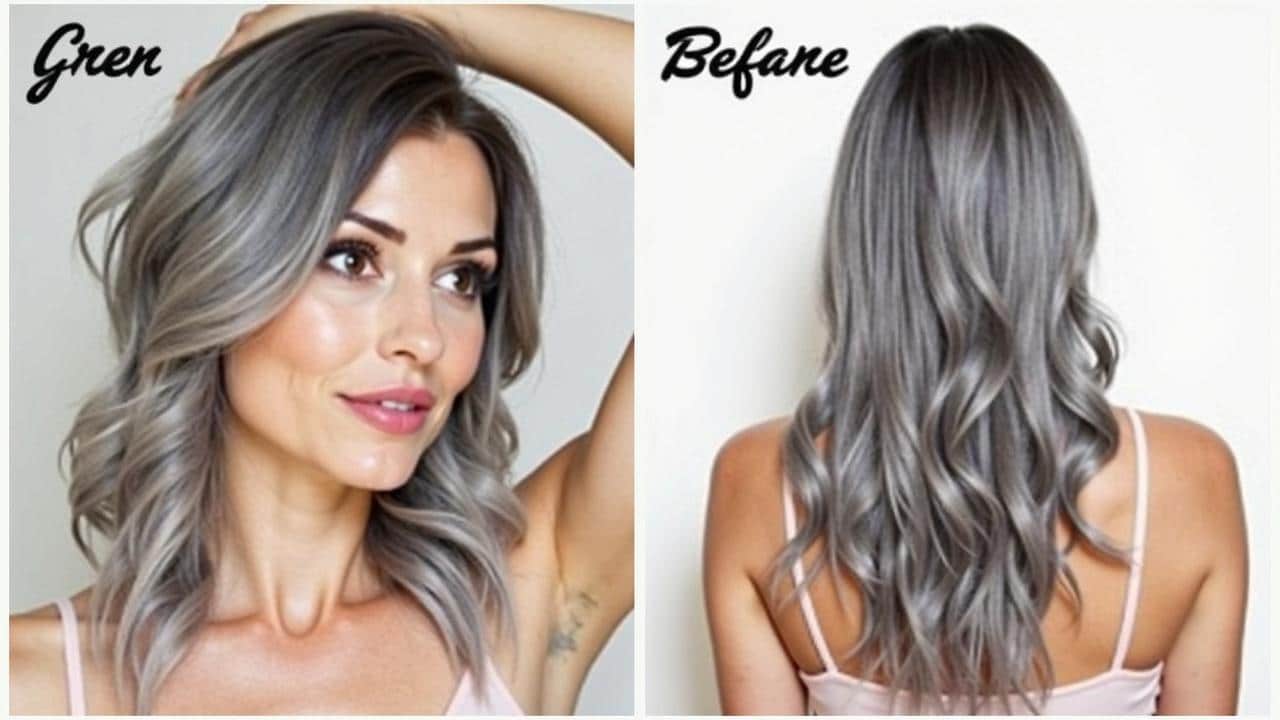
What’s striking, talking to people who’ve switched to conditioner add-ins, isn’t just the before-and-after photos. It’s the relief in their voice. One woman confessed she no longer plans social events around her “root schedule”. Another said she stopped feeling guilty about skipping salon appointments for months.
*Some greys peek through, and she’s fine with that now.* The hair looks like it belongs to a person who’s lived, not to a mannequin fresh from a box. There’s a quiet confidence in walking around with hair that isn’t pretending to be 25, yet isn’t surrendering to that washed-out, ashy look either.
This tiny bottle of pigment in the shower caddy does something subtle to self-image. It offers a middle path where the conversation isn’t “dye or don’t dye”, “embrace grey or fight it”. Instead, it’s: how do I feel like myself with the least drama, the least damage, and the least expense?
For some, that still means full silver, worn proudly. For others, it’s a gentle haze of colour that lets their eyes, skin and expression stay in harmony. It’s not about hiding age. It’s about refusing the idea that your only choices are chemical overload or total surrender.
If you’ve been stuck in the cycle of permanent dyes and resenting every appointment, this small conditioner ritual can feel almost radical. Five extra minutes in the shower. A few drops swirled into a creamy palm. No gloves, no shame, no countdown to the next urgent root fix.
The hair still tells your story, white threads and all. It just does it in softer focus. And that, for many people, is all they ever wanted.
| Key point | Detail | Value for the reader |
|---|---|---|
| Gentle pigment add-ins | Mix a few colour drops into regular conditioner for 3–10 minutes | Blends grey gradually without harsh dye or major time investment |
| Start low and slow | Use minimal pigment and shorter exposure at first | Reduces risk of over-dark, fake-looking colour or unwanted tones |
| Blending, not erasing | Softens contrast between grey roots and older lengths | Gives a more natural, low-stress way to feel like yourself again |
FAQ:
- Question 1Does a conditioner add-in really “restore” my natural colour?
- Answer 1Not biologically. Your follicles are still producing less pigment with age. What the add-in does is visually recreate the depth and tone you used to have, by laying sheer colour over the hair surface, especially on porous greys.
- Question 2Will it damage my hair like regular dye?
- Answer 2Most pigment drops and colour conditioners are far gentler than permanent dye. They usually sit on top of the hair instead of opening the cuticle. Always check the ingredient list, but many people with fragile or dry hair find them easier to tolerate.
- Question 3How fast will I see a difference?
- Answer 3Some people notice warmer, richer tones after the first use, especially on lighter hair. On darker or very resistant grey, it can take 2–4 applications to see a clear softening of the contrast.
- Question 4Can I use this if I already have salon colour?
- Answer 4Yes, many do. It can extend the life of salon colour and reduce how often you feel pressured to go back. Just talk to your colourist about undertones so your at-home pigment doesn’t clash with what they’ve done.
- Question 5What if I end up hating the result?
- Answer 5Because these pigments are semi-permanent and sit more on the surface, they usually fade with several washes, especially if you use a clarifying shampoo. That’s the safety net: you’re not locked into a long-term colour decision.