At a remote site in southern France, a colossal metal segment now hangs between promise and gravity inside a concrete well.
Engineers there are not just moving hardware; they are closing another gap in a machine built to imitate the Sun and test whether fusion can realistically power our grids in coming decades.
Another massive piece clicks into place at iter
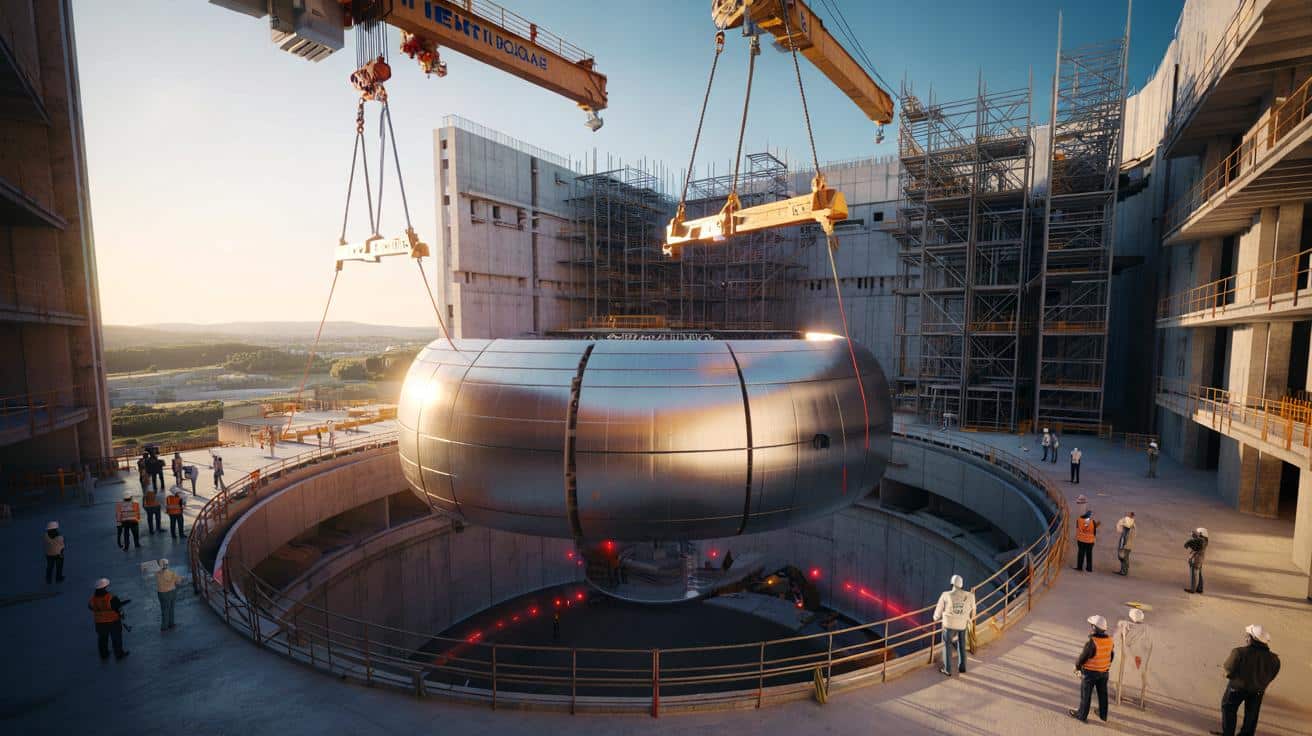
On 25 November 2025 in Cadarache, near Marseille, a steel giant weighing several hundred tonnes inched its way down into a reinforced concrete pit. This was vacuum chamber module no. 5 of ITER, the world’s largest experimental fusion reactor. It now sits alongside its neighbours, modules 6 and 7, which were installed earlier in April and June.
The operation took place inside the tokamak pit, the circular vault that will one day contain a doughnut-shaped plasma hotter than the core of the Sun. Module 5 is the third sector of a nine-piece ring that forms ITER’s toroidal vacuum chamber. With it in place, roughly a third of the chamber’s inner shell now exists in its final configuration.
ITER’s vacuum chamber acts as the hollow heart of the machine, where a 150‑million‑degree plasma must remain stable without ever touching the walls.
The full tokamak will reach around 30 metres in height and similar width. It is not a power plant but a proof-of-concept facility designed to show that fusion can generate more energy than it consumes. Each structural step, like this one, matters for the long-term schedule: first hydrogen plasmas around 2030, then deuterium–tritium fusion shots later in the 2030s.
How do you lower a 400‑tonne sector with millimetre precision?
A slow-motion choreography above a concrete abyss
Lowering module 5 was less like a typical construction lift and more like surgery. Two overhead cranes worked in tandem, guided by laser trackers and dozens of engineers watching from control rooms and platforms. The clearance between the module and surrounding structures is measured in centimetres; acceptable misalignment is down to a few tenths of a millimetre.
Before any descent, each module passes through a dedicated cleaning building. There it is scrubbed of dust and contaminants, since even small particles can create problems inside a high-vacuum vessel or interfere with future inspections and diagnostics.
Once cleaned, the segment moves into the assembly hall. There, cranes rotate and tilt the enormous piece, aligning it in three dimensions. Operators sometimes adjust its position by as little as a sheet of paper’s thickness.
Every lift is rehearsed in simulations, then repeated in the hall as a meticulously timed sequence involving cranes, sensors and human spotters.
➡️ Got an Annoying Twitch? Here’s What to Consider Before You Think The Worst : ScienceAlert
➡️ 8 phrases deeply selfish people often say without realising it
➡️ Psychologists agree: “Life feels lighter the day you stop measuring your worth by this”
➡️ You don’t realise it, but these 5 habits secretly make you seem unlikeable
➡️ I made this cozy bowl-style dinner and it felt incredibly satisfying
When the module finally reaches the tokamak pit, the pace slows further. The team must align the new sector not only with the concrete base, but also with neighbouring modules that were installed months earlier. Too much force on the wrong flange, and months of machining work could be ruined.
What a single iter module actually contains
Each of the nine vacuum chamber modules is essentially a compact machine in itself. Inside every sector sit:
- Two superconducting magnet coils that help shape and stabilise the plasma
- A thermal shield to protect cold components from the reactor’s radiant heat
- A thick steel wall segment that forms part of the vacuum boundary
- Feedthroughs and interfaces for diagnostics and heating systems
These elements must line up cleanly across all nine modules, so that cables, cooling pipes, and support structures can thread through the torus without distortion. Before any welding starts, engineers verify the geometry of the module with metrology instruments that measure positions down to tens of microns.
An industrial symphony spanning three continents
Who is actually building iter’s core?
ITER is not a national project; it is an international industrial puzzle. The latest lift shows how many players have to synchronise to move a single piece into place.
A Chinese–French consortium, coordinated by CNPE and involving institutes such as CNIC, ASIPP and SWIP together with France’s Framatome, manages integration of the central solenoid, the cryostat and the feed systems for the magnets, as well as the placement of the vacuum modules in the pit.
Italian company SIMIC S.p.A. focuses on the fine positioning and interconnection of neighbouring modules once they are seated. Indian engineering giant Larsen & Toubro provides ultra-precise welding on the vessel’s port openings, where future diagnostics and piping will connect. US-based Westinghouse takes responsibility for the final welds that will permanently join all nine sectors into a continuous torus.
Every module is bespoke, machined to tolerances more familiar to aerospace manufacturing than to traditional civil engineering.
Because each partner uses its own tooling, materials and standards, ITER’s central team must impose rigorous specifications so parts built in one country will mate flawlessly with components delivered from another. Any mismatch could trigger months of rework.
Progress tracker: iter’s vacuum chamber
| Module | Installation date | Status |
|---|---|---|
| No. 7 | April 2025 | Installed |
| No. 6 | June 2025 | Installed |
| No. 5 | 25 November 2025 | Installed |
| Nos. 1–4 and 8–9 | 2026 (planned) | Pending |
The aim is to install one new module roughly every two to three months through 2026. Once all nine sectors are in place, crews will start the full circumferential welds, leak tests and detailed inspections, which themselves will take years.
From metal ring to artificial sun
Why these nine modules matter for fusion
The vacuum chamber forms the primary barrier between the ultra-hot plasma and the rest of the reactor. When ITER finally switches on, a mixture of hydrogen isotopes will be heated to around 150 million degrees Celsius. At that temperature, matter becomes plasma and must be kept away from any solid surface.
The fusion plasma will never “touch” these walls directly; magnetic fields must hold it in a hovering loop, like a smoke ring held away from the metal.
If the chamber flexes, leaks or shifts, those magnetic fields will change shape and the plasma could crash into the wall, quenching the reaction and potentially damaging components. That is why each module installation is treated almost like an aerospace event rather than a typical construction milestone.
ITER’s long-term goal is to demonstrate that such a device can produce more energy from fusion than the power fed into the plasma heating systems. The project also aims to test materials, remote-handling robots and control software that future commercial reactors will need.
Delays, costs and the ticking clock
When the ITER site broke ground in 2010, planners hoped for a first plasma in 2025. Reality intervened. Design tweaks, supply chain issues, and the COVID-19 pandemic pushed the schedule back by several years. The current roadmap envisions first non-fusion hydrogen plasmas around 2030, with deuterium–tritium shots sometime between 2035 and 2039.
The budget has grown as well. Estimates now put the total cost above €22 billion, funded mainly by the European Union, China, India, Japan, South Korea, Russia and the United States. For critics, this looks like a slow, expensive detour from quicker climate solutions. For supporters, it is the price of testing a technology that, if it works, could provide low-carbon baseload power for centuries.
What happens inside iter before the first plasma
The road from metal to machine
Once the vacuum chamber closes, several major systems still need to go in. Engineers must install the divertor, a component that extracts helium “ash” from the plasma and handles intense heat loads. Shielding blocks and internal structures will be placed to protect magnets from radiation. Hundreds of diagnostic instruments will line sightlines into the plasma to track temperature, shape and turbulence.
Powerful radio-frequency and neutral-beam heating systems will then be connected. These will inject energy to bring the plasma from a few million degrees up to full fusion temperatures. All this happens before any serious attempt at fusion firing.
Early campaigns, expected at the end of this decade, will use simple hydrogen plasmas to test magnets, controls, cooling systems and protection algorithms. Only when the team is confident in the machine’s behaviour will they introduce deuterium and, later, tritium fuel.
Key concepts behind the giant experiment
What “tokamak” and “plasma confinement” actually mean
The term “tokamak” comes from Russian and describes a toroidal magnetic chamber. In plain terms, it is a metal doughnut wrapped with huge electromagnets. Those magnets create a cage of magnetic field lines, looping around the ring, that corral charged particles.
Plasma confinement means keeping those charged particles in a stable orbit long enough for them to collide and fuse. The challenge is that hot plasma behaves like a restless fluid threaded with electrical currents. It wriggles, twists and can suddenly erupt in bursts that slam into the vessel. ITER is designed to study these instabilities at a scale never attempted before.
Two fuel types matter most here: deuterium and tritium. Both are isotopes of hydrogen. Deuterium occurs naturally in seawater. Tritium is radioactive and must be produced in reactors or bred in special blankets surrounding future fusion cores. When they fuse, they produce helium and a neutron, along with substantial energy.
Risks, trade-offs and what success might look like
Fusion does not carry the same meltdown risk as conventional fission reactors, because the plasma extinguishes if anything goes wrong. Yet technical risks remain. Components near the plasma face extreme heat and neutron bombardment, which can weaken metals and complicate maintenance. Tritium handling also requires strict safeguards due to its radioactivity and ability to diffuse into materials.
If ITER manages to sustain a deuterium–tritium plasma that yields more power than it consumes, it will not light our homes directly, but it will reshape energy planning for the second half of this century.
Simulations by energy analysts often place commercial fusion, if it arrives, alongside offshore wind, long-duration batteries and advanced fission as part of a mixed low-carbon grid. In that picture, fusion plants would run steadily, covering base demand, while variable renewables fill in peaks and storage smooths the gaps.
For now, the focus at Cadarache is far more concrete: six remaining modules must slide into the pit with no surprises. The success of module no. 5 shows that the teams have gained experience and confidence. Yet every new lift still feels like a test, not just of cranes and steel, but of the wider bet that fusion energy is finally edging from science fiction towards engineering reality.