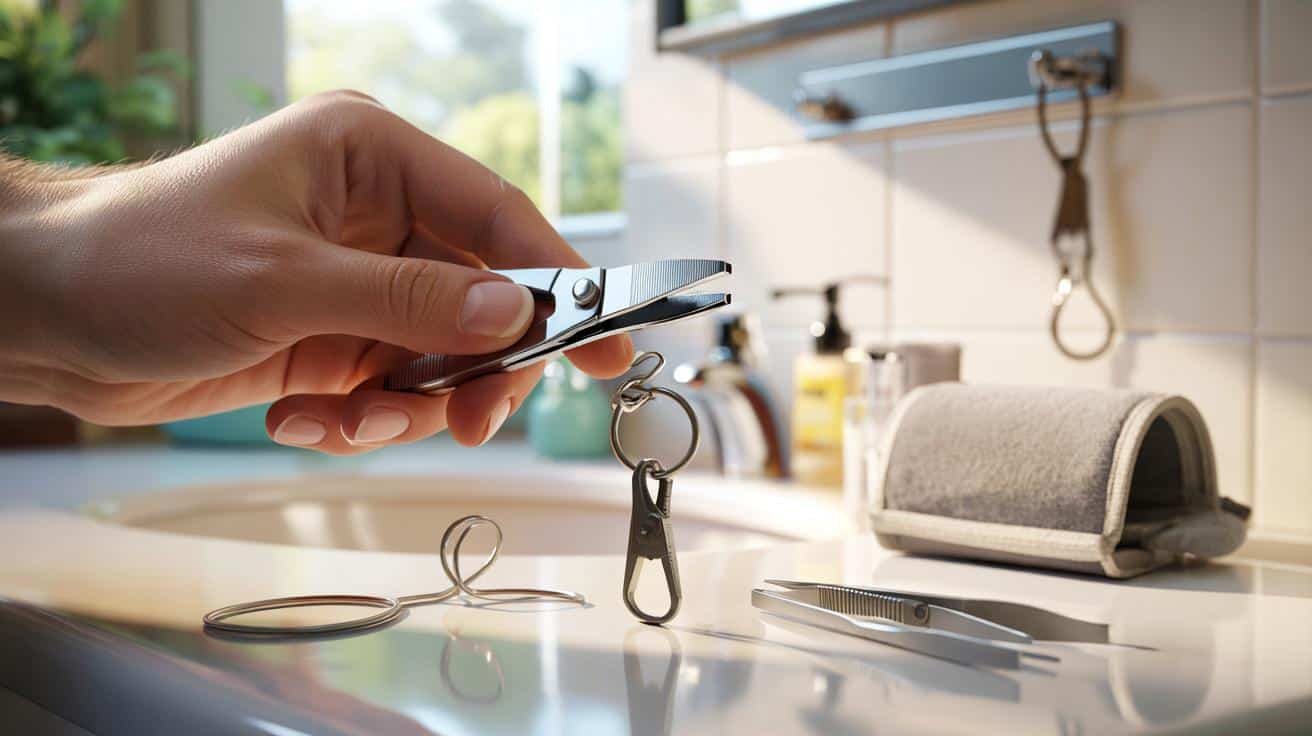
Look closely at your clipper and you will spot it: a tiny, neat hole at one end. Many assume it is just decoration. In reality, that little gap hides several practical uses that can make grooming easier, travel simpler and even help with small DIY jobs.
The tiny hole you never paid attention to
Modern nail clippers are designed for speed and precision, not for mystery. Still, that small hole on the lever or body has a clear primary purpose: attachment.
That “decorative” hole is meant to fix the clipper to a keyring, chain, hook or metal loop so you always know where it is.
Once clipped to your keys, a lanyard, a washbag zip or a travel pouch, the nail clipper becomes far harder to lose. For frequent travellers, parents, or anyone constantly rummaging for grooming tools, this single tweak in how you carry it can make a big difference.
From handbag chaos to one fixed place
Nail clippers are famously easy to misplace. They are small, they slide under towels, and they vanish into bathroom drawers. Using the hole as intended helps bring order back.
You can:
- Hang the clipper on a hook in the bathroom.
- Attach it to a keyring by the front door.
- Clip it to the inside of a toiletry bag.
- Keep it on a small carabiner with tweezers and scissors.
One quick glance, and you know exactly where the tool is. That may sound minor, yet over months and years it saves time and repeated small frustrations.
By treating the nail clipper like a key or a USB stick and attaching it via the hole, you reduce the chances of it disappearing into drawers forever.
A surprisingly handy trick: bending wires and cables
The hole also lends itself to a more improvised role: shaping thin wires or cables. Threading a cable through the opening and pressing gently with the clipper gives you a more controlled bend than using fingers alone.
➡️ 8 phrases deeply selfish people often say without realising it
➡️ What it reveals psychologically when you feel uncomfortable receiving compliments
➡️ Why gardeners hang cork stoppers on lemon branches
➡️ Neuroscience reveals the personality trait that can absorb criticism
➡️ How to clean glass tables without constant fingerprints
This is useful for small tasks at home:
- Neatly bending soft craft wire for decorations or jewellery.
- Shaping thin electrical cables where you need a gentle curve.
- Creating consistent angles in wire used for hobby electronics or model building.
The tool does not replace pliers, and it should never be used on live electrical cables. Yet when you lack proper equipment and the material is thin and soft, the hole plus firm pressure can act as a simple, makeshift bending jig.
What many clippers can do besides clipping
The hole is just one hidden feature. Over time, manufacturers have quietly turned nail clippers into miniature multi-tools.
| Feature | Typical use |
|---|---|
| Folding nail file | Smoothing sharp nail edges, quick cosmetic corrections |
| Small metal spatula or tip | Cleaning under nails, pushing back cuticles, opening envelopes |
| Pointed edge | Opening packaging, tightening tiny screws in glasses or gadgets |
| Sturdy edge | Careful cable stripping or cracking soft nutshells (with caution) |
These extras turn a basic grooming tool into something closer to a compact pocket aid. Many people already use their clippers to open stubborn plastic packaging or scrape at labels, often without realising those metal edges are designed to tolerate some of that work.
A nail clipper can act as nail tool, mini file, tiny screwdriver and makeshift opener in one compact object.
Why technique still matters for healthy nails
The hidden features mean little if nails are cut badly. The clipper itself was invented in the 19th century as a more precise alternative to knives and crude scissors. Used correctly, it supports nail health; used carelessly, it can trigger painful problems.
Dermatologists generally recommend:
- Cutting toenails straight across or with a gentle curve, not extreme rounding.
- Avoiding very deep cuts at the corners, which can encourage ingrown nails.
- Using the file to smooth edges instead of aggressively trimming tiny bits.
- Cleaning the tool regularly to reduce bacteria and fungal build-up.
Research published in the open-access journal Physical Biology has highlighted how nail shape, constant decoration and strong chemicals can affect mechanical stresses in the nail plate. Excessive gel, hard acrylics and harsh removers can make nails weaker over time.
Scientists advise fans of elaborate manicures to keep cuts straight or gently parabolic, as poor shaping can amplify stress imbalances in the nail.
The study also noted that when the natural balance between growth forces and attachment to the nail bed is disturbed, residual stresses build up. These can evolve, producing deformities or painful conditions later on. Using a clipper or nipper that gives a clean, controlled cut helps keep that balance more stable.
Making the most of a small everyday tool
Used with its full design in mind, the nail clipper becomes a quiet organiser of daily life. The hole lets you hang it, attach it, or add it to a small “essentials set” with tweezers and a file. That, in turn, encourages regular trimming and better hygiene.
For families, one practical approach is to assign each person a colour-coded keyring attached through the hole. Each ring holds an individual clipper. This reduces the spread of fungal infections, cuts down on arguments over “who took the clipper”, and keeps sharing to a minimum.
Travellers can thread a slim cord through the hole and tie it to the inner loop of a washbag. Even if airport security requires moving items around, the tool always ends up back at the same anchor point.
Risks, limits and when not to improvise
Using the hole to bend wires or as a general-purpose clamp has its limits. Forcing thick or hardened wire through can distort the tool and blunt the cutting edges. Using it on live or damaged electrical cables risks serious injury.
Basic rules help keep things safe:
- Stick to thin, soft wire if you use the hole for bending.
- Do not use the clipper as a main screwdriver on tight screws.
- Avoid chipping or prying at hard surfaces with the cutting blades.
- Keep one clipper just for nails and another for rough tasks if you multitask a lot.
Small detail, long-term habit
The hole is a tiny design choice, yet it encourages a useful habit: giving small tools a fixed home. That habit reduces clutter, supports better hygiene, and makes routine care easier. The same logic can apply to tweezers with loops, scissors with eyelets or USB drives with small openings.
Next time you pick up your nail clipper, thread a ring, cord or chain through that modest gap. Over weeks, you may find you lose the tool less, trim more regularly and pay a bit more attention to how you cut. For such a small piece of metal, that is a respectable amount of quiet influence.