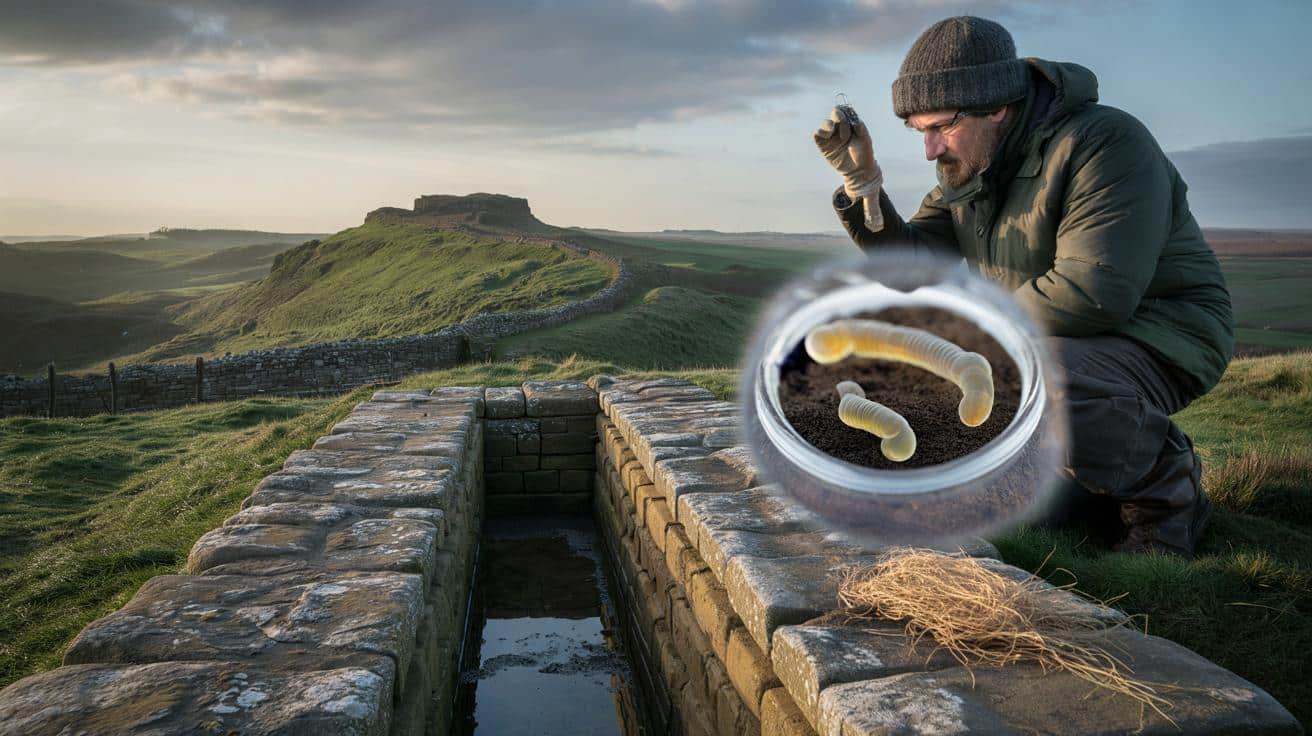
The wind on Hadrian’s Wall cuts straight through you, even in early spring. You stand where legionaries once queued shoulder to shoulder over a long stone trench, cloaks wrapped tight, trying not to look down. Behind the postcard view of rolling green hills and rugged ruins, archaeologists kneel by what used to be the latrine, holding tiny glass vials filled with soil so old it almost turns to dust in their hands.
Under the microscope, that dust comes to life. Egg-shaped ovals of ancient parasites glow against the slide like a night sky full of tiny, unwelcome moons. The soldiers who guarded Rome’s northern frontier 1,800 years ago lived with these things inside them, day after day.
The empire looked invincible on the surface.
Their guts told a different story.
Inside the Roman toilets that changed the story of Hadrian’s Wall
Archaeologist Piers Mitchell leans over a sample from a latrine at Housesteads fort, one of the best-preserved sites on Hadrian’s Wall. What looks like ordinary dirt is actually the compacted remains of centuries of use: human waste, broken pottery, food scraps, straw, and the fine dust of time. Under the microscope, it’s an entire ecosystem of the past.
The team’s new analysis has revealed something both fascinating and a little stomach-turning. The soil is thick with eggs of whipworm, roundworm, and other gut parasites that don’t just pass through quietly. They latch on, drain energy, trigger cramps, and weaken bodies that already lived under relentless northern rain and military discipline. That picture-perfect Roman frontier? It stank, and it scratched from the inside.
One small sample from a latrine trench can hold thousands of parasite eggs. The researchers sifted through layers of back-filled toilet pits and drainage channels along different stretches of the Wall: Housesteads, Vindolanda, and several lesser-known forts where only foundations remain. Each site told the same, uncomfortable truth.
Roman soldiers stationed here were heavily infested, not occasionally, but chronically. At Vindolanda, where wooden tablets have already revealed gossip, shopping lists, and complaints about the cold, the microscopic story lines up with the written one. Men wrote about “weakness” and “persistent illness”. Now we know that behind those vague words, their intestines were probably crawling with life.
This isn’t just about gross details from the past. Gut parasites can stunt growth, cloud concentration, and sap the stamina needed for long marches in armor and sudden fights along the frontier. The empire invested in walls, weapons, and logistics, while the basic health of its troops silently eroded from within.
The latrine findings also flatten some of the romantic myths about Rome’s supposedly advanced hygiene. Aqueducts and bathhouses sound modern to us, almost glamorous. Yet the very systems that impressed visitors — shared sponges, communal toilets, reused water — became perfect highways for parasite eggs. The Wall wasn’t just a line on the map. It was a place where Rome’s confidence met the messy limits of ancient sanitation.
➡️ A first in 100 years: a chinook salmon returns to its native California river
➡️ This Ancient Deadly Disease Is Growing More Resistant To Antibiotics, And Experts Are Worried
➡️ How changing when you check messages improves focus without missing anything important
➡️ You don’t realise it, but these 5 habits secretly make you seem unlikeable
➡️ How to Eliminate Moss from Your Lawn Naturally and Effectively?
➡️ The emotional reason some people feel relief after crying
How Roman ‘hygiene’ helped gut parasites thrive on the frontier
The Roman army actually had rules about cleanliness. Latrines were planned structures, not random pits, often lined with stone seats, with running water channels beneath. Soldiers washed in cold baths, scraped their skin with strigils, and shared a sponge-on-a-stick — the famous (or infamous) *tersorium* — for wiping. It sounds organized, even impressive, from a distance.
The problem is that the same cleverness that built the Wall also built the perfect parasite loop. Water flushed waste away, but not very far. Sponges were rinsed in communal basins, turning fresh water into a diluted soup of bacteria and eggs. From hand to mouth, bowl to latrine, field to kitchen, the cycle never really broke.
Imagine daily life at a fort like Housesteads on a winter morning. The ground is slick with mud, the barracks smell of damp wool and smoke, and the latrine is an open trench with a stone seat and a view of the moors. A soldier finishes his turn on the bench, dips the communal sponge in the flowing water channel, wipes, rinses, and leaves it hanging for the next man.
Later he eats bread, porridge, or stews thickened with local vegetables grown in fields fertilized with human manure from the same latrine system. Every bite is a chance for parasite eggs to hitchhike back into a new body. Nobody can see them. Nobody understands what they are. Yet they shape the way men sleep, fight, and complain in letters sent home to warmer provinces.
From a modern perspective, it’s tempting to judge. We know about handwashing campaigns, filtration, and deworming tablets sold at pharmacies. Back then there was no germ theory, no microscope, no concept of invisible organisms wrecking your digestion from the inside out. The Romans thought about bad air, bad water, even angry gods — not microscopic hitchhikers camping in their intestines.
Let’s be honest: nobody really does this every single day, even now, when we’re told how often we should wash, change sheets, or sanitize our phones. On a cold frontier posting with limited fresh water and constant military duties, shortcuts quickly become habits. The new study of Hadrian’s Wall latrines is less a story of “dirty Romans” and more a reminder of how fragile health becomes when infrastructure and daily habits quietly work against the body instead of for it.
What these ancient parasites quietly say about us today
There’s a practical lesson hiding in those ruined toilets. Modern epidemiologists look at Hadrian’s Wall almost like a frozen experiment: a closed community, limited movement, predictable routines, and a shared water and waste system. The parasites that show up in that soil are a fingerprint of how disease spreads when people live tightly packed together and reuse the same resources again and again.
One simple method used by the researchers — known as parasite egg analysis — is now standard in studying ancient health. Soil is mixed with water, sieved, and spun in a centrifuge so the heavier eggs sink to the bottom. What rises out is a long-term record of infection patterns that no written source can fake or forget.
If you’ve ever shared a small bathroom with too many people, you already know how fast “a bit messy” becomes “unlivable”. Multiply that by a full Roman cohort plus support staff, animals, visiting traders, and families squeezed into fort vicus settlements just outside the walls. The mistakes they made are the same shortcuts we are tempted to take: rushing meals, skipping handwashing, trusting that “a quick rinse” is enough.
Archaeologists reading these latrines are also reading our own blind spots. We talk a lot about high-tech medicine, but less about boring basics like sewage, water treatment, and food safety in less visible corners of the world. We’ve all been there, that moment when you realize the smallest daily habit — one shared towel, one shared dish, one ignored stomach ache — can set off a chain reaction in a home, a school, a barracks.
Mitchell summed it up quietly in one interview: “The Wall tells a story of strength and order, but the latrines tell a story of vulnerability. You cannot march your way out of a parasite infestation.”
- Roman “cleanliness” was real, but based on sight and smell, not microbes or parasites hidden in clear water and seemingly solid stools.
- Shared tools like the tersorium turned from clever inventions into invisible transmission belts for whipworm and roundworm eggs.
- Latrine analysis exposes class differences: elite baths in cities often show fewer parasites than cramped frontier forts, underlining how inequality shows up even in gut health.
- Modern sanitation systems were built precisely to break the kind of loop seen at Hadrian’s Wall — yet 21st-century crises remind us those hard-won protections can be fragile.
- Looking at ancient toilets is not just morbid curiosity; it’s a low-tech way to track health, diet, and living conditions over centuries when other evidence fails.
The Wall, the worms, and the quiet cost of empire
Stand again on Hadrian’s Wall and it’s easy to see only the big story: Rome versus “barbarians”, stone versus weather, empire versus time. The new analysis of those latrines pulls the camera right down into the bodies of the men who actually held the line. It brings their daily discomforts, their stomach cramps during night watch, their low, nagging fatigue into focus.
The great imperial project relied on thousands of soldiers who were, quite literally, not at their best. Not because they lacked courage, but because their intestines were a battleground they never understood.
There’s something quietly humbling about the idea that a mighty wall of stone could not protect against microscopic eggs floating in a trickle of reused water. Today, we like to think antibiotics, vaccines, and digital tracking give us the upper hand. Yet every new outbreak and every failing sewage system shows how quickly those old loops can restart when attention drifts and infrastructure cracks.
The latrines of Hadrian’s Wall don’t just tell us what went wrong in the past; they ask what blind spots we’re living with right now. Maybe the next big health story won’t start with a dramatic headline, but with some quiet corner of everyday life that feels too mundane to notice — until someone, years from now, starts sifting through our own buried waste and finds the clues we missed.
| Key point | Detail | Value for the reader |
|---|---|---|
| Ancient toilets as archives | Latrine soils along Hadrian’s Wall preserve parasite eggs that reveal real Roman health conditions | Shows how small traces can overturn “clean” myths about the past and sharpen our sense of present-day risks |
| Hygiene that backfired | Shared sponges, reused water, and manure-fertilized fields created a closed loop of gut parasite transmission | Highlights how well-meant habits and clever systems can spread illness when invisible agents are ignored |
| Modern mirror | Frontier forts function as models for crowded, resource-limited communities today | Invites reflection on our own daily shortcuts, infrastructure gaps, and the quiet health costs we rarely see |
FAQ:
- Question 1What kinds of parasites did researchers find in the Hadrian’s Wall latrines?
- Answer 1Mainly whipworm and roundworm eggs, along with evidence of other gut parasites that cause abdominal pain, diarrhea, and long-term fatigue.
- Question 2How can parasite eggs survive for 1,800 years in the ground?
- Answer 2The eggs have tough outer shells that can fossilize in damp, protected latrine soils, especially when quickly buried and kept away from light and oxygen.
- Question 3Does this mean Roman hygiene was “bad” compared to earlier societies?
- Answer 3Not simply: Romans had structured toilets and baths, but without germ theory their communal systems accidentally helped parasites spread.
- Question 4Are these findings unique to Hadrian’s Wall, or seen across the Roman Empire?
- Answer 4Similar parasite profiles show up at other Roman sites, though rates vary; crowded military forts and poorer districts tend to be worst affected.
- Question 5What can this kind of research change for us right now?
- Answer 5It reinforces how crucial clean water, effective sewage, and small daily hygiene habits are, especially where people live in tight quarters with shared facilities.