One of the boldest ideas now on the table comes from a supersonic aircraft start-up that wants to repurpose its jet engine core as a 42 MW gas turbine dedicated to feeding the electricity-hungry servers of artificial intelligence.
A jet engine moves from runway to server rack
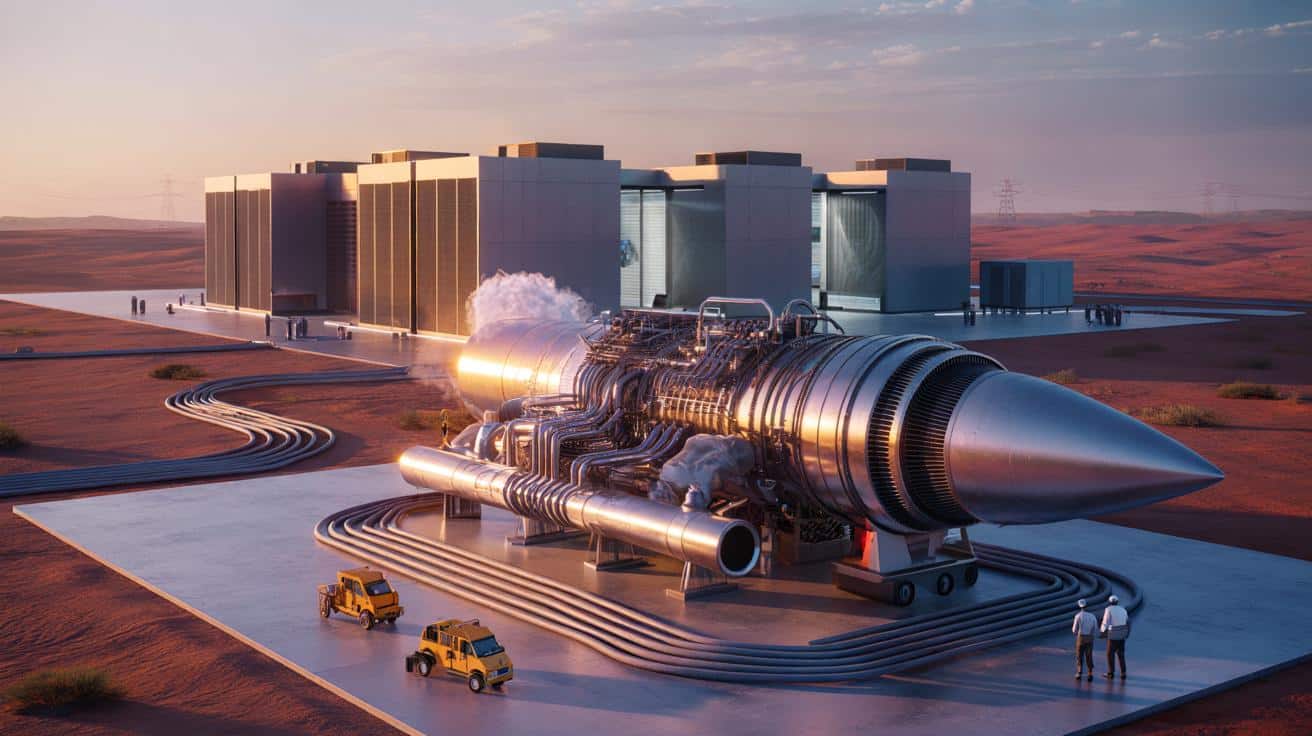
Boom Supersonic, best known for its Overture supersonic airliner project, has unveiled “Superpower”, a stationary gas turbine rated at 42 megawatts. Instead of pushing an aircraft through the sky, this engine will sit on the ground and drive generators for AI data centres.
The concept relies on Symphony, the high-temperature turbofan engine core designed for long-duration supersonic flight. Engineers at Boom have adapted that core for industrial use, stripping away the fan and flight hardware, and optimising it for continuous power generation.
Superpower is a 42 MW gas turbine derived from a supersonic jet engine core, purpose-built to power energy-hungry AI data centres.
Because Symphony was created to run at extreme temperatures and pressures, Boom claims the Superpower variant can deliver full output in harsh conditions that usually cripple conventional turbines. The unit is engineered to maintain its 42 MW rating even at 43°C ambient temperature, and it does this without needing water for cooling.
First major deal: 29 turbines for an AI compute player
The launch customer is Crusoe, a US high-performance computing and AI infrastructure company. Crusoe has ordered 29 Superpower turbines, representing 1.21 gigawatts of planned capacity. The contract is valued at around $1.25 billion, or roughly €1.16 billion at current exchange rates.
For Boom, this is a significant commercial step for equipment that has not yet left the test stand. For Crusoe, it is a shortcut around a problem that is rapidly becoming existential for large-scale AI projects: many US grids are already saturated.
US grids struggle with AI’s energy appetite
Across many parts of the country, utilities are warning that they cannot connect new, large data centres on the timelines requested by cloud and AI companies. High-voltage transmission projects take years and often face local opposition, planning delays and supply chain bottlenecks.
Crusoe’s approach is to deploy its own small power plants directly on site. Each Superpower turbine would sit next to the data centre, feeding electricity straight into the local distribution network or even directly into server halls.
➡️ This Ancient Deadly Disease Is Growing More Resistant To Antibiotics, And Experts Are Worried
➡️ How to clean glass tables without constant fingerprints
➡️ Some people talk incredibly loudly: What that reveals about their character
➡️ February feeders place this cheap treat to ensure birds return every morning
➡️ Psychology explains why emotional states can shift without obvious reasons
➡️ Do You Always Wake Up Between 2 And 4 A.m.? This Hormone Might Be To Blame
On-site generation lets data centre operators bypass grid bottlenecks and build where transmission capacity is scarce or delayed.
This strategy appeals especially in the US Southwest, where grid capacity is strained and temperatures are high. Traditional gas turbines can lose up to 30% of their output during heatwaves as hot, thin air reduces efficiency. Superpower aims to avoid that drop-off, which could mean more predictable performance during peak demand and peak heat.
How a supersonic turbine is different
Superpower borrows several key elements from the Symphony engine:
- A high-temperature core built to withstand long periods of stress at supersonic cruise conditions.
- Advanced materials and coatings designed to survive repeated thermal cycles.
- A comprehensive digital monitoring system, originally tested on Boom’s XB‑1 demonstrator aircraft.
Every hour that a Superpower unit runs in a data centre, Boom gathers detailed operational data: temperatures, vibration profiles, efficiency curves, and signs of wear in critical parts. Those metrics then feed back into the development of the flight-certified version of Symphony.
This creates a kind of industrial loop. The energy product generates revenue while also serving as a real-world testbed for the aviation engine.
By selling power turbines, Boom simultaneously funds its aircraft programme and stress-tests the same core technology in continuous operation.
Factory plans and production targets
Boom plans to complete a full Superpower prototype by the end of 2026. Customer deliveries are currently slated for 2027, subject to certification and integration work.
Longer term, the company is targeting the production of 4 GW of turbine capacity per year by 2030. To reach that level, Boom intends to build a dedicated plant for industrial turbines, starting with a 2 GW annual capacity and expandable assembly lines. Equipment for this facility has reportedly already been ordered.
Vertical integration as a survival strategy
To push both Superpower and the Overture aircraft forward, Boom has raised an additional $300 million from investors including Darsana Capital, Altimeter, ARK Invest and Robinhood Ventures. The company’s chief executive, Blake Scholl, has framed the move as a deliberate pivot toward vertical integration.
In practice, that means Boom wants to own the design and production of its turbines, its engines and much of its manufacturing infrastructure, rather than relying on traditional aerospace suppliers or energy OEMs.
According to Boom’s leadership, building its own engines and power systems is no longer a luxury but a requirement for keeping pace with AI-driven timelines.
Energy revenue from Superpower, if orders materialise at scale, could give Boom a steadier funding base than one-off aerospace milestones, which often depend on government contracts or long certification cycles.
Data centres’ electricity demand is exploding
The timing of Superpower’s launch reflects a profound shift in digital energy use. Global data centres already consume an estimated 460 terawatt-hours per year, roughly equivalent to the entire annual electricity consumption of the UK. Analysts at the International Energy Agency expect that figure could double by 2027.
Several trends are driving this surge: massive generative AI models, ever-expanding cloud services, 5G networks and the rise of edge computing. Each of these adds new workloads, and each demands low-latency, high-availability power.
| Region | Preferred data centre power strategy |
|---|---|
| United States | Gas-fired microplants, experiments with small modular reactors near data hubs |
| Europe | Solar farms with battery storage, some green hydrogen projects and strict efficiency rules |
| China | Hydropower-linked sites, wind-hydro hybrids, immersion cooling for dense server farms |
| Nordic countries | Cold climate hosting, hydro and wind power, extensive use of free-air cooling |
Boom’s model fits into the US trend toward gas-fired microgeneration, but with an aerospace twist. Instead of using standard industrial turbines, it brings flight-grade hardware down to ground level.
Environmental trade-offs and fuel considerations
Superpower still runs on gas, so it emits CO₂ and other pollutants like conventional gas turbines. That raises questions at a time when many governments are pushing for deep decarbonisation of both power and digital infrastructure.
Boom’s engineering team argues that a highly efficient, high-temperature turbine can cut emissions per unit of compute compared with older, less efficient plants. There is also potential compatibility with low-carbon fuels such as biogas or future synthetic fuels, although those supply chains remain small and more expensive than standard natural gas.
For communities near data centre clusters, on-site gas turbines could bring local noise and air quality concerns. At the same time, they can reduce the need for long-distance power imports and new transmission lines that often trigger public resistance. The trade-off between local emissions and broader grid expansion will likely become a recurring political battle.
Key technical terms worth unpacking
Several concepts underpin this shift from aviation engine to data centre turbine:
- High-temperature core: The central part of the engine where compressed air mixes with fuel and burns. Higher temperatures generally mean higher efficiency, but they also stress materials.
- Thermal cycle: Each heating and cooling event during operation. Frequent cycles can cause fatigue and cracks in metal components.
- On-site generation: Producing electricity at or next to the point of use, rather than importing it over long-distance lines.
Because Superpower is designed for continuous operation, not takeoff and landing cycles, the stress profile differs from aviation use. Data from these turbines could help Boom fine-tune where to reinforce parts on the flight engine and where to lighten them.
What this could mean for future AI campuses
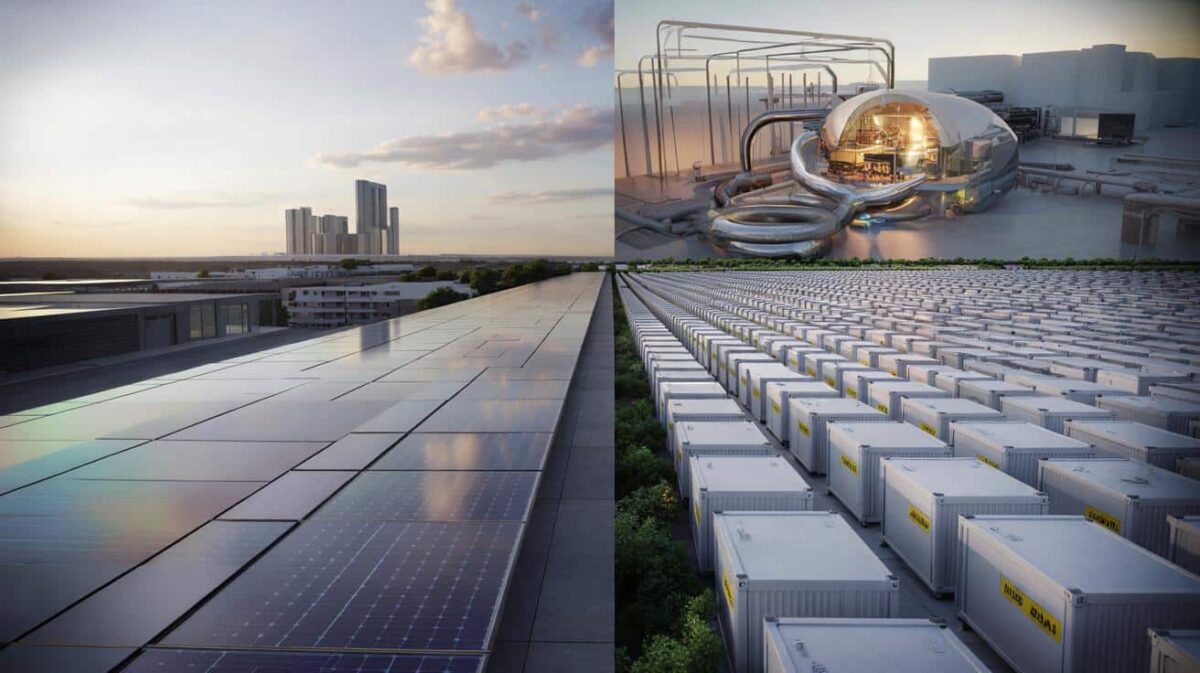
If Superpower meets its performance claims, future AI campuses might resemble small industrial parks, each with its own compact power station made of gas turbines, battery banks and possibly later, small nuclear units or hydrogen systems. A data centre operator could mix and match these options to hedge fuel costs and reduce emissions.
In one scenario, a campus in the desert Southwest could run several Superpower turbines on natural gas, add solar panels for daytime peak shaving, and use batteries for short-duration backup. If low-carbon synthetic fuels become affordable, the same turbines might transition without major hardware changes.
This kind of modular energy architecture would give AI firms more control but also more responsibility. They would no longer be just large electricity consumers; they would act as power producers, facing regulatory scrutiny typically reserved for utilities.
The decision by a supersonic aircraft company to move into on-site power generation shows how tightly energy and computing are now linked. As AI workloads keep growing, that connection will only get harder to ignore, and the boundaries between aerospace, energy and digital infrastructure will continue to blur.