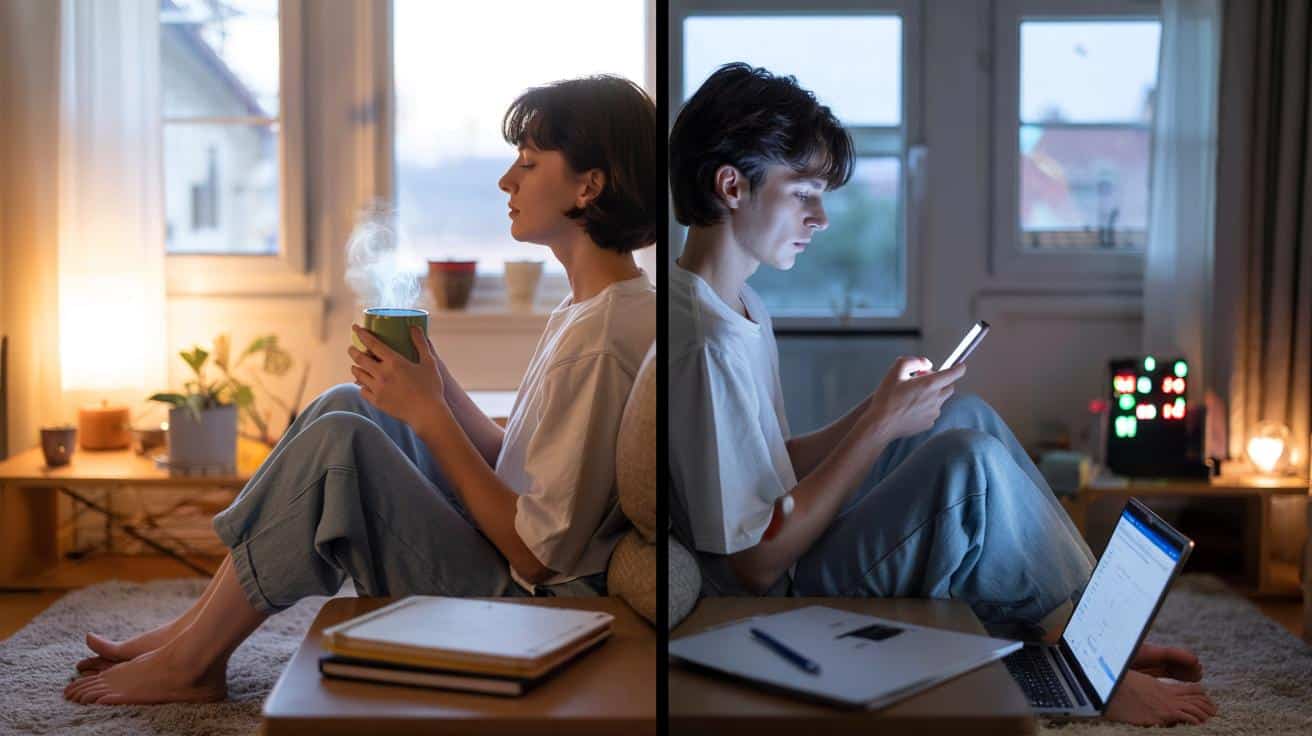
Laptop shut, notifications muted, soft light on in the kitchen. You stand there scrolling, one hand on a mug that’s gone cold, telling yourself you’re “switching off”. Your brain feels fried, but instead of resting, you fall into a bottomless feed of videos and half-read messages. An hour passes. Your shoulders are tighter, not looser. Your mind feels heavy, yet still strangely restless.
Was that rest? Or were you just hiding from your own thoughts?
The line between the two is thin, almost invisible in the noise of modern life.
Most of us cross it several times a day without noticing.
The question is quietly uncomfortable.
The fine line between pausing and running away
Mental rest is like putting your mind on a gentle pause.
Mental avoidance is more like yanking the plug out of the wall.
On the surface, the two can look identical: you on the sofa, phone in hand, brain “offline”.
Inside, though, the experience is completely different.
When you rest, your thoughts soften.
You feel a bit more spacious, a bit more present in your own body.
You might still be tired, but there’s a subtle sense of oxygen returning.
When you avoid, everything just gets pushed behind a mental door.
You feel numb, then guilty, then strangely anxious about opening that door again.
Psychologists sometimes describe mental rest as a “recovery state”.
Your nervous system downshifts, your attention loosens, your sense of threat drops.
With avoidance, your brain is still on high alert, just pointed in a different direction.
The stress isn’t processed, it’s parked.
That’s why you can spend three hours “relaxing” and stand up feeling wired, foggy and oddly on edge.
We’ve all had that moment after a long day where the thought of facing emails, finances or a difficult conversation feels like too much.
You reach for a quick escape: streaming, scrolling, or zoning out in a game.
The first ten minutes feel like relief.
Your brain gets a hit of novelty and distraction.
But two hours later, nothing in your wider life has moved an inch, and you’re even more drained than before.
There’s data behind this feeling.
Studies on passive screen time link long, unintentional sessions with higher levels of anxiety and lower mood.
Not because screens are “evil”, but because they so easily slide from rest into avoidance.
Especially when we’re exhausted, hungry, or emotionally overloaded, the temptation is huge.
It’s not laziness.
It’s self-protection that’s slightly mis-aimed.
The tricky part is that avoidance often dresses up as “self-care”.
“ I need this,” we tell ourselves, pressing play on the next episode while a deadline lurks in the back of our mind.
Over time, this pattern trains the brain to see certain tasks, conversations or feelings as dangerous territory.
So the relief you feel in the moment quietly feeds a larger loop of dread and postponement.
Mental rest heals the system.
Mental avoidance freezes it.
How to tell which one you’re actually doing
A simple test: how do you feel just after the break?
If it was genuine rest, you’ll usually notice a tiny bit more clarity.
Not a miracle transformation, just a slight “oh, ok, I can face this again” feeling.
Your breathing is slower.
Your shoulders aren’t as close to your ears.
You can name what needs to be done, even if you still don’t love it.
If it was avoidance, the return feels panicky or heavy.
You snap back to reality with a jolt.
The emails seem bigger, the problem at home more impossible, the conversation more terrifying.
You might think, “I’ll take five more minutes,” though you already know it’ll be 45.
That little voice that whispers “you’re running away” gets louder, and shame quietly joins the party.
➡️ Why gardeners hang cork stoppers on lemon branches
➡️ 6 sentences you usually only hear from genuinely authentic people
➡️ How changing when you check messages improves focus without missing anything important
➡️ You don’t realise it, but these 5 habits secretly make you seem unlikeable
➡️ “I make this creamy oven dinner when I want consistency more than excitement”
➡️ How to Eliminate Moss from Your Lawn Naturally and Effectively?
A practical way to spot the difference is to ask one blunt question before you “switch off”:
*Am I moving towards my life, or away from it?*
Rest tends to support your future self, even in tiny ways.
It puts petrol back in the tank.
Avoidance steals from your future self.
It offers comfort now in exchange for more pressure, more unfinished business, more 3 a.m. worry later.
Turning breaks into real mental rest
One small shift can change everything: decide the break before the break.
Pick a start, an end, and a purpose.
“I’m going to lie on the bed for 15 minutes, no phone, just breathing.”
Or, “I’m going to watch one episode, then set an alarm to stand up and stretch.”
Clarity turns a vague escape into an intentional pause.
Build micro-rituals around your rest.
Five slow breaths before you open your book.
A glass of water before you scroll.
Looking out of the window, noticing the sky, before pressing play.
These little anchors signal to your brain: this is recovery time, not disappearance time.
They help you stay slightly more awake to your own needs, instead of drifting into autopilot.
Soyons honnêtes : personne ne fait vraiment ça tous les jours.
You’ll forget, you’ll get sucked into rabbit holes, you’ll have evenings where “rest” is just crisps and doomscrolling.
That doesn’t make you weak.
It just means your brain is human, shaped by stress and algorithms and habit.
What matters is noticing the pattern one minute sooner than yesterday.
“Rest is not the absence of effort, it’s the presence of care.”
Care for your mind doesn’t always look pretty.
Sometimes it’s going to bed at 10pm instead of “catching up” on everything.
Sometimes it’s writing down three worries on a notepad, then deliberately watching silly videos as a conscious, time-bound breather.
Sometimes it’s texting, “Can we talk tomorrow? I’m too fried to be kind tonight.”
- Choose one daily “true rest” moment: 10–20 minutes, no multitasking.
- Keep one tiny task visible (like a post-it) so you return from breaks with direction.
- Notice your body, not your screen, as the main signal of whether you’re rested.
Living with both: rest, avoidance and the messy middle
There’s a quiet relief in admitting that some avoidance is inevitable.
We all dodge hard feelings now and then.
What changes everything is moving from unconscious avoidance to conscious choice.
“I can’t face this tonight, and that’s okay, but tomorrow I’ll do one small step.”
That kind of honesty takes the sting out of self-criticism.
The more you practise genuine mental rest, the less terrifying reality tends to feel.
Your brain learns that pausing isn’t the same as abandoning yourself.
Hard tasks remain hard, but they stop expanding into monsters.
You start to trust that you can step away and come back, without losing courage or momentum entirely.
That trust is a quiet form of power.
The subtle difference between rest and avoidance isn’t just about productivity.
It’s about how you relate to your own life.
Do you meet it with small, shaky doses of presence, or mostly from behind a curtain of distraction?
There’s no perfect score here.
Just a daily choice to lean a little more towards recovery and a little less towards escape, moment by moment.
| Point clé | Détail | Intérêt pour le lecteur |
|---|---|---|
| Repérer la sensation après la pause | Léger regain de clarté = repos, montée d’angoisse = évitement | Aide à ajuster ses habitudes de “déconnexion” au quotidien |
| Décider la pause à l’avance | Fixer durée, format et intention du break | Transforme les échappatoires floues en vrais temps de récupération |
| Prendre soin du futur soi | Restes qui soutiennent plutôt que repoussent les problèmes | Moins de culpabilité, moins de surcharge mentale en fin de journée |
FAQ :
- How do I know if I’m resting or just avoiding my problems?You can usually tell by how you feel right after the break. If you feel a bit clearer and more grounded, that’s rest. If you feel more anxious, guilty or rushed, you were probably avoiding.
- Is it always bad to avoid things mentally?Short-term avoidance can be a coping tool when you’re overwhelmed. It becomes harmful when it’s your default response and stops you from dealing with what matters over days, weeks or months.
- What are some examples of real mental rest?Short walks without headphones, gentle stretching, lying down with eyes closed, reading for pleasure, journalling, quiet hobbies, or simply sitting with a hot drink and no screens for ten minutes.
- Can scrolling social media ever count as rest?Yes, if it’s intentional, time-limited and doesn’t leave you feeling worse. Set a timer, choose what you want from it (laughs, inspiration, connection) and stop when that’s done.
- What if I’m too exhausted to do “healthy” rest?Lower the bar. Two minutes of slow breathing, a shower in silence, or lying on the floor with your eyes closed all count. Tiny pockets of real rest are more powerful than long stretches of half-hearted distraction.