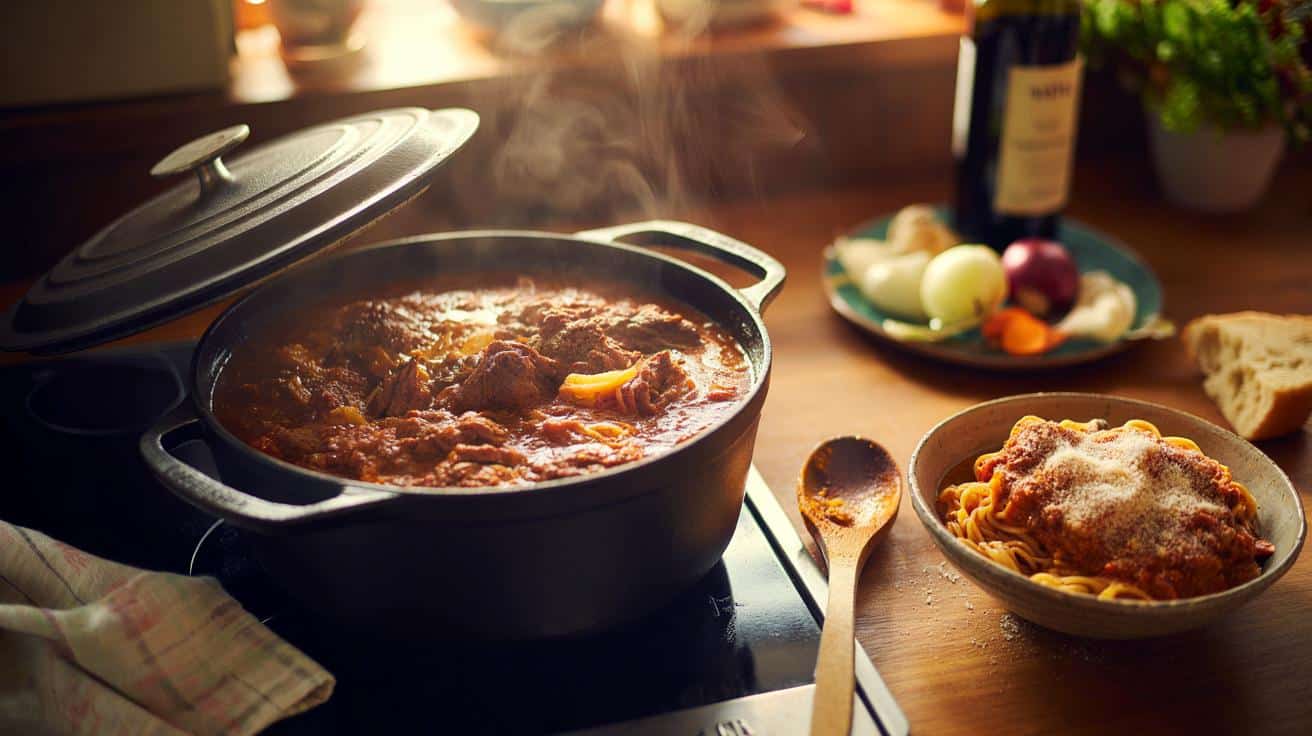
The first thing you notice is the sound. Not the ping of a microwave or the impatient hiss of water boiling too fast, but a quiet, steady bubble from a heavy pot you almost forgot you owned. The kitchen light is softer than usual. There’s a wooden spoon resting on the counter, smudged with a glossy, brick-red sauce.
You lift the lid and a wave of warmth hits your face – tomato, wine, garlic, something deeper you can’t quite name. The clock says it’s late. Your phone says there are fifty other things you should be doing. Yet you just stand there, breathing in dinner.
Some meals fill you up.
This one seems to slow everything down.
The secret life of a slow-simmered pot
There’s a particular kind of silence that falls over a home when something has been simmering on the stove for hours. The TV can be on, kids can be arguing over a charger, emails can be piling up, and still the center of gravity quietly shifts toward that one pot.
You walk past it every ten minutes, pretending not to care. Then you find any excuse to lift the lid “just to check.” The sauce clings thicker to the spoon. The aroma gets darker, rounder, a little smoky. You start planning which bowl you’ll use, whether you’ll grate more cheese than usual, if you can justify a second piece of bread.
By the time dinner is ready, the whole room smells like anticipation.
Picture this: a simple beef and tomato ragù on a Tuesday night. At first, it’s almost boring. Red sauce, browned meat, onion, a splash of wine, the usual suspects. You could eat it after 25 minutes and call it a day.
But you don’t. You turn the heat down until it just barely trembles. You leave the lid askew. You let it go for two, three, even four hours. Every time you stir, the chunks get smaller, the fat glistens, and the sharp edge of the tomato disappears into something deeper.
When you finally sit down to eat, the fork sinks through the meat like it’s forgotten it was ever tough. The sauce tastes not just of tomatoes and beef, but of time itself.
➡️ How reducing mental noise can improve overall well-being
➡️ What really happens to your metabolism after 35 and how to slow the change naturally
That’s the quiet magic of slow-simmered dinners. They don’t just cook the ingredients, they transform the relationships between them. Muscle fibers break down and melt into the sauce. Acids soften. Harsh flavors round out and start talking to each other.
What was once a pile of separate things in a pot becomes one coherent flavor that you can’t easily pick apart. You don’t think “onion, carrot, thyme.” You just think “this.”
And with every extra half-hour on low heat, that “this” gets richer, more layered, more complete.
How to coax depth out of a simple pot
If there’s one gesture that changes everything, it’s this: give your food time at a low, steady heat after you’ve done the fast work. Start strong and noisy – sear, sizzle, brown, deglaze – then let the whole thing drop into a quiet murmur.
Take a basic stew or sauce. Brown the meat more than you think you should. Let the bits stick a little, then dissolve them with broth or wine, scraping every last caramelized speck off the bottom. Add your liquids, bring it to a brief boil, then immediately drop it down until just a few lazy bubbles break the surface.
From that moment on, your main job is restraint.
Most of us rush this part, and it’s not because we don’t love flavor. We’re tired. We’re hungry. The day’s been long and the to-do list is staring at us from across the room. You glance at the pot and think, “This is probably fine already.”
And yes, it’s fine. It’s dinner. But something happens if you treat that pot like a slow investment instead of a quick transaction. You walk away. Fold laundry, answer a message, scroll a bit, come back to stir. Then walk away again. Simmering asks for trust, not constant interference.
Let’s be honest: nobody really does this every single day.
That’s why, when you do, the result feels like a small luxury.
Sometimes the richest flavor has nothing to do with what you add, and everything to do with what you’re willing to wait for.
Think of slow-simmered dinners less as “recipes” and more as gentle rituals. A short checklist helps:
- Start with a hard, deep brown on your meat or vegetables.
- Deglaze the pan to rescue every browned bit into the sauce.
- Keep the heat low enough that the surface barely trembles.
- Stir occasionally, not obsessively, so nothing sticks.
- Give it at least an hour longer than you think you can.
*The ingredients don’t really change after the first twenty minutes – your patience does.*
A meal that keeps deepening as you eat
There’s something almost surprising about the first bite of a slow-simmered meal. It’s familiar, but a little more intense than you expected. The second bite is better. By the third, you’re slowing down, not because you’re full, but because you’re trying to catch all the layers at once.
The richness doesn’t hit you like a punch; it kind of sneaks up. Maybe the sweetness from the long-cooked onions starts to show. Maybe there’s a faint whisper of spice that wasn’t there in the first spoonful. Every pass of the fork seems to reveal a new detail that had been quietly building in the background for hours.
This is where the emotional frame shifts. You’re not just eating to silence hunger or clear out the fridge. You’re tasting the result of every small, unglamorous choice you made earlier in the day: turning the heat down instead of cranking it up, not skipping the browning step, letting the sauce thicken instead of diluting it.
Some bites carry more sauce, others more tender meat, others just a piece of bread dragged across the bottom of the bowl. Each one feels like a slightly different version of the same story. The meal literally changes as it cools, as the flavors settle, as the liquid keeps reducing right there on your plate.
You start to understand why some families guard their slow-cooked recipes like heirlooms.
There’s no neat moral here, no productivity hack hidden behind the steam. Just a small, stubborn truth: a pot that simmers slowly on your stove has a way of slowing you down with it.
You might eat it alone at the counter with a podcast in your ears. You might share it with friends who show up late, hungry, and a little worn out. Either way, the meal is doing something generous in the background. It’s taking cheap cuts, basic pantry staples, the scraps of your attention, and turning them into something that feels oddly generous.
Maybe that’s why, when the last spoonful is gone, the room feels a tiny bit quieter than before.
| Key point | Detail | Value for the reader |
|---|---|---|
| Start hot, finish low | Brown hard at the beginning, then simmer gently for 1–4 hours | Deeper flavor and tenderness without complicated techniques |
| Trust time | Let the pot sit on low heat with only occasional stirring | Richer, more unified taste and less stress in the kitchen |
| Simple ingredients, big payoff | Basic items like onions, tomato, and cheap cuts transform slowly | Comfort-restaurant vibes at home on a regular budget |
FAQ:
- Question 1How long should a slow-simmered sauce or stew cook to really deepen in flavor?At least 60–90 minutes on low is a good baseline, and many dishes become outstanding around the 2–3 hour mark.
- Question 2Can I walk away from the stove while something is simmering slowly?Yes, as long as the heat is truly low, the lid is partly on, and you come back every 20–30 minutes to stir and check the liquid level.
- Question 3What kind of pot is best for long, slow simmering?A heavy-bottomed pot, like cast iron or a thick stainless-steel Dutch oven, helps keep the heat gentle and even so nothing burns.
- Question 4Do I always need wine or fancy stock to get a rich result?No, long-cooked onions, tomatoes, and bones or cheap cuts can create deep flavor even with simple water and salt.
- Question 5Can I get the same effect in a slow cooker or Instant Pot?You can get close: slow cooker “low” settings mimic gentle simmering, and pressure cookers speed up tenderness, though the flavor will feel slightly different from an open pot on the stove.