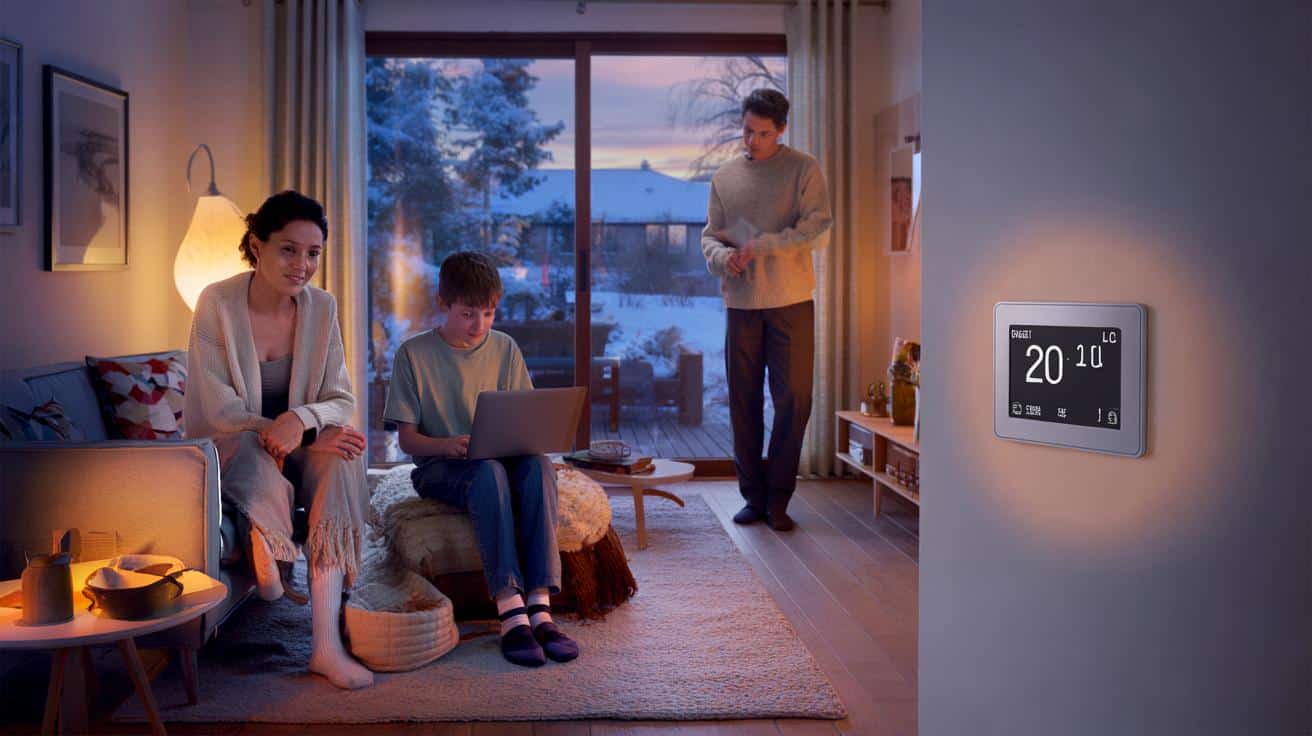
The thermostat on the hallway wall glows a stubborn 19 °C. Outside, the wind slaps against the windows, and inside, Sophie pulls her cardigan tighter for the third time in an hour. Her teenage son walks past in a T‑shirt and socks, complaining that the house feels like a fridge. Her partner shrugs: “They said 19 degrees is the rule, it saves money.” The scene could be anyone’s living room this winter.
Yet something feels off. The family is uncomfortable, the heating is on, and the energy bill is still climbing.
So what if the famous 19 °C rule we’ve been repeating for years no longer reflects the way we live, work and heat our homes today?
The new “ideal” temperature: not 19 °C, but a smarter comfort range
Across Europe, energy agencies long pushed 19 °C as the magic number. One value to stick on posters, on bills, in public campaigns. It was clear, simple, strict. Except, homes are not laboratories and people are not thermostats.
Today, researchers and building specialists are quietly saying something different: **comfort lives in a range, not in a rigid rule**. For most modern homes, the sweet spot now sits closer to 20–21 °C for living areas, with slightly cooler bedrooms. The nuance matters.
Because the real key is not one number. It’s the balance between air temperature, humidity, insulation quality, and how our bodies actually feel heat.
Look at what changed in just ten years. More people now work from home, spending entire days indoors, sitting still in front of screens. Kids follow online classes in bedrooms that were never meant to be daytime offices. Elderly parents move in, with different needs and circulation problems that make them feel cold sooner.
In a recent European survey, households reported their “comfortable” living room temperature at around 20.5 °C on average. That’s already above the old 19 °C mantra. At the same time, energy use exploded in badly insulated homes trying to respect the rule but cranking radiators for longer hours.
The mismatch between the official line and daily life has become obvious, one energy bill at a time.
Experts in thermal comfort talk about “operative temperature” rather than just what the thermostat shows. That includes the temperature of walls, windows, floors and even the furniture around you. If your walls are cold and poorly insulated, 19 °C on the thermostat can feel like 17 °C on your skin.
So the new message from specialists is more nuanced: aim roughly for 20 °C in living spaces, 21 °C if you’re sensitive or sedentary, around 18–19 °C in bedrooms. Adjust one degree up or down based on insulation and who lives there. *The real rule is: listen to your body, not your guilt.*
And for energy savings, the crucial factor is not clinging to 19 °C, but reducing unnecessary peaks and long hours of overheating.
How to heat smarter: small moves that change everything
Start with a simple daily ritual: zoning your home. Instead of one uniform 21 °C everywhere, choose “active” and “calm” areas. Keep your living room and home office close to your comfort point, say 20–21 °C during the day. Let hallways, toilets and rarely used rooms drop to 17–18 °C.
At night, drop bedroom temperatures by 1–2 degrees and close doors to trap the heat where you actually sleep. This zoning approach uses the same boiler or heat pump, but tells it a different story.
It’s like setting priorities: your comfort is focused where you truly live, not wasted in empty corners of the house.
Many households still fall into the same trap: they switch the heating off completely during the day, then blast it in the evening to “catch up”. The walls cool down, the system runs at full power, the bill climbs, and everyone feels cold for the first hours.
Energy specialists now repeat the opposite: keep a stable, slightly lower base temperature, then add gentle boosts when you’re home. Let’s be honest: nobody really does this every single day. Life is messy, schedules change, kids forget to close doors.
So aim for a simple rule of thumb instead: avoid big swings. One or two degrees of difference is enough, not five.
Heating engineer Alain Robert sums it up this way: “The 19 °C rule was a good slogan in the 80s. Today, with better windows, mixed schedules and aging occupants, the real target is a flexible band around 20 °C. You save more by controlling how often and where you heat than by obsessing over a single number.”
- Living room / office – Around 20–21 °C when occupied, a bit lower when empty
- Bedrooms – About 18–19 °C for sleep quality and savings
- Bathroom – Short peak at 22–23 °C for shower time, lower the rest of the day
- Hallways / storage – 16–18 °C, just enough to avoid a cold shock
- General rule – Cut 1 °C and add a layer of clothing before changing the boiler settings
A new relationship with heat: from rule to personal “climate”
The fall of the 19 °C rule says something bigger about our homes. For years, public messages treated us like identical bodies in identical apartments. Turn the dial to 19 °C, be good citizens, don’t ask questions. That age is ending.
Now, the question is more intimate: what is your own comfort climate? A young adult in a shared flat, a remote worker in a small studio, a retired couple in a draughty house from the 70s will not live at the same temperature.
We’re slowly learning to talk about heating like we talk about food or sleep: something personal, where your habits matter as much as the theory.
That doesn’t mean wasting energy or heating at 24 °C all winter with the windows open. It means finding a realistic compromise between comfort, health and bills, instead of reciting an outdated slogan. The plain truth is that a well‑insulated home at 20 °C can use less energy than a poorly insulated home stubbornly kept at 19 °C.
So the next time someone throws the “official” temperature at you, you can answer with something more grounded. Your own numbers, your own rhythm, measured in degrees and in real life.
The rule was simple. Real comfort is a bit more complex, and much more human.
| Key point | Detail | Value for the reader |
|---|---|---|
| 19 °C is no longer a universal rule | Experts now talk about a comfort range around 20–21 °C for living areas, adjusted to each home | Gives freedom to adapt heating without feeling guilty |
| Zoning and stability save more than strict numbers | Prioritising key rooms and avoiding big temperature swings reduces waste | Concrete way to cut bills while staying comfortable |
| Each household needs its own “climate” | Age, insulation, activity level and health all change the ideal temperature | Helps set realistic, personalised heating habits |
FAQ:
- What is the new ideal temperature for a living room?Most specialists now recommend around 20–21 °C for living rooms and home offices, with small adjustments based on insulation and how sedentary you are.
- Does raising the thermostat from 19 °C to 20 °C explode the bill?One extra degree does raise consumption, but the total impact depends on insulation and heating time; better control and zoning can offset that increase.
- Is 19 °C dangerous or unhealthy?For many healthy adults, 19 °C is tolerable, but seniors, babies and people with certain conditions may need 20–21 °C to avoid discomfort or respiratory issues.
- What about bedrooms: should they also be at 20–21 °C?Sleep specialists usually advise slightly cooler rooms, around 18–19 °C, with warm bedding and pyjamas rather than high air temperature.
- How can I reduce my bill without feeling cold?Focus on sealing draughts, closing shutters at night, zoning rooms, using programmable thermostats and lowering by just 1 °C while adding a clothing layer.
➡️ What it reveals psychologically when you feel uncomfortable receiving compliments
➡️ How mental balance improves when expectations are simplified
➡️ I realized my home needed fewer rules, not more cleaning
➡️ This dinner comes together naturally, without overthinking
➡️ This small change in your cooking routine can make meals feel lighter and easier to digest
➡️ Goodbye microwave: here’s the appliance that will replace it, and it’s much better