For more than two decades, the nuclear carrier Charles de Gaulle has symbolised French power at sea. Now Paris is preparing a generational leap: retiring its flagship in the 2030s and betting big on a next‑generation carrier that aims to be the most advanced in Europe.
A lone nuclear giant nearing the end of its watch
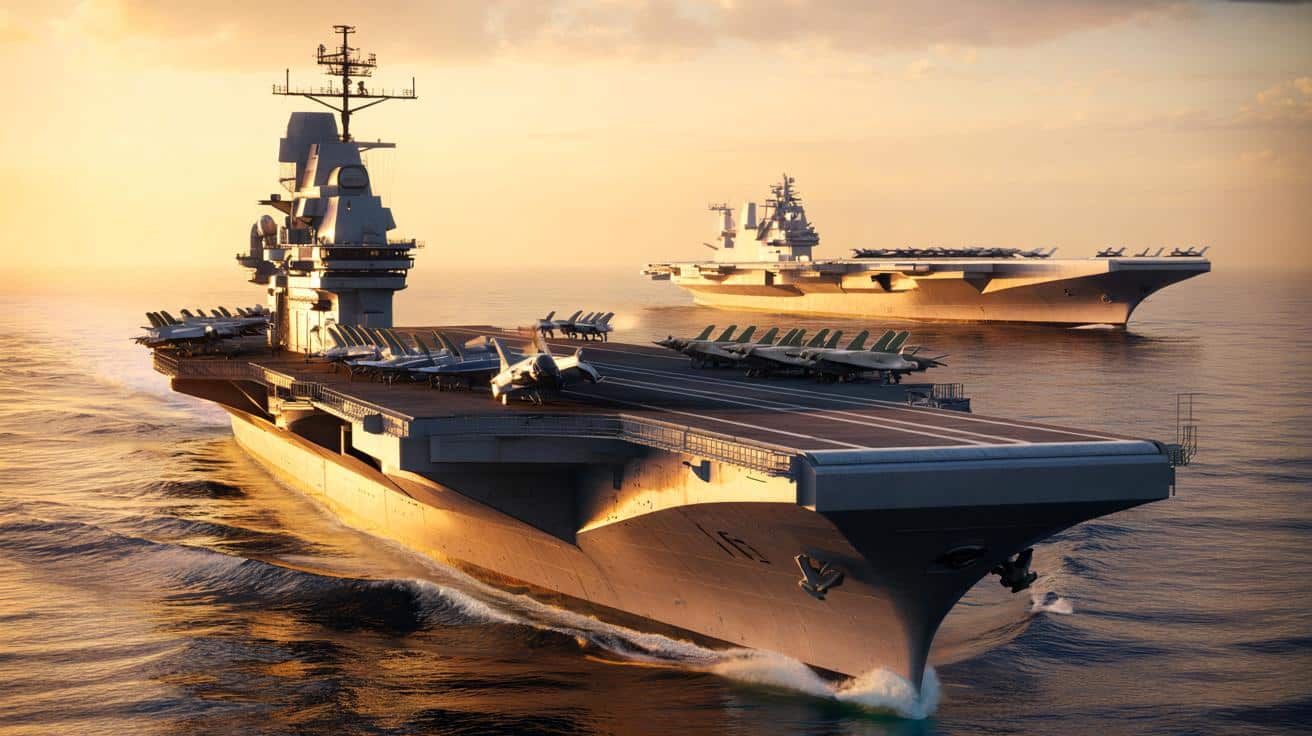
The Charles de Gaulle, hull number R91, is an oddity in global naval power. Outside the United States, no other navy has ever fielded a nuclear-powered aircraft carrier. Launched in the late 1990s and commissioned in 2001, the ship turned France into the only European country able to project fast jets from a nuclear platform.
From the Mediterranean to the Indo‑Pacific and the Red Sea, the carrier has joined NATO task forces, escorted US strike groups and flown combat missions over Iraq, Syria and the Sahel. Its two K15 nuclear reactors give it years of endurance at sea, limited mainly by food, spare parts and the stamina of its 1,900‑strong crew.
The Charles de Gaulle is the only nuclear aircraft carrier ever built outside the United States, and it has anchored French strategy for over 20 years.
Yet the design dates back to the Cold War’s final decade. Hangars and elevators were never optimised for modern drones. The flight deck layout reflects older doctrines. And its top speed of roughly 27 knots lags behind US supercarriers, making some joint operations less flexible.
A powerful but ageing combat platform
The French Navy still treats the ship as a crown jewel. During the “Clemenceau 25” deployment, the carrier group sailed as far as the South China Sea without needing foreign bases, showing Paris can act at distance on its own terms.
This autonomy rests on a CATOBAR system – catapult assisted take‑off but arrested recovery – using steam catapults. These devices hurl Rafale M fighters into the air loaded with fuel and munitions, and launch E‑2C Hawkeye radar aircraft that provide airborne early warning.
Compared with ski‑jump carriers, like those operated by the UK or China, the French system allows heavier loads and a broader mix of aircraft. That translates into longer reach and more flexible strike options.
Yet every major deployment now comes with a cost. Maintenance windows grow longer. Upgrades are harder to bolt onto a nuclear hull designed in the 1980s. New generations of combat drones struggle to fit within the existing infrastructure.
The Charles de Gaulle still packs a serious punch, but its architecture is bumping up against the limits of what can be modernised.
➡️ This Ancient Deadly Disease Is Growing More Resistant To Antibiotics, And Experts Are Worried
➡️ Neuroscience reveals the personality trait that can absorb criticism
➡️ 8 phrases deeply selfish people often say without realising it
➡️ People who stay happy and fulfilled after 60 have usually given up these 9 habits
➡️ Ways to organize your closet so that getting dressed in the morning feels effortless and saves time
Charles de Gaulle at a glance
| Full-load displacement | Approx. 42,500 tonnes |
| Length | 261.5 m |
| Propulsion | 2 K15 nuclear reactors |
| Top speed | 27 knots (~50 km/h) |
| Air wing | About 30–40 aircraft (Rafale M, E‑2C, helicopters) |
| Crew | Roughly 1,950 personnel |
| Service entry | 2001 |
| Planned withdrawal | Around 2038, with PANG taking over |
PANG: the project aiming to be Europe’s most advanced carrier
To replace this ageing flagship, France has launched a hugely ambitious programme: the Porte‑Avions de Nouvelle Génération (PANG), or new‑generation aircraft carrier. The first ship is due to take over around 2038, giving a long overlap for testing and trials.
Where the Charles de Gaulle displaces a modest 42,500 tonnes, PANG is planned at around 75,000 tonnes. That pushes it into the same weight class as some US carriers, although with a smaller air wing and crew.
PANG is designed as a nuclear‑powered, EMALS‑equipped carrier that can launch heavy jets and swarms of drones – a step change for European naval aviation.
From steam to electromagnetics
One of the most striking shifts is the move from steam catapults to EMALS (Electromagnetic Aircraft Launch System), supplied by US firm General Atomics. France has already ordered three EMALS catapults.
Electromagnetic launchers accelerate aircraft using powerful electric motors instead of pressurised steam. This allows smoother acceleration, reducing stress on airframes and making launches more efficient for lighter drones and heavier aircraft alike.
- Heavier take‑off weights for future fighter jets
- More delicate launch profiles for unmanned systems
- Less mechanical wear than ageing steam catapults
The deck and hangar layouts are being drawn up with combat drones in mind from day one. Unmanned aircraft are expected to conduct reconnaissance, electronic warfare and, eventually, strike missions alongside Rafale M and its future successor.
A nuclear heart with a digital brain
Like its predecessor, PANG will rely on nuclear propulsion. That choice allows sustained high speed, long deployments and fewer visits to foreign ports. For a middle power like France, that kind of persistent presence is a political tool as much as a military asset.
The more radical change lies inside the combat systems. PANG is planned as a kind of floating data centre, with integrated artificial intelligence to help manage sensors, weapons and drone operations across the carrier strike group.
On PANG, artificial intelligence is expected to help fuse data from ships, aircraft and satellites, giving commanders a faster, clearer view of the battlespace.
AI‑driven decision-support tools could, for instance, suggest flight deck cycles, recommend optimal patrol patterns for drones, or flag unusual movements in crowded sea lanes. Human officers would still make the calls, but with more processed information at their fingertips.
A single carrier, a strategic dilemma
France’s ambition comes with a structural problem: the navy has only one carrier. When the Charles de Gaulle heads into lengthy refits, French fixed‑wing naval aviation at sea simply stops.
PANG will not fix that on its own. If there is only one new carrier, the country faces the same gaps in availability. The armed forces argue for a second PANG, pointing out that major navies – the UK, China, India, the US – all aim for at least two carriers to ensure one is at sea while another is in maintenance.
Politicians see the price tag. Early estimates put a single PANG at over €8 billion, before factoring in the air wing, escorts and decades of upkeep. In a tight defence budget, those sums compete with aircraft, submarines, drones and cyber capabilities.
For Paris, the choice is stark: either fund a second carrier and secure permanent availability, or accept regular gaps in high‑end naval air power.
Why carriers still matter for France
Despite missile proliferation and debates about vulnerability, aircraft carriers still offer something few other assets can: visible, mobile and scalable power. A strike group can loiter beyond territorial waters, signal resolve, reassure allies and, if needed, launch air operations without overflight permissions.
For a country with global territories – from the Caribbean to the Indian and Pacific Oceans – that flexibility matters. A carrier cruising near New Caledonia or Réunion sends a very different message than a statement in Paris or a diplomatic note in Brussels.
Key terms worth unpacking
Several concepts sit at the heart of this shift from Charles de Gaulle to PANG:
- CATOBAR: a carrier able to launch aircraft with catapults and recover them with arresting wires, enabling heavier payloads than ski‑jump ships.
- EMALS: an electromagnetic launch system that replaces steam, offering more precise and flexible acceleration.
- Nuclear propulsion: reactors drive the ship for years without refuelling, but refits are complex and politically sensitive.
- Carrier strike group: the escorts – destroyers, frigates, submarines and support ships – that protect and supply the carrier.
What PANG could change in a crisis
Imagine a regional crisis in the Indo‑Pacific in the 2040s. A French task group centred on PANG could sail from Toulon, cross the Suez Canal and reach the area with minimal port calls. Nuclear propulsion keeps the ship moving fast, while supply vessels focus on fuel and food for the escorts.
Once on station, EMALS catapults would fling a mix of crewed fighters and drones skyward. Manned Rafales, or their replacement, might conduct deterrent patrols, while unmanned systems scan vast stretches of ocean and coastline. An AI‑supported command centre on board would sift through radar, sonar, satellite and electronic signals to track hostile units and civilian traffic alike.
In that kind of scenario, the difference between a 1980s‑designed carrier and a purpose‑built digital platform is not academic. It shapes how fast France can react, how many missions the air wing can fly each day, and how safely crews can operate under pressure.
As the Charles de Gaulle moves toward retirement and shipyards prepare to cut steel for PANG, France is betting that a single, cutting‑edge carrier can keep it in the top tier of naval powers – at least as long as politicians are willing to foot the bill for the nuclear monster that follows.