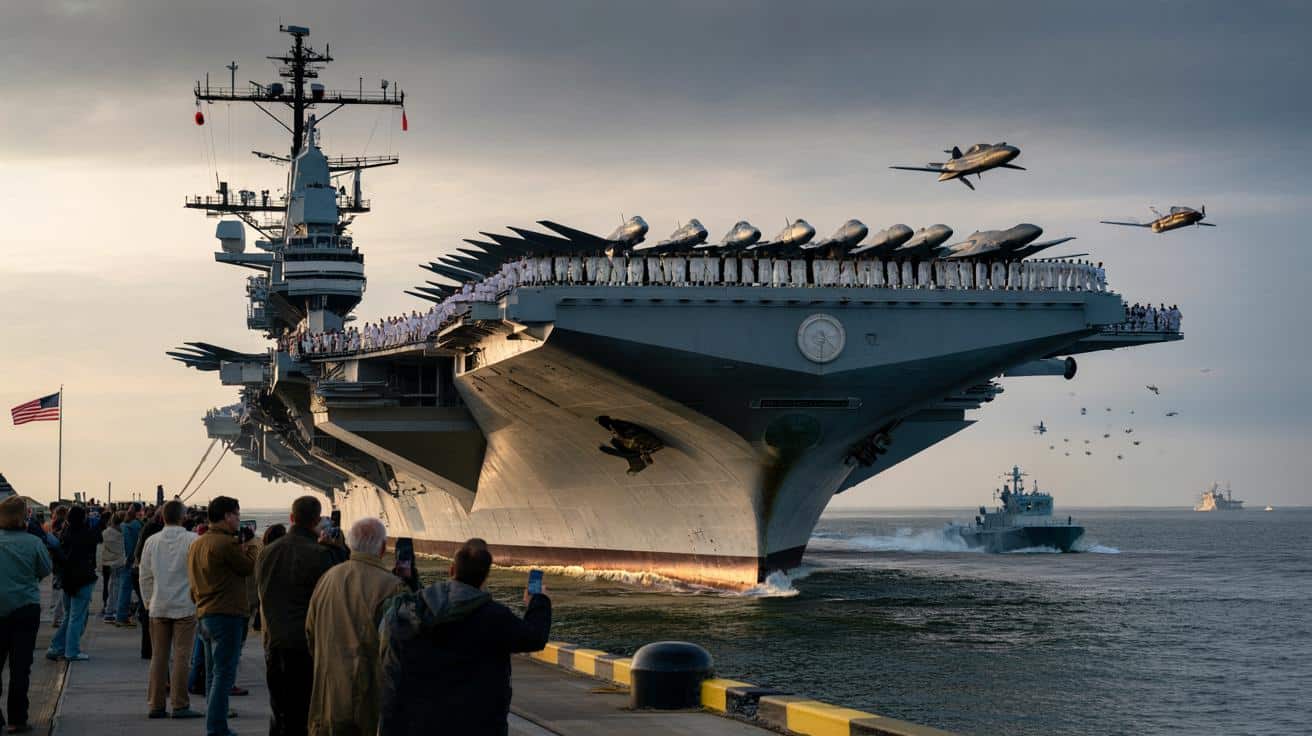
On a gray Atlantic morning, the USS Harry S. Truman slid back into Norfolk like a floating city returning from another planet. Families pressed against the pier rails, phones high, waiting for that first blurry glimpse of sailors lined up in dress whites along the deck. The ship’s brass band tried to sound festive. It didn’t quite cover the low rumble of turbines and the sharp smell of fuel and sea air.
On the surface, it was a familiar American ritual: hugs, flags, homemade signs, promised barbecues. Underneath, the mood felt strange, almost split-screen. This heavyweight of steel and jet noise is coming home at the same time the Navy is quietly saying the future belongs to drones, lasers, and invisible networks.
The Truman’s wake looked like a question mark trailing across the water.
The old giants return just as the rules of war are changing
Watch the Truman up close and you understand why aircraft carriers still dominate the imagination. The hull towers over the dock like a concrete apartment block tipped on its side. Jets squat on the deck, their folded wings giving them the wary posture of sleeping predators. Everything creaks, whines, hums with barely controlled power.
Sailors move along the catwalks in practiced choreography, tightening lines, calling out to friends on the pier. For them, this isn’t geopolitics. It’s rent payments, missed birthdays, a long deployment finally over. The rest of the world sees something else entirely: the returning symbol of American reach, arriving at a time when those symbols are starting to look vulnerable.
Talk to anyone on the waterfront and you hear the same tension between pride and worry. One petty officer, home from his second deployment on Truman, shows off pictures of jet launches at sunset. Then he scrolls to a grainy clip on his phone: a Ukrainian drone slamming into a Russian ship hundreds of miles away. Different ocean, same lesson.
Iranian-made drones harassing U.S. ships in the Red Sea. Chinese anti-ship missiles designed to hit carriers from over the horizon. Cheap quadcopters dropping grenades on armored vehicles in Ukraine. The Truman is a $4.5 billion behemoth crewed by thousands. A lot of the new hardware that threatens ships like her costs less than a high-end SUV and can be flown by someone who grew up on Xbox.
That’s the unease hanging over this homecoming. The Navy is pouring money into hypersonic weapons, autonomous vessels, and AI-driven command systems, while still relying on a fleet architecture born in World War II and polished during the Cold War. The aircraft carrier remains the centerpiece, the floating embassy, the mobile airbase politicians love to point to.
Yet planners in the Pentagon war-game future battles where carriers stay far back, hiding outside missile range. They now imagine crowded seas full of cheap unmanned craft, where the first strike might not come from a jet screaming off a deck, but from a silent swarm guided by algorithms. The Truman comes home, and everyone cheers, but the strategic whisper in the background is clear: this might be the twilight of an era.
How the Navy is quietly trying to future‑proof a 100,000-ton relic
Walk below decks on the Truman and the future is already creeping in around the pipes and paint. There are new console stations tucked between older analog gauges, extra antenna arrays bolted on like high-tech barnacles, experimental cables running where nobody planned for them twenty years ago. This is how the Navy modernizes: layer by layer, patch by patch, never fully stopping the machine.
➡️ How a single unclear expense category can throw off an entire monthly budget
➡️ Why people who replay past mistakes often have high self-awareness
➡️ How to Eliminate Moss from Your Lawn Naturally and Effectively?
➡️ What really happens to your metabolism after 35 and how to slow the change naturally
On the flight deck, you’ll sometimes see a small drone sitting awkwardly among the big F/A-18s, like a hatchling in the wrong nest. Flight crews test new data links that let aircraft share information instantly. Combat systems sailors train on software updates that arrive as often as smartphone patches. *The trick is keeping a Cold War giant agile enough to survive in a TikTok-speed battlefield.*
The honest conversation you hear in wardrooms and briefing rooms is that nobody feels fully ready for what’s coming. The Navy talks about “distributed maritime operations” and “kill webs” that link ships, aircraft, satellites, and cyber units into one nervous system. Sounds tidy in a PowerPoint. In real life, it means sailors juggling more sensors, more screens, and more decisions at once.
Let’s be honest: nobody really believes every system will work perfectly on day one of a real shooting war. There are worries about software glitches at sea, about cyberattacks on increasingly digital ships, about training sailors for jobs that didn’t even exist when the Truman was built. These are not failures of courage. They’re growing pains in a force trying to fight tomorrow’s war with today’s hardware and yesterday’s budgets.
One senior officer who has served on multiple carriers summed it up during a pier-side chat, watching the Truman’s crew disembark in waves of white uniforms and backpack straps:
“Carriers aren’t obsolete, they’re just no longer the only game in town. We still need the big decks to show up, to launch jets, to reassure allies. But we’re kidding ourselves if we think we can just do Gulf War 2.0 against a serious opponent with hypersonics and drones buzzing everywhere.”
He ticked off the Navy’s quiet priorities on his fingers, like a checklist for survival:
- Spread forces out across more, smaller ships so one hit doesn’t cripple a whole task force.
- Push more tasks to unmanned vessels and aircraft, especially in lethal “no-go” zones.
- Harden networks and power grids on every ship against cyber and electronic attacks.
- Train crews to fight “degraded,” assuming GPS, comms, or key sensors might drop out.
- Invest in defensive tech like lasers and railguns to swat down drones and missiles cheaply.
A symbol caught between nostalgia and the next war
The Truman’s return lands in the middle of a broader American anxiety. There’s the visible part: a carrier easing into port, jets overhead, a reassuring shot for nightly news. Then there’s the invisible layer: quiet briefings about Chinese naval growth, classified wargames where blue forces lose more often than they’d like, budget debates over whether to build the next supercarrier or more nimble ships and shore-based missiles.
For people who grew up with images of carriers as untouchable fortresses, this shift feels almost like a crack in the national story. The U.S. Navy is still the most powerful on Earth by a long stretch. Yet the Truman’s massive silhouette carries a hint of vulnerability now, **a reminder that dominance is a moving target**. The wars of the future won’t just be fought on open oceans with metal and fire. They’ll run through undersea cables, through hacked logistics systems, through satellite constellations blinking above the clouds.
| Key point | Detail | Value for the reader |
|---|---|---|
| Carriers face new threats | Drones, long-range missiles, and cyber tools can challenge even large ships like Truman | Helps you see why familiar symbols of power suddenly look less invincible |
| Navy is adapting on the fly | Layered upgrades, unmanned systems, and new tactics are being tested at sea | Shows how old platforms can still matter if they evolve instead of freeze in time |
| Future wars are hybrid | Sea battles will mix physical strikes with digital attacks and information warfare | Gives a clearer picture of what “the next war” might actually look and feel like |
FAQ:
- Is the USS Truman being retired soon?The Truman has many service years left and is undergoing periodic upgrades, though debates continue over how much to invest in older carriers as new technologies emerge.
- Are aircraft carriers becoming obsolete?Not exactly. They’re becoming more vulnerable in certain scenarios, so the Navy is changing how and where it uses them, while pairing them with new unmanned and land-based systems.
- What kinds of drones threaten large ships?Small explosive drones, long-range one-way attack drones, and sea-skimming unmanned boats can all be used in swarms to overwhelm traditional defenses.
- How is the Navy preparing for cyber warfare at sea?By hardening networks, segmenting critical systems, practicing “offline” operations, and training specialized cyber teams aboard major ships and ashore.
- Why do politicians still love carriers so much?Carriers are highly visible symbols of power and commitment. They show up on TV, reassure allies, and can be parked off a crisis zone in a way satellites or cyber tools simply can’t.