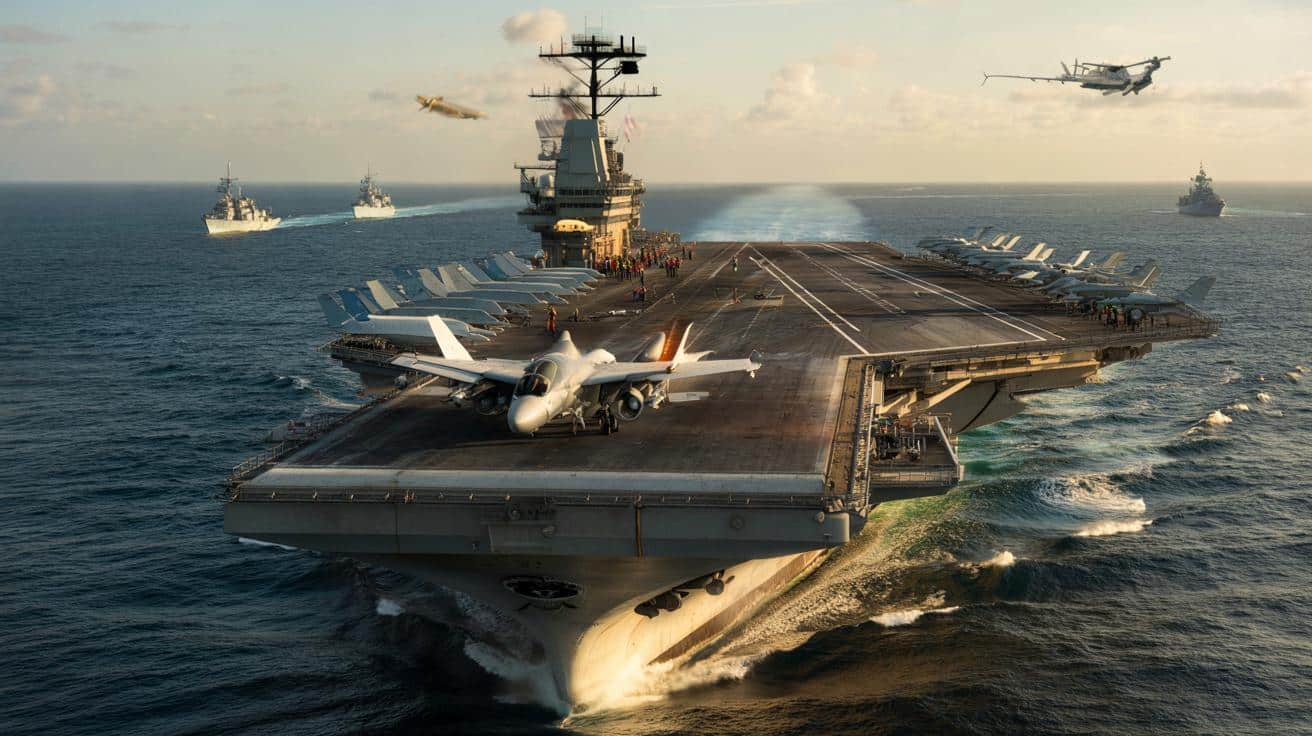
Far from any coastline, a warship longer than three football pitches can launch fighter jets, host thousands of people and quietly project influence across entire regions. That ship is not science fiction. It is very real, nuclear-powered, and today it stands as the largest aircraft carrier ever put to sea.
The aircraft carrier, a floating airbase
Long before this giant appeared, navies had already grasped a simple idea: whoever controls the skies above the sea usually wins. That is where aircraft carriers came in, as mobile airfields that can be positioned exactly where political or military leaders need them.
The basic concept dates back to the early 20th century. In 1910, a US pilot managed an experimental take-off from the cruiser USS Birmingham. That small leap marked the start of a long process: turning warships into platforms from which aircraft could take off and land safely, even in rough seas.
Modern aircraft carriers are far more than just launch pads for jets. They are self-contained towns. On board you find dormitories, kitchens, workshops, medical facilities, command centres, even gyms and chapels. Thousands of people live and work there for months, keeping flight operations going around the clock.
At sea, an aircraft carrier acts as a mobile piece of sovereign territory, bringing national air power to any ocean on the planet.
For governments, carriers serve several purposes at once: deterrence, rapid response, humanitarian support after disasters, and visible reassurance to allies. Size directly affects how many aircraft they can operate and how long they can stay on station without support.
The giant with a presidential name
The title of world’s largest aircraft carrier currently belongs to the United States Navy’s USS Gerald R. Ford, designated CVN-78. Built by Northrop Grumman, it is the lead ship of a new generation of American supercarriers designed to succeed the Nimitz-class vessels that served for decades.
The Ford was delivered to the US Navy in 2017 after more than ten years of construction and testing. It is named after Gerald Ford, the 38th president of the United States, who served from 1974 to 1977 and was himself a naval officer during the Second World War.
Stretching around 337 metres in length and weighing close to 100,000 tonnes, USS Gerald R. Ford is slightly longer than the Eiffel Tower is tall.
➡️ Radioactive hybrid boars are thriving in Fukushima. Now scientists finally know why
➡️ In The 80s everyone drank it, now it’s forgotten – and it quietly nourishes your gut
The raw figures are striking:
- Length: about 337 metres
- Beam (width at the waterline): around 78 metres
- Displacement: roughly 100,000 tonnes fully loaded
- Top speed: close to 30 knots, or around 55 km/h
- Crew and embarked personnel: up to about 4,500 people
At full complement, the ship carries more inhabitants than many small towns. They include sailors, aviators, engineers, cooks, medics, intelligence analysts and many other trades you might not associate with a warship.
A floating air wing: almost 90 aircraft on board
The true power of an aircraft carrier lies on its flight deck and in its hangars below. Here, the Ford-class design aims to handle more sorties per day than earlier US carriers, and to do so more efficiently.
The USS Gerald R. Ford can embark close to 90 aircraft in total. That mix can shift depending on the mission, but typically includes:
- Carrier-borne fighter jets and strike aircraft
- Airborne early-warning planes with radar dishes on top
- Anti-submarine and utility helicopters
- Logistics and cargo aircraft
- Increasingly, unmanned aerial vehicles (drones)
For comparison, France’s nuclear-powered carrier Charles de Gaulle usually sails with around 40 aircraft and a total complement of roughly 1,900 crew and air personnel. In pure size and carrying capacity, the American ship sits in another category.
With capacity for almost 90 aircraft, the ship can run a sustained air campaign without relying heavily on land bases.
That capability gives Washington a powerful diplomatic tool. A single carrier strike group, centred on the Ford, can be dispatched to a crisis zone, operating fighters, surveillance aircraft and helicopters day and night for weeks on end.
Inside a nuclear-powered city at sea
Life on board for thousands
Keeping nearly 4,500 people fed, rested and able to work under pressure is a logistical feat. Kitchens operate constantly, serving thousands of meals per day. Freshwater is produced on board. Waste has to be handled carefully to avoid polluting the sea. Medical teams run fully equipped operating theatres, ready for anything from routine care to combat injuries.
Daily life is strictly organised. Crews work in shifts. Flight operations may continue around the clock, so some personnel sleep while others launch and recover aircraft. Space is at a premium. Cabins are compact, and junior sailors often sleep in stacked bunks. For many, the carrier is both workplace and home for months.
Power and propulsion beneath the waterline
The Ford is powered by two nuclear reactors, granting it enormous endurance. In practical terms, that means the ship can operate for years without refuelling its reactors, though food and other supplies still need regular replenishment from support ships.
Nuclear propulsion also frees up internal volume that would otherwise be taken by fuel tanks. That space can be used for aircraft maintenance, storage, weapons and living areas. The ability to sail at high speed for long periods makes it harder to track and target.
Nuclear propulsion gives the carrier strategic reach: it can move quickly from one theatre to another without depending on fuel convoys.
Why size matters at sea
A very large carrier offers some concrete advantages:
- More aircraft, which means greater firepower and flexibility
- More fuel and munitions, allowing longer operations without resupply
- More redundancy: multiple systems and backups, improving resilience
- Better sea-keeping in rough weather, improving flight safety
But scale also brings costs. The Ford’s price tag is often estimated at around 13 billion dollars for construction alone, not counting the aircraft, escorts and long-term maintenance. Training a crew to operate such a complex platform takes years. Any serious damage to a ship of that value would carry a heavy political and military impact.
How the USS Gerald R. Ford is used
In peacetime, the carrier spends much of its time in training, exercises with allies, and visible patrols in key sea lanes. The ship rarely sails alone. It is normally the centrepiece of a carrier strike group composed of:
- Guided-missile destroyers and cruisers to provide air defence and missile capability
- A submarine for undersea protection and attack missions
- Support ships carrying fuel, ammunition and spare parts
Together, this group can act as a mobile base that supports fighter patrols, surveillance flights, anti-submarine sweeps and, if ordered, combat missions on land and at sea. During crises, the arrival of a carrier group often sends a political signal even if no shots are fired.
Key terms to understand
Several technical expressions often appear around aircraft carriers:
- Knots: A unit of speed used at sea and in aviation. One knot equals about 1.85 km/h. The Ford’s speed of around 30 knots means roughly 55 km/h.
- Displacement: The weight of water a ship pushes aside when it floats, effectively the ship’s weight. For the Ford, that is close to 100,000 tonnes.
- Sortie rate: The number of flights an air wing can launch and recover over a given period. New systems on the Ford aim to raise that figure compared with older carriers.
Risks, debates and future scenarios
Such a large, expensive vessel naturally raises questions. In an age of long-range missiles and hypersonic weapons, some analysts argue that big carriers could become vulnerable. A successful hit on a single ship would remove a major asset from action and potentially cause heavy casualties.
On the other hand, defenders of the carrier model point to layered defences: escorts, onboard missile systems, electronic warfare tools and combat air patrols all work together to protect the ship. Constant movement at high speed and the sheer size of the oceans also make targeting more complex than it appears on paper.
Future conflict scenarios often involve a blend of traditional assets like carriers with newer tools such as swarms of drones, cyber operations and space-based surveillance. In that context, a large carrier like USS Gerald R. Ford may act as a central node, coordinating and supporting a wide range of forces rather than simply serving as a runway for jets.
For now, with its 337 metres of steel, 100,000 tonnes of displacement and capacity for nearly 90 aircraft and 4,500 people, the Gerald R. Ford stands as a clear signal: some nations are still betting heavily on sheer presence at sea as a pillar of their strategy.