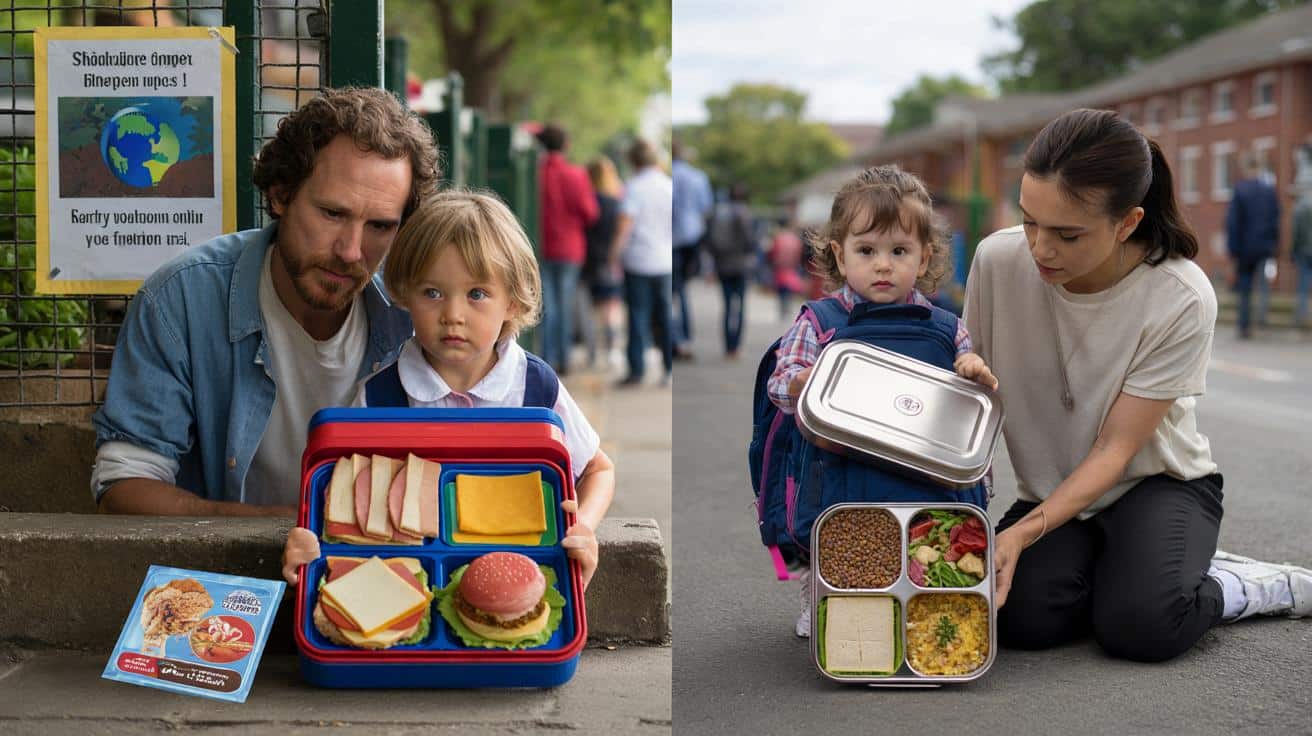
The bell has barely rung at 8:30 a.m. and the school gate already looks like a referendum on the future of the planet. One dad stuffs a Pokémon lunchbox with ham and cheese sandwiches, not even glancing at the small “Climate Action Week” poster taped to the fence. A few steps away, a mum quietly slides a stainless-steel box of lentil salad and tofu cubes into her daughter’s backpack, almost bracing for comments. The kids don’t care. They just want something that doesn’t taste boring and won’t get them laughed at on the playground.
On the internet, though, it’s war. Scientists publish stark graphs about methane and cow burps. Parents answer with photos of beaming kids holding burgers and captions about “letting children be children.” Somewhere between the lab report and the lunchbox, the debate turns personal.
Nobody wants their child to be a climate villain. Nobody wants to be called a bad parent either.
Why a ham sandwich suddenly feels like a political statement
For decades, a meat-filled lunchbox was just that: a practical, protein-rich way to keep kids full till 3 p.m. Now that same sandwich is being talked about as a small slice of climate collapse. Scientists link industrial livestock to soaring emissions, deforestation, and water waste. Parents scroll through headlines saying red meat is “the new coal” and feel a flicker of guilt as they spread mayo on white bread.
But guilt doesn’t pack lunches. Habit does. Culture does. Family recipes and grandparents’ Sunday roasts do. The science is loud, yet the routines are sticky.
Look at the numbers and the tension starts to make sense. Global livestock is responsible for around 14–15% of human-caused greenhouse gas emissions, with beef and lamb leading the pack. One climate scientist I spoke to compared a weekly beef habit to “flying several extra short-haul trips a year without leaving your kitchen.” That gets attention.
Yet on the same street, you’ll meet parents who grew up on farms where animals meant survival, not climate graphs. To them, being told that feeding their kids meat is “fuelling collapse” feels less like data and more like an accusation. They hear scientists, but they also hear strangers calling them irresponsible in the comment section under a photo of their kid’s spaghetti bolognese.
Underneath the shouting, there’s a simpler dynamic at play. Climate researchers are trained to think in tons of CO₂, long time horizons, planetary boundaries. Parents think in empty stomachs, picky eaters, dinner in 20 minutes after a long shift. Both worlds are real, but they rarely meet in the middle. *That gap is where the resentment grows.*
So when a viral headline says “meat-free childhood or climate catastrophe,” some hear an urgent warning, while others hear moral blackmail. It’s not that one side loves the planet and the other doesn’t. It’s that they’re living inside completely different clocks: one counts down to 2050, the other to tonight’s bath time.
Between “ideological abuse” and quiet compromise at the dinner table
If you want to glimpse the raw nerves in this debate, listen to parents who feel cornered. Some fiercely reject the idea of raising their children without meat, calling it “ideological abuse” or “turning kids into political symbols.” They talk about protein, iron, “real food”, and childhood memories of barbecues that shaped their sense of family. Then they see activists saying any meat in a lunchbox is complicity in collapse. No wonder they double down and vow to keep packing those ham sandwiches “even if the planet pays the price.”
➡️ He disappears in 2026: the tax break millions of households will lose
➡️ Before Trees, Earth Was Ruled By Giant Life Forms That Seem From Another World
➡️ Here the 2026 Winter Olympics began and here ends the story of a legend of Italian stadiums
➡️ If you’re over 60, this is why prolonged sitting feels harsher
Behind the bravado there’s often something softer: fear of being judged, of losing control over how they raise their own kids.
You can hear that fear in small domestic scenes. A 9-year-old comes home from school and announces, “My teacher said meat is bad for the planet. Are we bad people?” One mother told me she froze, spatula in hand, as her son stared at the chicken sizzling in the pan. She wasn’t furious at the science. She was furious at feeling ambushed in her own kitchen. Another dad described his daughter refusing her beloved bolognese after a YouTube video about cows and climate. He felt like his family traditions had been labelled toxic overnight.
We’ve all been there, that moment when the world barges into your home through a child’s question and nothing feels simple anymore.
Strip away the loaded language and the core conflict is surprisingly basic. Parents think their first job is to keep their children healthy, happy, and emotionally secure. Climate scientists think their first job is to warn the public about future disaster, especially for those same children. These missions aren’t enemies; they just clash when delivered like ultimatums. Let’s be honest: nobody really rewrites their entire grocery list because of a single alarming headline.
What does shift things is something smaller and less dramatic: one meatless day that doesn’t trigger a meltdown. A burger swapped for bean chili that actually gets eaten. A feeling that you’re still in charge, not being lectured. That’s where change quietly grows, under all the noise.
A middle path: less panic, less meat, more honesty with kids
So what does a realistic middle ground look like for parents who care about the climate but don’t want to wage war at the dinner table? One simple, concrete move: target frequency, not purity. Instead of “meat is banned,” try “meat moves from everyday to sometimes.” Many families start with one or two nights a week where dinner is vegetarian by default: pasta with tomato and lentils, veggie tacos, chickpea curry. Lunchboxes can follow the same pattern: hummus and veg wraps one day, egg-and-salad sandwiches another, then the beloved ham or chicken roll on the remaining days.
It’s not a manifesto. It’s just a quiet reshuffling of the week, with less drama and fewer ultimatums.
The emotional landmines are often more dangerous than the recipes. Kids pick up on tension fast, so turning food into a battlefield rarely ends well. Talk climate in simple, age-appropriate ways, but don’t dump the entire weight of planetary collapse onto an 8-year-old choosing between yogurt or cheese. Some parents stumble by swinging from “eat whatever” to strict bans overnight, then feeling crushed when their children rebel. Others get stuck in shame and do nothing at all because change seems too big.
A gentler approach is to admit you’re figuring it out. “We’re trying to eat a bit less meat because of the planet, but we’ll do it step by step.” It signals care, not control.
“Food should not become an instrument of moral panic,” says one pediatric dietitian I interviewed. “You can cut your household meat consumption in half without turning your child’s plate into a battleground or their childhood into a climate seminar.”
At the same time, a few simple guardrails help keep the shift both sane and sustainable:
- Rotate easy, familiar vegetarian meals so it doesn’t feel like an experiment every night.
- Keep an eye on nutrients like protein, iron, and B12 if meat is reduced a lot, especially for younger kids.
- Invite kids into the process: let them choose one meat-free meal a week, or help prep lunchbox fillings.
- Talk about animals and the planet without turning every bite into a test of virtue.
- Accept that some weeks will be messy, and that “less meat” over a year matters more than any perfect day.
What future are we really feeding?
Long after the Twitter storms move on, the truth will still be sitting quietly in our kitchens. What we feed our children shapes more than their bodies; it shapes their sense of normal. If “normal” is cheap meat at every meal, the climate math looks grim. If “normal” is a mix of plant-based staples, occasional meat, and open conversations about why, the story changes. Not overnight. Not in one policy cycle. Across a lifetime.
The hard part is admitting that nobody has a perfectly clean answer. The science on emissions from meat is robust. The science on how to raise emotionally resilient kids in a warming world is still being written, in real time, around every family table.
Maybe the question isn’t “meat or no meat,” but “how do we feed our kids in a way we can explain to them with a straight face in 20 years?” Some parents will ditch animal products entirely. Others will cling to roast chicken Sundays and simply trim the rest of the week. Most will land somewhere awkward in the middle, still learning, still compromising between climate charts and lunchbox reality.
One day, today’s children will look back and ask what grown‑ups did while the planet was heating up. Part of that answer will be in the policies and protests. Another part will be in the small, unglamorous choices we made at the supermarket, on tired Tuesday evenings, when nobody was watching.
| Key point | Detail | Value for the reader |
|---|---|---|
| Meat has a real climate cost | Livestock, especially beef and lamb, generates a large share of food-related emissions | Helps parents see why scientists sound alarmed without feeling personally attacked |
| All‑or‑nothing thinking backfires | Framing meat-free childhoods as the only ethical option fuels resistance and shame | Reassures readers that meaningful change can start with small reductions |
| Practical, gradual shifts work best | Mixing meat-free days, kid-friendly recipes, and honest conversations | Offers realistic tools to align family habits with climate concerns |
FAQ:
- Question 1Are scientists really saying parents who feed kids meat are causing climate collapse?Some researchers stress that high meat consumption, especially beef, is a major driver of climate change. They’re pointing to patterns and systems, not accusing individual parents of single-handedly collapsing the planet.
- Question 2Is a meat-free childhood healthy for kids?With good planning, many dietitians say a well-balanced vegetarian or even vegan diet can work for children, but it needs attention to protein, iron, B12 and overall calories. Some families prefer a “less meat” approach because it feels easier to manage.
- Question 3Am I a bad parent if I still pack ham sandwiches?No. You’re a parent living in a messy transition era. The question is not perfection, but whether you’re willing to gradually shift habits as you learn more and as better options become available.
- Question 4How can I talk to my child about meat and climate without scaring them?Use simple, calm language. Explain that some foods are heavier for the planet, so your family is trying to eat a bit more of the lighter ones. Emphasize solutions and agency, not doom.
- Question 5What’s one change that actually makes a difference?Cutting beef and lamb down to “once in a while” and replacing them with plant-based meals or poultry has a big impact on your food-related emissions, while still leaving room for favorite family dishes.