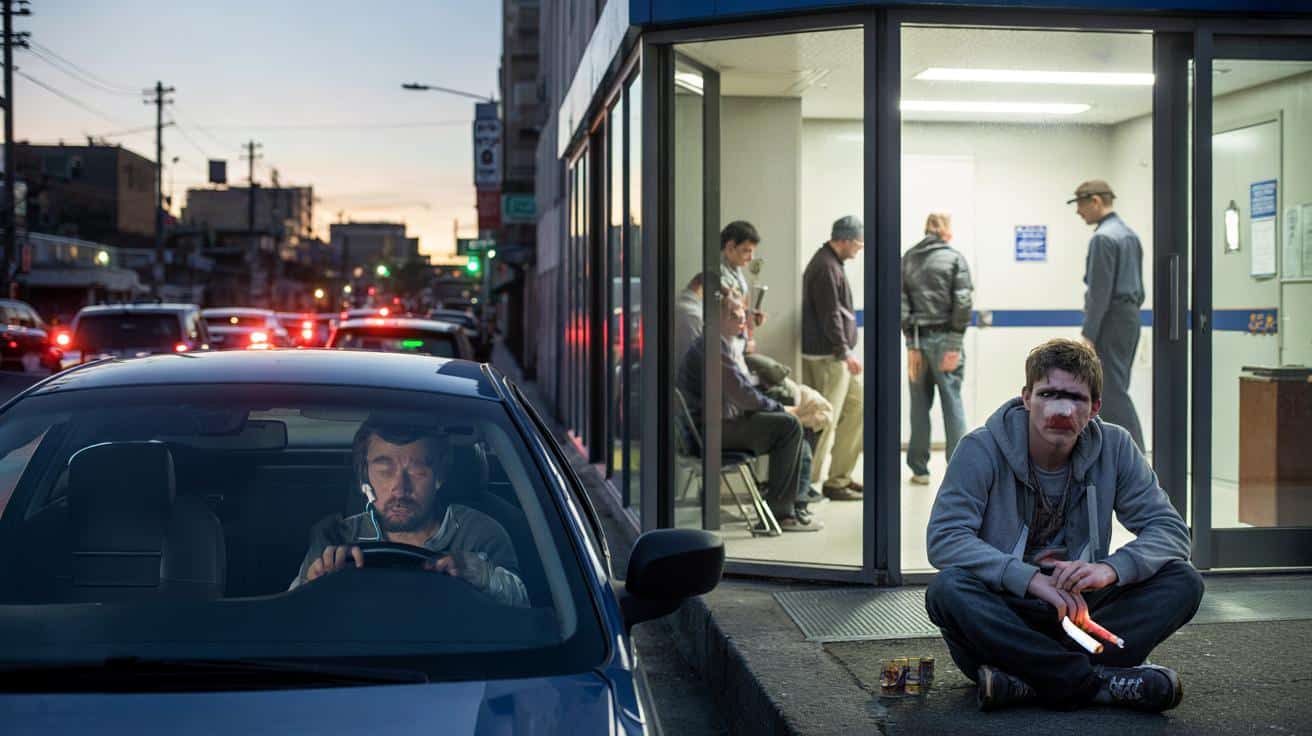
The man in the grey hoodie didn’t look like a public menace.
He was sitting cross-legged on the cold pavement outside a rehab clinic, smoking the end of a roll‑up, watching other people go in. The sliding doors opened and closed on a loop of quiet despair: tired faces, parents with hollow eyes, a security guard pretending not to notice anything.
Across the street, cars idled in traffic, drivers scrolling their phones, half-listening to podcasts about “freedom” and “personal responsibility”.
If you squinted, the whole scene looked like a standoff between two versions of adulthood.
One that says: we all fall, and we try to pull each other back up.
And another that growls: you chose this, live with it.
Some people want that second voice to set the law.
When freedom sounds like abandonment
Among libertarians, the argument is clean and sharp. Adults own their bodies. Adults own their choices. So adults should be allowed to swallow, snort or inject whatever they want, without cops kicking down doors or judges wagging fingers.
From that starting point, the next step sounds brutally logical.
If an adult burns their life to the ground with fentanyl or meth, that’s their freedom too.
Why, the argument goes, should a nurse working double shifts or a delivery driver paying rent on a tiny room be forced to fund their rehab bed through taxes?
Talk to emergency room staff on a Saturday night and the theory starts to smell different.
One nurse in Manchester told me about a regular: a man in his thirties, polite when sober, vicious when high. He overdoses, gets revived with naloxone, screams abuse at the staff, then vanishes. Weeks later, he’s back again.
The cost of those repeat rescues is measured in overtime, burnout, and the quiet rage of colleagues who haven’t had a proper break in twelve hours.
Behind each headline about “record overdoses”, there’s a rota that doesn’t add up and a team that’s running out of patience.
Strip away the slogans and you hit the uncomfortable core: what do we actually owe each other when someone keeps walking into the same fire?
➡️ From perovskite to fusion: the energy breakthroughs finally leaving the lab in 2026
➡️ If you’re over 60, this is why prolonged sitting feels harsher
➡️ He disappears in 2026: the tax break millions of households will lose
➡️ China Has Planted So Many Trees It Has Changed The Water Cycle
➡️ SpaceX in merger talks with other Musk companies ahead of IPO
The “legalize everything, shut every rehab” crowd leans on a kind of tough-love fatalism. They say the threat of catastrophe concentrates the mind. That without a free safety net, people will think twice before using.
Reality doesn’t really work like that. Addiction rewires the brain’s risk calculator. At a certain point, the fear of dying tonight loses against the need to not feel like this for five minutes. Let’s be honest: nobody really runs a careful cost–benefit analysis at 3 a.m. in a bathroom stall.
The fantasy of clean freedom vs messy humans
If you truly believed in radical, no-rescue freedom, you’d redesign the whole system.
Legalize every drug for adults. No more undercover busts, no more cartel profits. Pharmacies selling heroin like they sell cough syrup. No public rehab. No state-funded detox. You want help? Pay for it yourself or call your friends.
On paper, that framework looks tidy and coherent. It treats adults like adults. It removes the paternalistic state from your bloodstream. It also assumes something wildly optimistic: that everyone entering this drug market starts from the same place, with the same power to choose.
Picture two people walking into this brave new world on the same sunny afternoon.
One is a 28‑year‑old software developer. Good salary. Supportive family. Occasional cocaine on weekends. If things go south, private clinic, time off work, therapist on speed dial.
The other is 17, though he tells people he’s 19. Grew up around violence, already drinks to sleep, already carries the weight of three lifetimes in his shoulders. He doesn’t read think‑pieces about “body autonomy”. He just wants something that makes the noise in his head stop.
On paper, both are “free” adults able to choose. In real life, one is gambling a bit from a net. The other is betting his last coin on a broken table.
The plain truth is that zero‑rescue freedom always hits the weakest hardest.
That doesn’t mean adults are children or victims incapable of choice. It means choices are made inside specific bodies, histories, bank accounts. When we say, “If you ruin your life, that’s on you,” we erase everything that made that life easier or harder to wreck in the first place.
There’s also a cold economic twist. When someone spirals without any rehab, they don’t quietly vanish. They show up in crime stats, prison budgets, foster care numbers, long‑term disability payments. The taxpayer still pays. Just later. And at scale.
What a different kind of “freedom” could look like
There is another way to talk about freedom that doesn’t sound like a shrug.
Imagine legalizing drugs, yes, but pairing that with something like a “freedom contract”. Adults can use what they want, from regulated sources, with clear information. In return, the state commits to three things: clean supply, low‑threshold help, and the right to step back in.
That last piece matters. People cycle in and out of wanting help. One month they’re “fine”, the next they’re terrified. A healthy system treats that wobble as normal, not as weakness, and keeps the door open without endless forms or moral lectures.
The common mistake, on both sides of the debate, is talking as if there are only two options: a nanny state that drags you into rehab against your will, or a cold market that sells you whatever you want and leaves your body on the pavement when you’re done.
Most of us live somewhere between those extremes in every other part of life. We accept seatbelts and speed limits not because we love rules, but because we’ve buried enough friends. We buy insurance not because we plan to crash, but because we know we might.
That same messy, honest logic can apply to drugs. We can say: you’re free. And also: we won’t let you drown alone if you change your mind.
At some point, the debate stops being about policy and slides into something rawer: what kind of people we want to be to each other.
“Every time someone says ‘let them die, it’s their choice,’ I think of my brother,” one woman told me outside a harm‑reduction center. “He was brilliant when he was sober. When he used, he was a stranger. Which one are you punishing?”
- Legalize with care — Controlled supply, transparent labeling, age checks, and real education about risks instead of scare stories.
- Keep support visible — Walk‑in clinics, peer groups, and online counseling that don’t require hitting absolute rock bottom to access.
- Fund rescue lightly, not blindly — Time‑limited, outcome‑tracked programs that help people climb, without promising to carry them forever.
- Protect kids aggressively — Strict rules for marketing, packaging, and public use, the same way we treat alcohol around schools.
- Talk about shame less, reality more — Honest conversations at home and at work about why people use, not just what they use.
The uncomfortable question underneath the slogan
The slogan “legalize all drugs and shut down rehab” sounds fearless on a podcast.
Sitting in a waiting room that smells of disinfectant and cheap coffee, watching a 19‑year‑old shaking through withdrawal, it feels different.
Maybe the real fault line isn’t between people who love freedom and people who hate it. Maybe it’s between those who can imagine themselves or their kids on that plastic chair one day, and those who are sure they’ll always stay on the safe side of the glass. *We’ve all been there, that moment when we’re so sure disaster is something that happens to other families, on other streets.*
| Key point | Detail | Value for the reader |
|---|---|---|
| Freedom isn’t symmetrical | Legal rules hit people differently depending on their background, money, and mental health | Helps you question simple “it’s their choice” narratives |
| Costs don’t disappear | Removing rehab doesn’t erase public spending; it shifts it to prisons, hospitals, and social care | Lets you see the long game behind tax and safety debates |
| Middle paths exist | Legalization can be paired with regulated supply and targeted, time‑limited support | Gives you language to argue beyond all‑or‑nothing positions |
FAQ:
- Question 1Does legalizing all drugs automatically mean more addiction?
- Answer 1Not automatically. Data from places like Portugal, which decriminalized personal use, suggests addiction rates can stay stable or even drop when combined with support and education. The details of regulation matter more than the slogan.
- Question 2Why should taxpayers fund rehab for people who keep relapsing?
- Answer 2Because the alternative often costs more. Untreated addiction tends to show up in emergency care, police work, courts, and lost productivity. Targeted rehab is partly compassion, partly hard‑nosed budgeting.
- Question 3If adults are responsible, shouldn’t they pay entirely for their own treatment?
- Answer 3In a perfect market, maybe. In real life, many people hit addiction with no savings, no insurance, and no family support. Public funding is a way of not turning poverty into a death sentence.
- Question 4Would shutting down rehab actually scare people away from heavy drug use?
- Answer 4Most evidence points the other way. Fear has limited power once someone is already addicted. Access to help, not just threats of abandonment, is what changes long‑term outcomes.
- Question 5Is it possible to support legalization and still believe in public rehab?
- Answer 5Yes. Many experts back a model where drugs are legal and regulated, while harm‑reduction, counseling, and time‑limited rehab remain publicly funded. That mix tries to respect adult choice without pretending humans are perfectly rational robots.