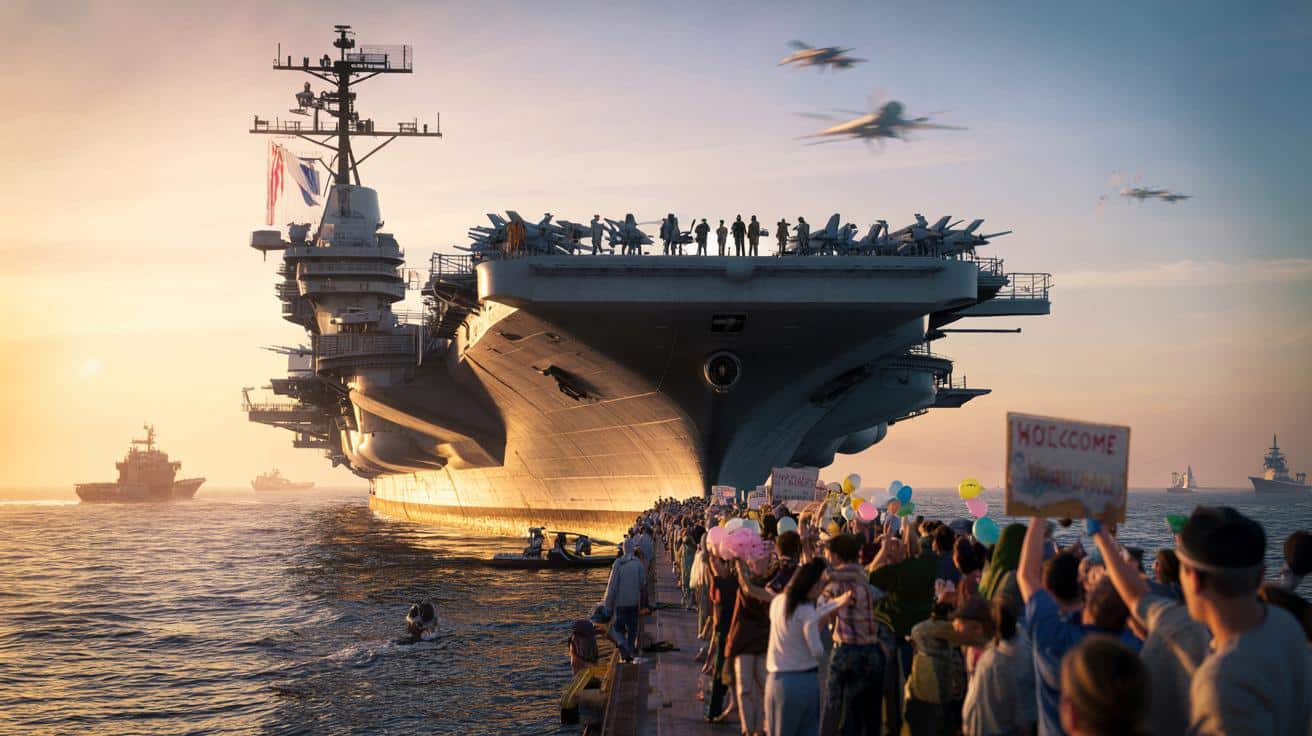
The pier was crammed shoulder to shoulder, a rippling line of families clutching cardboard signs and cheap balloons that had already started to sag. Children sat on their parents’ shoulders, scanning the gray horizon for a ship they’d only seen on TikTok and news clips. When the USS Harry S. Truman finally appeared, huge and slow and scarred by months at sea, the crowd broke into that strange sound that’s half roar, half sigh of relief.
Sailors in dress whites lined the deck like a human fence. Phones went up. A brass band did its best to cut through the wind.
And behind the hugs and tears, you could hear another quiet conversation starting among the uniforms and the staffers: was this triumphant return also a warning sign for the U.S. Navy’s place in the wars to come?
The Truman looked glorious.
It also looked a little like the past sailing home.
The Truman comes home… and the future feels far away
Ask any sailor on the Truman’s deck, and they’ll tell you the same thing: there’s nothing like that first glimpse of home port. The smells change first, from salt and jet fuel to wet asphalt and fried food drifting from the waterfront. The ship slows, tugs nudge its flanks, and the whole crew edges closer to the railings, trying to spot their people in the blur of faces.
Yet behind the ceremony, senior officers watched with a different lens. The Truman is a 100,000-ton symbol of American sea power, returning from a deployment in a world where cheap drones hit targets once reserved for cruise missiles. As the band played, some of them were already asking a blunt question.
Is this the last era where a massive carrier like Truman is still the star?
Inside the Pentagon, the debate isn’t theoretical anymore. Wargames against a near-peer adversary in the Pacific often end the same way: aircraft carriers on the edge of enormous missile envelopes, forced to hang back or risk being swarmed by long-range “carrier killers” that cost a fraction of the ship they’re hunting.
On Truman’s last deployment, the crew spent long nights rehearsing defense against fast, unpredictable threats—drones, small boats, cyber intrusions bleeding into ship systems. Some sailors joked that they were “fighting ghosts on Wi-Fi” while still sleeping beneath steel bulkheads designed during the Cold War.
The Truman launched jets, patrolled skies, and reassured allies, as carriers have done for decades. Yet the mission sets were narrower, more constrained by invisible lines drawn on maps in Washington and Beijing.
➡️ With its 337 metres and 100,000 tonnes, the world’s largest aircraft carrier rules the oceans
➡️ Have you ever tried cloud eggs? This light way to cook them
➡️ France to cut its contribution to the Global Fund to Fight Aids, Tuberculosis and Malaria by 58%
Defense analysts quietly point out a cruel math. A single carrier strike group can cost $20–30 billion across its life cycle. An adversary can build thousands of precision-guided missiles and drones for the same price.
That mismatch has fueled growing pressure inside the Pentagon to move money away from big-deck carriers and into submarines, unmanned platforms, and distributed, “hard to kill” forces. Every triumphant homecoming like Truman’s is also a budget marker: should those billions fund more of this, or something radically different?
To some in the Navy, the Truman’s return at a moment of strategic pivot feels like a polite nod… and a quiet snub. The ship did everything asked of it, and yet the loudest conversations now are about a future where its kind plays a shrinking role.
A future war built for subs, drones… and not for carriers
Walk the Truman’s hangar bay and you see the past and future colliding in real time. F/A‑18 Super Hornets sit wingtip-to-wingtip, kings of the last 20 years of air power. Next to them, you’ll spot the first hints of change: unmanned refueling drones, prototype systems testing how a giant ship can launch aircraft with no pilot on board.
The Navy’s vision of future war leans hard into this direction. Smaller crews, more robots, more autonomy, less reliance on one glaringly obvious, billion-dollar target afloat on the surface. Submarines, quiet and invisible, suddenly look a lot sexier to planners than towering carriers that dominate Instagram feeds.
That shift plays out in subtle ways, like who gets funded, who gets promoted, and which program offices suddenly find their emails answered faster.
One officer who just left a carrier command track describes it like a slow fade. Early in his career, being part of a carrier battle group felt like holding the keys to the kingdom. Ports rolled out the red carpet. Every crisis started with: “Where’s the nearest carrier?”
Lately, he says, the questions sound different. People ask about underwater networks, satellite constellations, cyber teams, AI-driven targeting. At one point on deployment, his ship had to adjust operations because of concerns about being tracked by long-range sensors tied to low-cost drones. “We used to worry about enemy fleets,” he told me, half amused, half drained. “Now we’re worried about being geotagged like a food truck.”
The Truman still projects power, no question. Yet more often it does so cautiously, from farther offshore, bristling with defenses that admit the unspoken fear: one lucky hit could rewrite history.
Strategists call it “distributed maritime operations” and “mosaic warfare,” terms that sound neat in slides but feel far messier in real life. The simple version is this: spread your forces so wide and so unpredictably that no single strike can cripple you. Small ships, stealthy subs, mobile missile batteries ashore, swarms of drones overhead, all stitched together by data.
In that picture, the classic carrier looks a bit like an old mainframe computer in a cloud-computing age. Still powerful, still useful, but no longer the center of gravity. Congress loves carriers because they are jobs, symbols, and easy to show to voters. War planners are less sentimental.
*The Truman’s homecoming, in that light, feels like watching a legendary quarterback walk back into the stadium just as the league flips fully to a new, faster game.*
How the Navy is quietly rewriting its own story
One way the Navy is trying to close the gap is surprisingly humble: teaching carrier crews to think smaller. Onboard Truman, some of the most interesting experiments weren’t about bigger jets or louder launches. They were about running the ship like a node in a network instead of the sun in its own solar system.
Sailors practiced sharing targeting data in near real time with destroyers miles away and with aircraft they couldn’t even see. They drilled for scenarios where the carrier goes dark, emissions off, relying on remote sensors to “see” the battlespace without announcing its own position. The old reflex—turn on the radar, own the sky—is being slowly rewired.
Each of these little shifts nudges the Navy toward a world where the carrier is support as much as centerpiece.
This transition isn’t clean, and it isn’t painless. Sailors who grew up dreaming of launching off a carrier deck now wonder if their kids will serve on ships half the size, with no runway in sight. Older officers sometimes roll their eyes at buzzwords about AI and “kill webs,” then have to sit through briefings explaining that the algorithms are non-negotiable now.
There’s also a trust problem. Crews have watched big Pentagon fads come and go, from the Littoral Combat Ship drama to bloated programs that delivered late or not at all. So when they’re told that drones, software, and scattered forces are the new backbone, some quietly think: here we go again.
Let’s be honest: nobody really reads a PowerPoint about the “war of the future” and immediately changes the way they feel about the ship they sleep on every night.
In quieter corners, you do hear a more nuanced view, halfway between nostalgia and pragmatism.
“Carriers aren’t dead,” one retired admiral told me. “They’re just losing their monopoly on relevance. You still want them in the fight, you just don’t want them to be the only thing you can’t afford to lose.”
That view shows up in the Navy’s internal wish lists:
- More submarines, especially attack boats that can hunt, hide, and launch missiles unseen.
- More unmanned systems in the air and under the sea, tied into carrier groups but not dependent on them.
- Smaller, cheaper surface ships that can carry big missiles without painting a bullseye as large as a carrier.
- Resilient networks, so a damaged carrier doesn’t blind the whole force.
- Carriers that evolve: lighter crews, more drones on deck, new defensive layers against missile swarms.
In that world, the Truman isn’t obsolete. It’s a testbed—whether the crew likes that label or not.
A symbol returning, a question hanging in the air
As the last sailors stepped off the Truman’s brow and into the arms of people who had circled this date on the calendar for months, the big questions didn’t go away. They just slid into the backdrop, waiting for the next budget hearing, the next wargame, the next crisis where someone asks: “Can we send the carrier in, or is that too risky now?”
We’ve all been there, that moment when something you love and trust suddenly feels out of sync with the world spinning around it. That’s where the Navy sits with its carriers. Proud. Grateful. Slightly defensive. And very aware that the future doesn’t care about tradition as much as it cares about survivability and cost.
The Truman’s return is both a victory lap and a mirror. It reflects a country that still craves big, visible symbols of power, even as the real contests move into cables on the ocean floor, satellites in silent orbits, and lines of code hiding in server racks.
Whether future wars sideline ships like Truman—or reshape them into something we barely recognize yet—will say a lot about how quickly the U.S. can let go of its favorite icons when the battlefield changes shape.
| Key point | Detail | Value for the reader |
|---|---|---|
| Carriers face new threats | Cheap long-range missiles and drones can target billion‑dollar ships from afar | Helps readers grasp why the Truman’s return feels less secure than past homecomings |
| Navy strategy is shifting | Emphasis moving toward submarines, unmanned systems, and dispersed forces | Offers a simple way to understand where defense dollars and innovation are heading |
| Symbol vs. reality | Carriers remain politically powerful symbols even as planners question their central role | Gives context for future headlines and debates about “wasting” or redirecting military budgets |
FAQ:
- Why is the Truman’s return seen as a snub to the Navy?The ship came home to fanfare just as Pentagon debates and wargames increasingly sideline big carriers in favor of submarines, drones, and distributed forces, undercutting the Navy’s traditional pride in its flagship platforms.
- Are aircraft carriers becoming obsolete?Not overnight. They’re still highly useful for deterrence, airpower, and crisis response, but they’re losing their status as the unquestioned centerpiece of U.S. military strategy in a high‑end war.
- What makes carriers so vulnerable now?Precision “carrier‑killer” missiles, satellite tracking, and cheap drone swarms mean a large, visible ship is easier to find and potentially overwhelm, even from thousands of kilometers away.
- What forces are likely to dominate future naval wars?Fast attack submarines, unmanned underwater and aerial systems, mobile missile units ashore, and resilient data networks that connect many smaller platforms instead of relying on one giant hub.
- Will the U.S. stop building carriers like Truman?Probably not in the near term, but newer designs will be under intense pressure to carry more drones, use smaller crews, and fit into a distributed warfighting model rather than repeating the classic supercarrier formula.