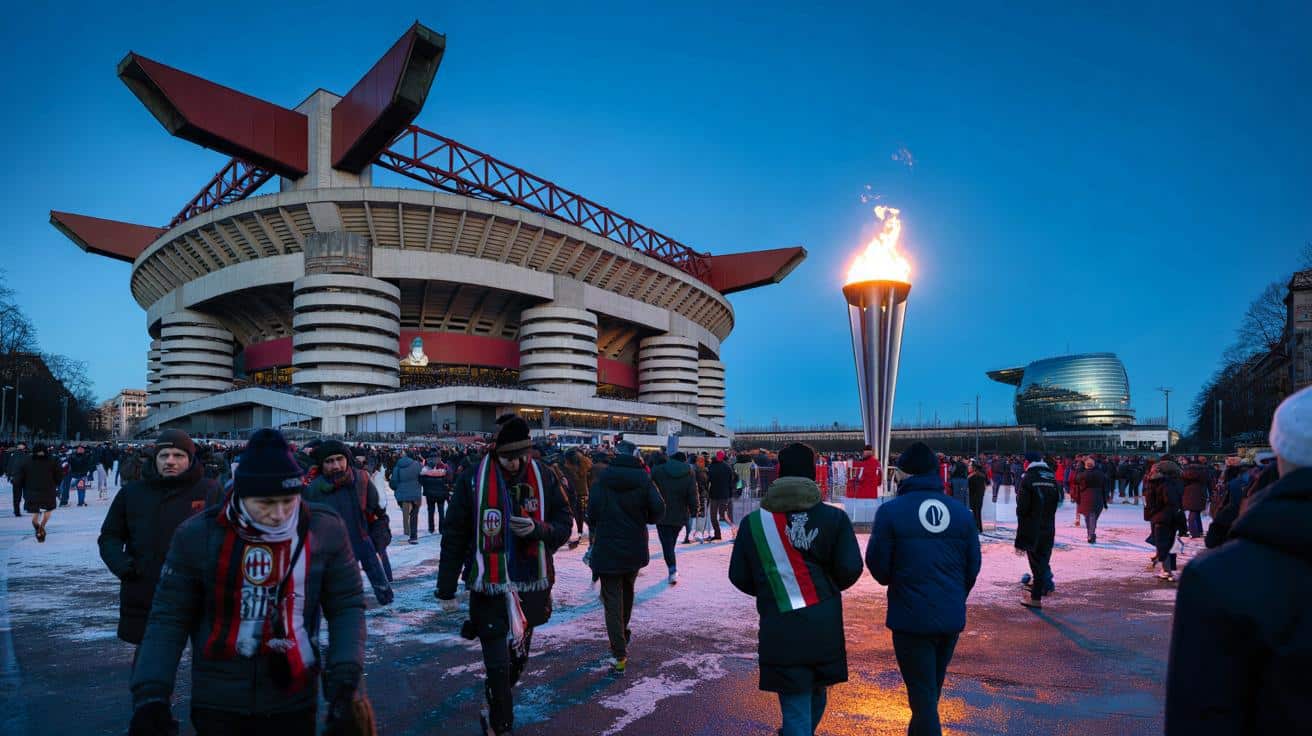
San Siro’s role as the opening stage of the 2026 Winter Olympics felt less like a ceremony and more like a farewell concert for a stadium that has shaped Italian sport, architecture and music for almost 100 years.
The English DNA at the heart of Lombardy
San Siro’s story began in December 1925, when Milan was rapidly industrialising and football was turning into mass spectacle. Piero Pirelli, the president of AC Milan and heir to the tyre empire, wanted something radically modern: a football‑only arena inspired by the compact, atmospheric stadiums of England.
He turned to architect Ulisse Stacchini, known for Milan’s monumental Central Station, and engineer Alberto Cugini. Together they designed a stark, functional ground that broke with the Italian habit of including running tracks. The stands hugged the pitch. Every seat focused on football.
Construction took just 13 months, a point of pride in interwar Italy, at a cost of around five million lire. When the stadium opened in 1926 with a derby between AC Milan and Inter, Inter’s 6–3 win felt oddly prophetic. From that day, the venue became the main stage for one of football’s fiercest rivalries, as both clubs battled not only for trophies but for the very soul of the stadium.
Born from English inspiration and Milanese ambition, San Siro was built for noise, drama and unforgiving closeness to the pitch.
Concrete spirals and red girders: how an icon was built
The stadium that millions recognise today is the result of three major transformations, each adding a new architectural layer and fresh meaning.
The 1930s: from open ground to concrete cauldron
In the 1930s, after the city of Milan took control of the venue, designers closed off the corners of the stands. That move turned San Siro into a full bowl, trapping noise and redefining it as a football cauldron rather than a simple ground with stands on four sides.
The 1950s: spirals that reshaped the skyline
In 1955, architects Armando Ronca and Ferruccio Calzolari added a second tier of seating and the now‑famous spiral ramps at the corners. The expansion boosted capacity towards the 85,000–100,000 range, far short of the wildly ambitious 150,000 once floated, yet still colossal by European standards.
Those concrete spirals, wrapping around the exterior like giant corkscrews, did more than move people. They became a symbol of motion, energy and modern engineering, instantly recognisable even to those who had never set foot inside.
➡️ 2,400-year-old Hercules shrine and elite tombs discovered outside ancient Rome’s walls
➡️ Tesla invests $2 billion in Musk’s xAI and reiterates Cybercab production starts this year
Italia ’90: red steel and eleven towers
The last major overhaul came ahead of the 1990 World Cup. Under the guidance of Leo Finzi and Giancarlo Ragazzi, a third ring of seating was built, resting on 11 enormous cylindrical towers.
Four of these towers hold up the dramatic roof, a web of steel and the striking red girders that pierce the Milan skyline. At night, the illuminated roof gave the stadium a theatrical presence, half spaceship, half fortress.
The 1990 redesign froze San Siro’s image in global memory: spirals twisting below, red beams slashing the sky above.
- Three main construction eras: 1920s, 1950s, 1990s
- Approximate peak capacity: close to 100,000 seats
- Defining features: spiral ramps, eleven towers, red roof trusses
“The opera of football” and a cathedral of music
The nickname “La Scala del Calcio” – the opera house of football – is more than poetic branding. Like Milan’s famous opera, the stadium specialised in drama, acoustics and ritual.
The steeply stacked stands, packed tight around the pitch, created a sound chamber. Chants and whistles didn’t just ring out; they bounced, multiplied, and pressed down on players. Zlatan Ibrahimović once said that the noise generated a unique mix of passion and fear. Visiting teams knew exactly what he meant the first time they walked out onto the pitch.
San Siro staged European Cup and Champions League finals, World Cup matches, Euro games and countless derbies where legends of AC Milan and Inter carved their reputations. Yet the stadium’s legacy goes well beyond football.
From the 1980s onwards, San Siro turned into a temple of live music. Bob Marley played here, briefly uniting rival fans in reggae rhythms. Bruce Springsteen returned again and again, calling the venue one of his favourite stops. Michael Jackson brought his Bad tour to the stadium in 1987. U2, the Rolling Stones, Beyoncé and Madonna all used the same structure that hosted Paolo Maldini and Javier Zanetti.
San Siro has also witnessed darker days. In February 2020, during the early spread of COVID‑19 in Europe, Atalanta’s Champions League tie against Valencia in Milan was later described by experts as a “zero match”, a potential accelerator of infections in northern Italy and Spain.
Olympic flame and final curtain: the 2026 turning point
The opening of the 2026 Winter Olympics gave San Siro one last global spotlight. The stadium that had hosted World Cups and Champions League nights suddenly became the arena for a snowy, choreographed celebration, a symbolic bridge between past and future.
Yet while the flame rose above the old concrete, the timeline for its retirement was already set. In late 2025, Milan sold the surrounding land to AC Milan and Inter, unlocking plans for a completely new venue next door.
Hosting the 2026 Olympics turned into a carefully staged goodbye: a celebration of history just before the bulldozers move in.
In 2023, heritage authorities granted San Siro protected status, acknowledging its cultural and architectural weight. That did not save most of the structure. Current plans envisage the demolition of about 90–91 percent of the existing stadium, preserving only a slice of the second tier as a kind of open‑air relic and viewing platform.
The new “Cathedral”: Foster + Partners and MANICA take over
The future of top‑level football in Milan now rests on a new design jointly developed by British firm Foster + Partners and US‑based MANICA. Their project, widely referred to as “the Cathedral”, aims to seat around 71,500 spectators – significantly fewer than San Siro, but with sharper sightlines and more premium facilities.
| Feature | San Siro | New stadium (“Cathedral”) |
|---|---|---|
| Approx. capacity | Up to ~100,000 | About 71,500 |
| Main materials | Reinforced concrete, exposed steel trusses | Glass, steel, high‑performance composites |
| Opening period | 1926 (with major upgrades) | Target: 2030–2031 season |
| Design focus | Capacity, atmosphere, monumentality | Sustainability, fan comfort, mixed‑use |
The budget, estimated at around €1.5 billion, reflects a new era for stadiums as entertainment districts rather than occasional venues. The plan includes hospitality areas, retail, year‑round events and improved public spaces.
For many residents, the loss of San Siro’s bulk feels painful. Campaigns to fully preserve the stadium have gathered signatures and celebrity backing. Yet the clubs argue that a modern arena is vital to compete financially with Europe’s biggest teams, whose revenues lean heavily on high‑end seating, sponsorship zones and digital infrastructure.
Balancing heritage, money and urban life
The San Siro case highlights tensions that cities face when dealing with ageing sports monuments. On one side stand structural limits, rising maintenance costs and climate considerations; on the other, a century of memories embedded in concrete.
Supporters of the new stadium point to better energy performance, lower emissions and improved public transport integration. New grounds often target net‑zero operations, with solar panels on roofs, rainwater collection and smarter lighting systems. Against that, demolition and rebuild come with a heavy carbon cost that critics argue could be reduced by deeper renovation instead.
Local businesses around San Siro also watch the transition closely. Matchdays and concerts funnel money into bars, restaurants and parking operations. Construction phases, changed access routes and event calendars can reshape whole neighbourhood economies for years.
What “Olympic legacy” really means for a stadium
The 2026 Games give Milan a rare chance to test how an event of this scale can influence long‑term urban form. The phrase “Olympic legacy” is often used loosely. In practice, it covers several overlapping ideas:
- physical infrastructure that remains after the Games
- economic shifts in tourism, jobs and local investment
- social effects, from civic pride to displacement disputes
- environmental gains or setbacks linked to new builds
In San Siro’s case, the legacy may feel almost inverted. Instead of building a new arena for the Olympics, Milan chose to let the Games close the book on the old one. The emotional weight of that final opening ceremony might shape how residents judge the new “Cathedral” when it finally opens.
For fans, architects and city planners, what comes next
For football fans, the shift raises practical questions. Ticket prices are likely to rise in a more premium, smaller venue. Season‑ticket policies, standing areas and away‑fan allocations will define whether the intense San Siro atmosphere can survive translation into a sleeker, more controlled building.
Architects and planners will watch closely how the preserved section of the old stadium is used. It could become an open plaza, a sports museum, or a hybrid public space that keeps alive the memory of those concrete spirals. If handled well, it may offer a model for balancing demolition with partial conservation when other giant arenas reach the limits of their lifespan.
The end of San Siro as a full stadium does not erase its influence. Future designers will continue to borrow its lessons on acoustics, intimacy and sheer theatrical impact. For Milan, the Olympic flame of 2026 did not just start a sporting fortnight. It marked the moment a legend of Italian stadiums handed the stage to a new generation of arenas, built under different rules, but still chasing that same raw roar of the crowd.