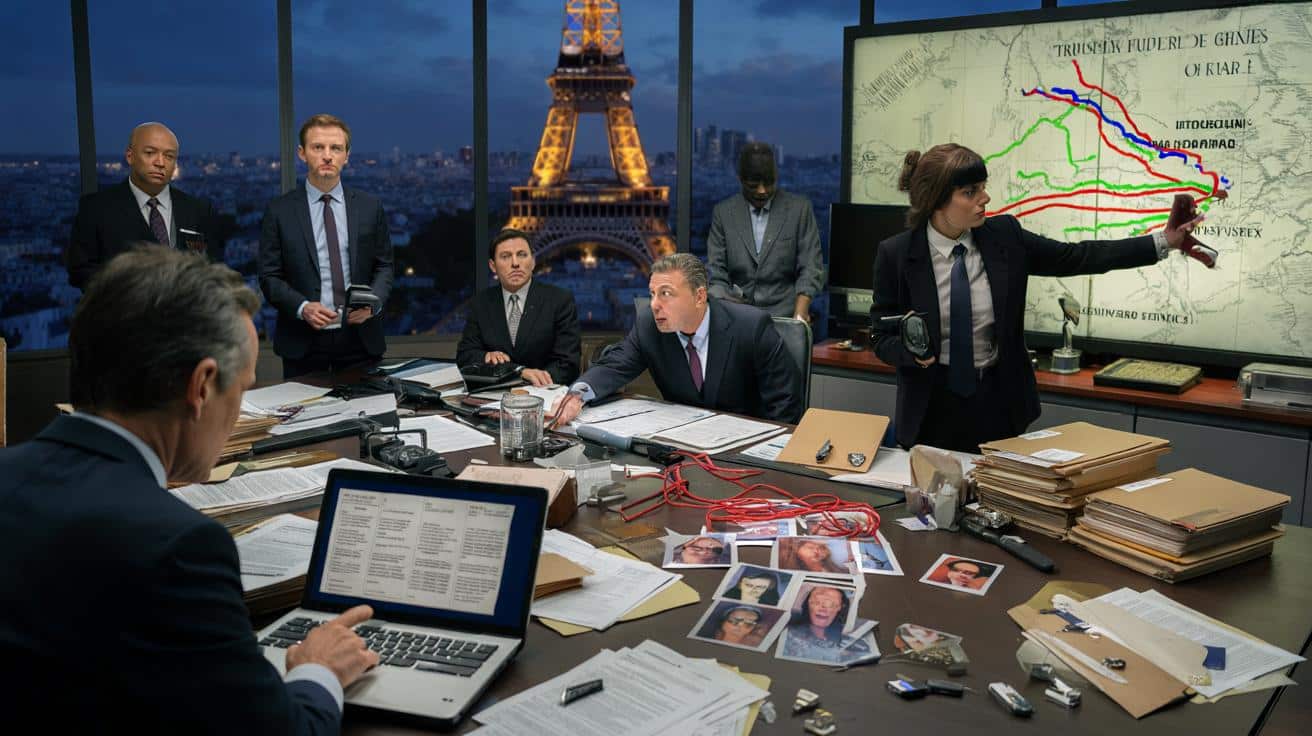
In Paris, prosecutors are building a new legal machine around the sprawling Jeffrey Epstein affair, as fresh US files raise questions about French nationals who once moved in his orbit.
A new French taskforce focused on Epstein-linked evidence
The Paris prosecutor’s office has announced the creation of a dedicated team of magistrates tasked with combing through Epstein-related material, including thousands of pages released by US authorities.
This special unit will review any documents that may point to alleged crimes involving French citizens or offences committed on French territory.
The goal, prosecutors say, is to identify “any piece” of evidence that could justify opening fresh investigations under French law.
The team will work alongside the national financial prosecutor’s office and specialist police units. Their mandate covers both sexual offences and possible financial crimes connected to Epstein’s network.
French officials are particularly focused on whether the new documents shed light on previously unknown suspects, or resurrect cases that had been closed after key figures died or proceedings stalled.
Brunel case pulled back into the spotlight
A central part of the team’s mission is a renewed examination of the case of Jean-Luc Brunel, the former French modelling agent widely reported as one of Epstein’s closest associates in Europe.
Brunel was charged in France with raping minors and placed in pre-trial detention, but he was found dead in his Paris prison cell in 2022. The case was formally dropped the following year, as French law generally requires a living defendant.
Prosecutors had previously described Brunel as a “close friend of Jeffrey Epstein” who allegedly used his access to the fashion industry to recruit vulnerable young women.
➡️ Neither boiled nor raw : the best way to cook broccoli to preserve maximum antioxidant vitamins
➡️ If you’re over 60, this is why prolonged sitting feels harsher
➡️ Asus permanently quits smartphones to go all‑in on AI
➡️ He disappears in 2026: the tax break millions of households will lose
Investigators say Brunel offered modelling opportunities to girls from poor backgrounds, then engaged in sexual acts with underage victims in the US, the US Virgin Islands, Paris and the south of France.
Ten women went on record accusing Brunel. Several described a pattern: being encouraged to drink alcohol, then experiencing forced sexual penetration. Their statements formed the backbone of the French case before it collapsed with his death.
The new Paris team will not bring Brunel back before a court. Instead, they are looking at whether the broader material around him, and the transatlantic flow of evidence from the Epstein files, could implicate other people under French jurisdiction.
Three new French-linked cases under examination
The latest tranche of Epstein-related documents from the US Department of Justice has triggered specific French inquiries into three different figures: a senior diplomat, a modelling agent and a musician.
- A serving or former French diplomat named in US files
- A model recruiter accused of rape in France in 1990
- A prominent conductor accused of sexual harassment in 2016
Allegations involving a French diplomat
At the request of the French foreign ministry, prosecutors are examining references to senior diplomat Fabrice Aidan in the US document cache.
Officials say they have opened an investigation focused on verifying information and gathering corroborating material that might confirm or disprove the reports. No charges have been announced, and being cited in the documents does not automatically indicate criminal liability.
Complaint against model recruiter with ties to Epstein
Prosecutors have received a formal complaint from a Swedish woman targeting Daniel Siad, described as a model recruiter with close links to Epstein.
She accuses him of sexual acts that she characterises as rape, alleged to have taken place in France in 1990. French investigators will have to navigate both the age of the claims and questions of limitation periods, while still taking testimony and supporting evidence into account.
Sexual harassment accusations against French conductor
A separate complaint has been filed against French conductor Frédéric Chaslin. The allegation concerns acts of sexual harassment said to have occurred in 2016.
Chaslin’s name does not feature as prominently in Epstein coverage, but prosecutors included the case among those newly registered as part of a broader push to address potential offences that intersect with the financier’s network.
Political shockwaves: Jack Lang and financial crime probe
The knock-on effects of the latest Epstein files are not limited to sexual offences. They have also spilled into the world of French politics and culture.
Jack Lang, a former culture minister and a familiar figure in French public life, resigned from his role as president of the Arab World Institute after appearing in documents connected to an offshore company linked to Epstein in 2016.
Lang has firmly denied wrongdoing, saying he was “shocked” to see his name associated with Epstein’s offshore structure.
The national financial prosecutor’s office has opened a preliminary investigation into suspected “aggravated tax fraud and money laundering” involving Lang and his daughter Caroline. This probe focuses on financial flows and corporate arrangements, not directly on sexual exploitation.
Under French practice, a preliminary investigation does not equal guilt. It allows prosecutors to collect bank records, corporate documents and witness statements before deciding whether to escalate to formal charges.
| Figure | Type of case | Status |
|---|---|---|
| Jean-Luc Brunel | Sexual offences against minors | Case closed after death in custody (2022) |
| Fabrice Aidan | Named in Epstein-related documentation | Evidence-gathering phase |
| Daniel Siad | Alleged rape (1990, France) | Complaint filed, under review |
| Frédéric Chaslin | Alleged sexual harassment (2016) | Complaint filed, under review |
| Jack Lang & Caroline Lang | Financial crime (tax fraud, money laundering) | Preliminary investigation open |
France’s legal stakes in a global scandal
Epstein died in a New York jail in 2019 while awaiting trial on federal charges of child trafficking, in what US authorities ruled a suicide. His death ended his criminal case but left a web of unresolved questions about his contacts in multiple countries.
France has a specific interest because its laws allow prosecution of sexual crimes against minors committed abroad by French citizens, and sometimes when foreign victims are brought into French territory.
The new French taskforce will need to assess several legal points for each lead: jurisdiction, timing, and whether evidence can meet the thresholds required in criminal court.
Some victims may prefer to pursue civil actions, which can run in parallel with criminal cases or continue if criminal proceedings stall. French courts can award damages even where a criminal conviction is not secured, if the civil standard of proof is met.
How cross-border justice works in the Epstein saga
This new French move also shows how international cooperation plays out in complex abuse and financial crime cases.
US authorities hold vast troves of documents: flight logs, emails, corporate records, court depositions. France, in turn, can request specific files or witness access through mutual legal assistance agreements.
For anyone trying to understand how a name can move from an American PDF into a French courtroom, a few basic ideas help:
- US prosecutors or courts declassify or release documents.
- Journalists, NGOs or governments flag possible French angles.
- French prosecutors open a pre-investigation to check jurisdiction and credibility.
- If evidence looks solid, a formal inquiry and potential charges follow.
This process is slow and often frustrating for victims, who may have to repeat testimony across borders. But it can also open new avenues where one country’s case has stalled and another’s laws are more flexible.
Why this matters for victims and public accountability
For survivors of sexual abuse linked to modelling agencies or entertainment circles, the French move signals that their complaints might still be heard, even decades later.
At the same time, the financial angle shows how reputational fallout can extend far beyond direct involvement in sexual crimes. Simply sharing business structures or offshore vehicles with Epstein now attracts intense scrutiny.
For readers trying to make sense of the different strands, the French response illustrates a wider pattern: as more material from the Epstein archives surfaces, countries are forced to re-examine their own legal blind spots, from how young models are recruited to how offshore companies are monitored.