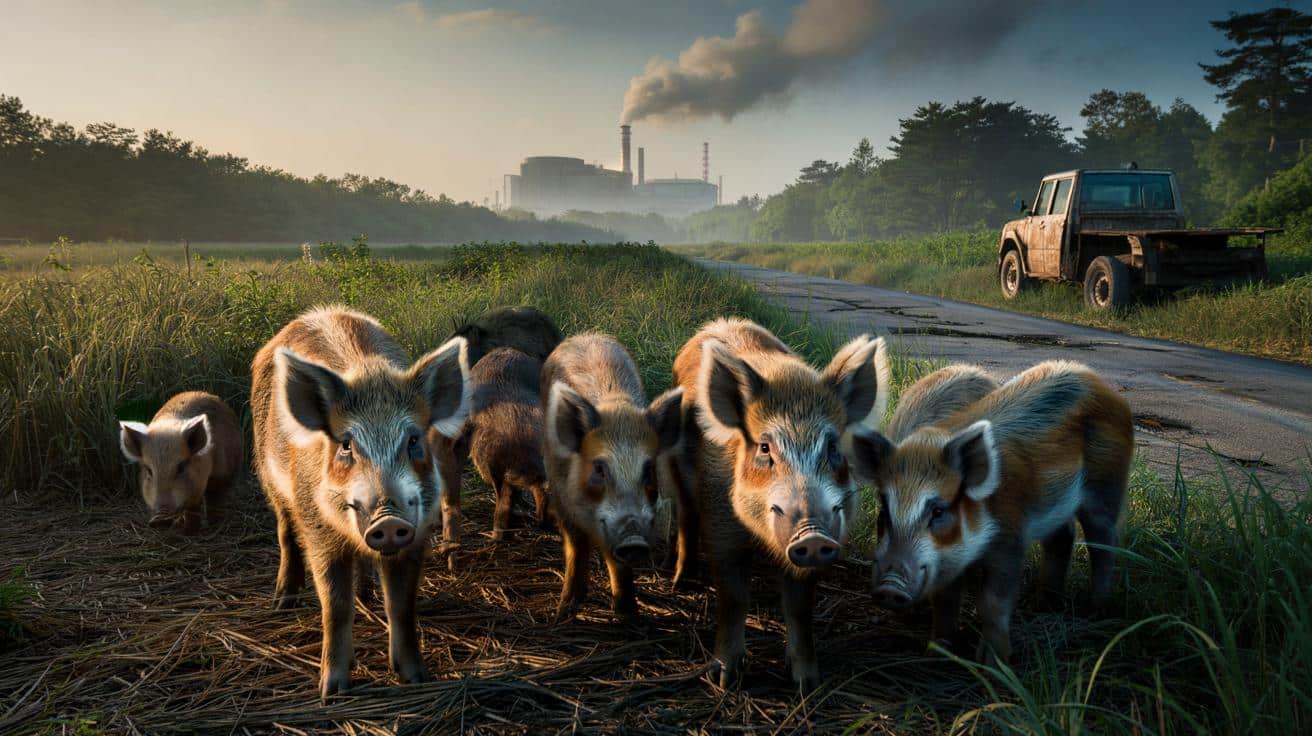
After the 2011 nuclear disaster forced people to leave, escaped farm pigs met resilient wild boar in the deserted countryside. Their mating created a living experiment in animal hybridisation right inside a contaminated landscape, and researchers have now pieced together why these animals are booming instead of fading away.
How farm pigs and wild boar became unlikely partners
When the Fukushima Daiichi power plant failed in 2011, tens of thousands of residents were evacuated at speed. Farms were abandoned. Pigs broke out of pens and wandered into nearby woodland and overgrown fields.
In those forests lived Japan’s native wild boar. With crops untended and hardly any people around to chase them off or hunt them, conditions were almost perfect for the animals. Food was plentiful, roads were eerily quiet, and barns and orchards became improvised shelters.
Freed from fences and human control, domestic pigs bred with wild boar. Over the next decade, their descendants spread through the region. Hunters and local authorities began reporting unusually bold boar with strange body shapes and coat colours, yet seemingly unfazed by low-level radiation.
The Fukushima exclusion zone turned into an unplanned open-air lab, showing in real time how domesticated genes mix into a wild population.
The team that followed the radioactive hybrids
A research group led by Professor Shingo Kaneko of Hirosaki University decided to treat this strange population as a scientific opportunity. They collected tissue samples from 191 wild boar and 10 escaped domestic pigs living in and around the contaminated zone.
The scientists focused on two kinds of genetic data:
- Mitochondrial DNA (mtDNA): inherited only from mothers, useful for tracking maternal lineages.
- Nuclear DNA markers: spread across the genome, showing how much “pig” versus “boar” ancestry each animal carries.
Using genetic models, they estimated how many generations had passed since the first cross-breeding and how strongly pig genes still influenced the modern boar population.
The maternal trick: faster breeding cycles
Domestic pigs have been shaped by thousands of years of human selection. Farmers want animals that breed often and grow quickly. As a result, female pigs can cycle and reproduce multiple times a year.
➡️ You don’t need to be an expert to make this foie gras: I use my microwave and it costs me far less
➡️ From Internship To Impact How Tech Careers Are Launched
➡️ Expanding AI Career Access Through Skills Based Evaluation
➡️ Twitter’s JavaScript roadblock: why you can’t use X.com without it
➡️ SpaceX in merger talks with other Musk companies ahead of IPO
➡️ Why varying the intensity and frequency of physical activity is better for your health
➡️ Asus permanently quits smartphones to go all‑in on AI
➡️ France and Germany plan a new “Airbus of military lasers” with MBDA & Rheinmetall joint venture
Wild boar are different. In natural conditions, they usually have a single breeding season per year, timed to match food availability and climate.
The team found that when a domestic sow mated with a wild boar male, the hybrid daughters tended to keep the rapid, year‑round breeding rhythm of their pig mothers. That reproductive pattern then continued down the maternal line.
Hybrids born from pig mothers inherited a “fast-forward” breeding calendar, allowing more litters and more generations in a short period.
This effect matters for population growth. More litters each year mean more young boar on the ground, which quickly boosts numbers if food and space are available—as was the case in Fukushima’s largely empty farmlands.
Why pig genes vanished faster than expected
At first glance, one might expect the area to end up filled with animals that look increasingly like domestic pigs. Yet the genetics tell a different story.
Boar that carried pig mitochondrial DNA often showed less pig ancestry in their nuclear genome than hybrids descended from wild boar mothers. Many individuals with a pig maternal line were already more than five generations removed from the original cross.
That means most of their nuclear DNA—the bulk of their genetic material—came from wild boar, not from pigs. The key was repeated backcrossing: hybrid animals kept mating with wild boar rather than with other hybrids or with new domestic pigs.
| Feature | Domestic pig | Wild boar |
|---|---|---|
| Breeding season | Multiple times per year | Usually once per year |
| Human control | High | None |
| Typical habitat | Farms and pens | Forests and scrubland |
| Role after Fukushima | Provided fast-breeding mothers | Provided most long-term genes |
The faster breeding cycle, inherited along the maternal line, essentially accelerated the evolutionary clock. Each quick generation replaced pig nuclear genes with boar genes, while the pig-style reproduction pattern stayed anchored in the mitochondrial lineage.
The pig ancestry that mattered most was not the look of the animal, but the reproductive engine tucked into its maternal line.
Fukushima as a model for global hybrid swine
Kaneko and colleagues argue that Fukushima’s circumstances were unusual but not completely unique. Across Europe, North America and parts of Asia, domestic pigs, feral hogs and wild boar now overlap more often than ever.
In countries like Germany, Italy and the United States, feral hog populations have exploded, damaging crops, wetlands and forests. Hunters sometimes report animals that show clear signs of mixed ancestry: longer snouts, spotted coats, or body shapes that fall between farm pigs and boar.
The Fukushima data suggest a general pattern. When domestic pigs enter wild boar populations, they may briefly shift the gene pool but leave a much longer legacy through their rapid breeding traits. That can turbocharge population growth while the animals gradually regain a more boar‑like genetic profile.
Radioactivity and resilience
The “radioactive” label attached to Fukushima’s boar relates to measurable contamination, not glowing monsters from a film. Many animals in the zone carry elevated levels of radioactive cesium in their tissues. That reflects what they eat—contaminated plants, mushrooms and soil organisms.
So far, there is limited evidence of dramatic physical deformities in these boar. They appear robust, fertile and highly adaptable, despite living in a lightly contaminated environment. That resilience raises difficult questions for policymakers: the animals pose ecological and agricultural risks, but they are also useful sentinels for long-term radiation effects on wildlife.
Why hybrid swine worry ecologists and farmers
Hybrid boar-pig populations are not just a curiosity; they bring real challenges. Larger, faster-breeding animals can rip up fields, damage forests and spread disease.
Some of the main concerns include:
- Crop damage: big groups of boar can destroy fields of maize, rice or wheat in a single night.
- Forest impact: rooting behaviour disturbs soil structure and seedlings, altering forest regeneration.
- Disease transmission: hybrid swine can act as reservoirs for pathogens like African swine fever, threatening domestic herds.
- Genetic pollution: rare native boar lineages may lose distinct traits as domestic genes wash through populations.
Faster breeding, inherited from domestic pigs, makes these problems harder to control. Shooting or trapping removes some animals, but numbers bounce back quickly if reproductive rates stay high.
Key concepts behind the Fukushima study
A few technical terms sit at the heart of this research, and understanding them helps explain why the findings matter.
Hybridisation means reproduction between two distinct populations or subspecies, in this case domestic pigs and wild boar. Hybrids can sometimes be stronger, more fertile, or more adaptable than either parent, a phenomenon known as hybrid vigour.
Mitochondrial DNA is a small set of genes found outside the nucleus, inside structures that power cells. Because it comes almost entirely from the mother, it acts as a stable signature of maternal ancestry, even while most of the nuclear genome gets reshuffled each generation.
Introgression refers to the gradual movement of genes from one population into another through repeated backcrossing. In Fukushima, pig genes entered the boar population, but repeated matings with wild boar diluted most pig nuclear DNA while leaving the pig-like reproductive system in place.
What Fukushima’s boar suggest about future wildlife management
Fukushima’s hybrid boar underline how quickly ecosystems can reorganise when humans step aside. Within just a few generations, a new type of animal emerged: genetically close to wild boar, yet carrying a pig-style breeding engine and living in a radioactive landscape humans largely avoid.
For wildlife managers and farmers worldwide, the lesson is that domestic escapees do not simply vanish into nature. They can reshape wild populations in subtle ways, especially when traits like reproduction, growth or behaviour spread along maternal lines and stay in place even after most visible domestic genes fade.
That raises practical questions: should authorities focus more on preventing escapes from farms, or on culling early hybrids before fast-breeding lineages take hold? Could genetic monitoring help spot dangerous trends—such as surging fertility—before populations become too large to control?
As climate change and land-use shifts push wildlife and livestock closer together, scenarios like Fukushima’s “radioactive hybrids” may no longer be rare curiosities. They could be previews of how mixed, fast-evolving animal populations respond when human pressure suddenly lifts or moves elsewhere.