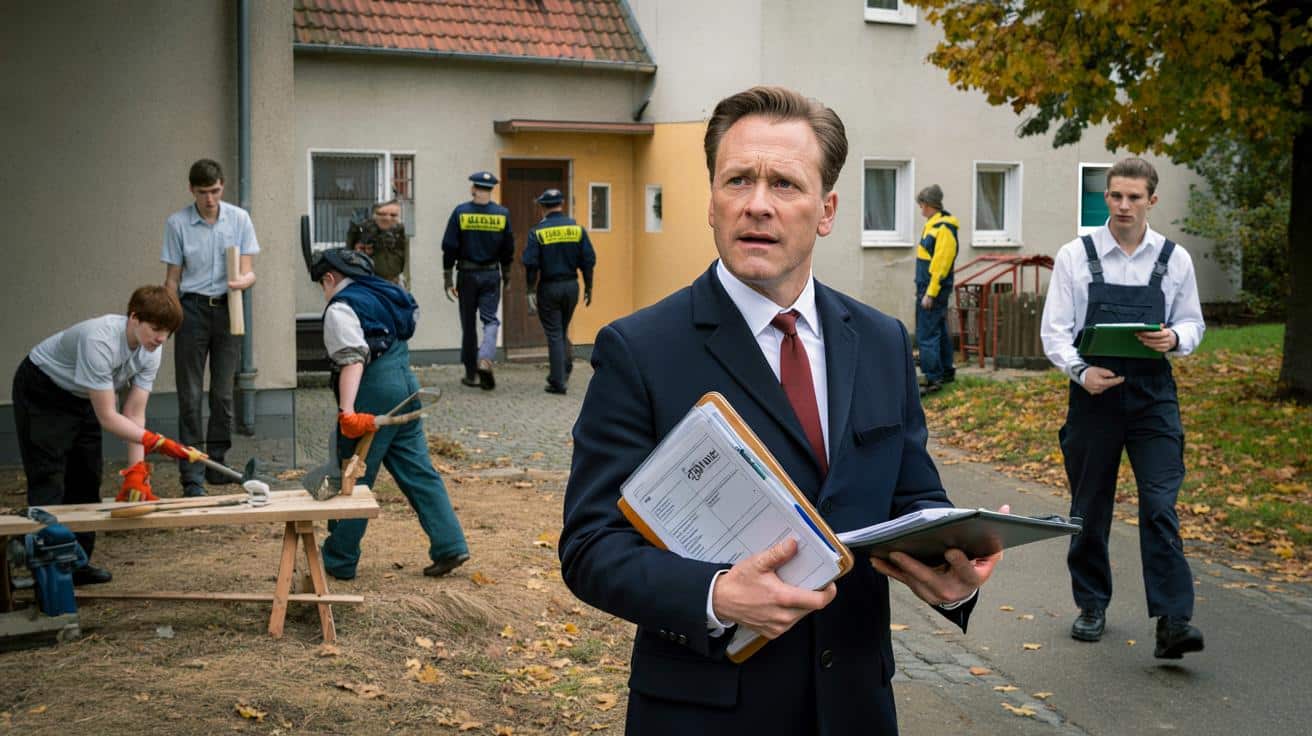
What started as a local response to youth unemployment in rural Thuringia has turned into a test case for Germany’s entire welfare debate – pitting a Social Democrat district chief against his own party colleagues in Berlin, and producing results that few in the capital had expected.
How a local SPD politician broke ranks on welfare
The story begins in Nordhausen, a district in the eastern German state of Thuringia. Local firms were complaining they could not find apprentices. At the same time, youth unemployment was rising and more under‑25s were claiming Bürgergeld, Germany’s basic welfare benefit for jobseekers.
District administrator Matthias Jendricke, a Social Democrat (SPD), asked his job centre staff what was going on. The answer shocked him. Some young claimants, he was told, openly declared they had no interest in work or training and simply wanted to receive Bürgergeld.
“I don’t want to do anything, I just want the money” – that, officials said, was the blunt message from a chunk of claimants.
Standard sanctions were not changing behaviour. Under current rules, the job centre can usually cut Bürgergeld payments by up to 30 percent for those refusing reasonable work offers. But Jendricke’s staff reported that some young people shrugged this off. One answer stuck with him: “Go ahead and cut it, my gran will top it up.”
For employees at the job centre, frustration turned into resignation. They felt powerless against hardened refusers who knew the system and its limits.
Inside the Nordhausen “work-for-benefit” model
Nordhausen decided to push the boundaries of what the law allows. The district launched a pilot: young Bürgergeld claimants under 25 could be obliged to perform community work if they had no valid reason not to work or start training.
The framework is strict but simple:
- Target group: Bürgergeld recipients under 25 without a job or apprenticeship
- Working time: 30 hours a week
- Payment: €1 per hour on top of Bürgergeld (around €120 a month)
- Type of work: community service in workshops and local services
- Sanction: benefit cuts for refusing without good reason
The young people are deployed in municipal workshops and sometimes at the district’s maintenance yard. Typical tasks include sweeping leaves, simple carpentry, minor repairs and helping with upkeep of public spaces.
➡️ France to cut its contribution to the Global Fund to Fight Aids, Tuberculosis and Malaria by 58%
➡️ The return of the aircraft carrier Truman is seen as a snub to the Navy in the war of the future
➡️ €1600 for a sliding trainer: the newest, craziest indoor cycling trend
➡️ The plant that perfumes the home and repels mosquitoes : here’s why everyone wants it in spring
➡️ He disappears in 2026: the tax break millions of households will lose
➡️ Radioactive hybrid boars are thriving in Fukushima. Now scientists finally know why
Supporters argue: if the state pays your rent and living costs, it can ask for a visible contribution in return.
The first results shocked even the organisers
In summer, the district wrote to 60 eligible young claimants and invited them to an introductory meeting. Fewer than 30 turned up. When the actual work began, just eight people showed up for duty.
Jendricke had anticipated resistance. He sent social workers, later joined by the municipal enforcement service, to visit the homes of those who did not appear.
During these checks, officials made a startling discovery: six registered claimants no longer lived at the addresses for which the state was paying rent. They were effectively drawing housing benefits for flats they did not occupy.
The district cancelled all payments for six cases – legally treated as close to benefit fraud.
In total, the job centre sanctioned 31 of the 60 invited claimants. Their benefits were cut by between 10 and 30 percent, typically €50 to €150 a month. Around 30 young people are now consistently taking part in the scheme and earning a small addition to their Bürgergeld through community work.
From “too expensive” to “a good investment”?
The federal labour ministry in Berlin, led by SPD politician Bärbel Bas, has been critical of nationwide work obligations for Bürgergeld recipients. Officials there warn of high organisational costs: supervising placements, managing absences, dealing with disputes.
Jendricke calls that argument nonsense. He insists the upfront costs pay off.
“If I get just one person off lifelong Bürgergeld through this, I save around €20,000 a year,” he argues.
The district chief admits the scheme is labour‑intensive. It only works at scale in Nordhausen because it currently targets a relatively small group: under‑25s. Keeping track of attendance, coordinating placements and following up on no‑shows eats staff time.
Yet he believes expanding such obligations to older age groups would still be worthwhile. People over 50 on benefits, he says, often know their chances on the open labour market are slim and sometimes actively seek structured community work to regain routine and social contact.
Do hard sanctions work – or just stigmatise?
Nordhausen’s experiment feeds into a fierce national debate. In the neighbouring state of Saxony‑Anhalt, conservative premier Sven Schulze (CDU) has publicly demanded that Bürgergeld recipients should perform community work as a standard obligation. His message: those who receive support from taxpayers should provide something tangible in return.
Critics from the SPD youth wing and the Greens accuse Nordhausen of practising coercive labour, stigmatising the poor and exploiting vulnerable young people for low pay. They argue the scheme sends the wrong signal in a wealthy country: that poverty is mainly a question of willpower.
Jendricke rejects those charges. He draws a sharp line between those who cannot work and those who simply will not.
“The welfare state exists for people who cannot work. If that gets blurred, acceptance among taxpayers who do work starts to erode,” he says.
He also stresses that long-term dependence on Bürgergeld harms the claimants themselves. The payments are too low to live comfortably, and long spells out of the labour market can mean poverty in old age. For him, the sofa as a permanent “career plan” is a dead end.
What happened to the young people in the scheme?
The outcomes so far are mixed. On the positive side, two participants quickly found regular jobs after the project started. Others moved into internships with local companies, using the community work as a bridge into the labour market.
Yet the reality on the ground remains messy. During a January visit to the project’s operator, Jendricke found that only about half of the 30 registered participants were actually present that day. Unreliable attendance and frequent sick notes remain a constant challenge.
The project also shifted his view on the size of the hardcore group that refuses all cooperation. Official estimates often put this at around one percent of Bürgergeld recipients. Nordhausen’s experience suggests the share could be significantly higher, at least in some regions, when controls intensify.
A looming reform that could raise the stakes
Germany’s national Bürgergeld system itself is on the political chopping block. Under a planned reform by a future conservative-led government under Friedrich Merz (CDU), Bürgergeld is expected to be reshaped into a stricter “basic security” system.
The current coalition agreement foresees tougher sanctions. While today the maximum cut is 30 percent in many cases, the new rules would allow full suspension of benefits for persistent refusers who reject all reasonable offers without justification.
Nordhausen is already preparing its files – because full benefit cuts will only hold in court if job centres can prove repeated and deliberate refusal.
Jendricke is openly waiting for this legal shift. Once complete cuts are permitted, he wants to expand the Nordhausen model from under‑25s to almost all Bürgergeld recipients in his district. He believes only a real threat of losing the entire benefit will push hardened refusers out of what he sees as self‑chosen dependency.
Key terms in Germany’s welfare debate
For readers outside Germany, some of the jargon can be confusing. Three pieces matter most to this story:
- Bürgergeld: Germany’s basic jobseekers’ benefit, replacing the older Hartz IV system. It covers living costs and housing for those with little or no income.
- Sanction: A reduction in Bürgergeld when claimants miss appointments, refuse reasonable work or ignore integration measures.
- Gemeinnützige Arbeit: Community work that serves the public, such as cleaning parks, maintaining public buildings or supporting local services.
| Aspect | Current Bürgergeld rules | Nordhausen pilot |
|---|---|---|
| Target group | All jobseekers meeting means test | Under‑25 Bürgergeld recipients without job or training |
| Work obligation | Participation in job centre measures, but no broad daily work duty | 30 hours per week of community work if no valid reason not to |
| Extra payment | Top‑ups only for specific programmes | €1 per hour on top of Bürgergeld |
| Sanction level | Usually up to 30% benefit cut | 10–30% cuts used; full loss only in fraud‑adjacent cases |
What a similar scheme could mean in practice
Imagine a 22‑year‑old in a mid‑sized German town, out of school, with no vocational training and little work history. Under a Nordhausen-style model, this person would not simply sign up for Bürgergeld and head home.
Within weeks, the job centre could assign a 30‑hour schedule: repairing park benches on Mondays, helping in a municipal workshop on Tuesdays, cleaning public buildings later in the week. Attendance would be tracked. Missed days without medical proof or serious reason would lead to written warnings, then cuts to the benefit. Persistent no‑shows could face a full suspension of payments under the planned reform.
On the positive side, that 22‑year‑old might discover practical skills, build a work routine and catch the eye of a local employer. A supervisor at the workshop could recommend them for a paid apprenticeship. Basic punctuality and teamwork, learned in community work, may help them pass a first job interview.
On the negative side, the scheme could also push those with hidden mental health problems further into crisis if pressure replaces support. Some might vanish from official records instead of integrating – couch-surfing, working cash-in-hand or relying on family, rather than facing a rigid work schedule for low pay.
Risks, benefits and open questions
Nordhausen’s experiment highlights both the promise and the tension of work‑for‑benefit models. There are clear potential benefits: better control against fraud, earlier detection of disengaged youths, and a tangible route into internships or jobs for those who respond well to structure.
The risks sit on the other side of the ledger. Community work can shade into pressure if placement quality is poor or if underlying issues such as addiction, depression or learning difficulties go untreated. Low hourly payments risk fuelling accusations of cheap labour, especially when tasks resemble regular municipal jobs.
For policymakers in Berlin and in other European capitals watching Germany’s debate, one lesson stands out from Nordhausen: strict obligations only work when they go hand in hand with close supervision, social work support and honest monitoring of what happens to those who fall through the net – not just those who show up for duty each morning.