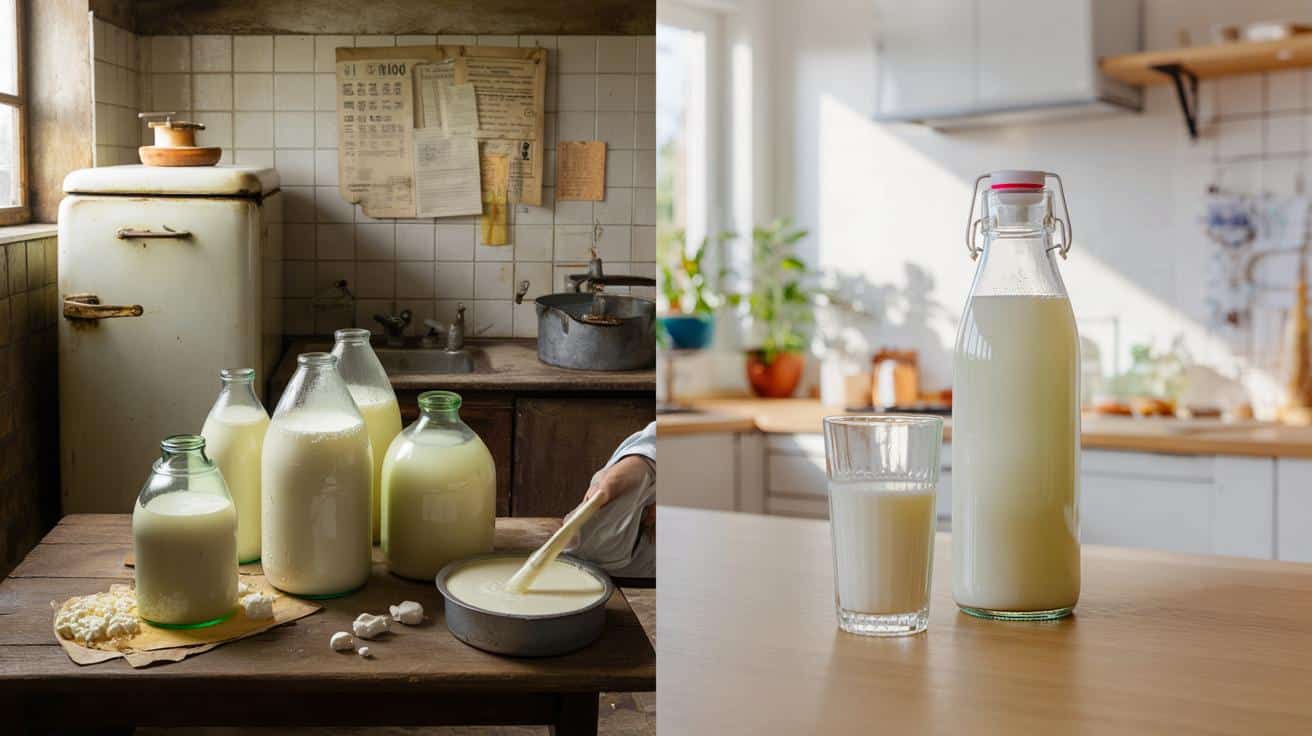
Born in the austere kitchens and dairy plants of communist-era Poland, this low-cost “milk champagne” was once a staple on shop shelves. Today, almost no one outside food-history circles remembers Serwowit – a fermented whey drink that modern gut-health influencers would probably pay good money to rebrand.
From ration cards to cult status: the rise of Serwowit
In the 1970s and 80s, Polish supermarkets were more likely to have empty fridges than rows of glossy yoghurts. Kefir with exotic fruit, Icelandic-style skyr or protein puddings simply did not exist. Milk and basic curd cheese were the norm, and everything else was considered a luxury.
That scarcity forced food technologists to get creative. One of their biggest problems was what to do with whey – the pale, slightly greenish liquid left behind after making curd cheese. Most dairies treated it as waste or animal feed.
A group of Polish specialists looked at that “waste” differently. Whey was rich in proteins, minerals and vitamins. So they set out to transform it into a drink people would actually want to buy. Out of that laboratory improvisation came Serwowit: a lightly alcoholic, tangy, sparkling beverage that ended up being sold across the country.
From a technical nuisance in dairies, whey became the base of one of the most distinctive drinks of late communist Poland.
What exactly was Serwowit?
Serwowit was a fermented whey drink with a taste somewhere between a mild kvass and an almost alcohol-free beer. It smelled faintly of yeast, was slightly cloudy and, when chilled, could be sharply refreshing on a hot day.
The production process was straightforward. Fresh sweet whey — not sour — was mixed with a small amount of sugar and baker’s yeast. Specific lactic acid bacteria were sometimes added to guide fermentation. As the microbes feasted on the sugar and lactose, they produced lactic acid, a trace amount of alcohol and natural carbonation.
That gave the drink its nickname in Poland at the time: “milk champagne”. It fizzed, it foamed, and for people used to bland, diluted cordials, it felt surprisingly luxurious for something made from what used to be an industrial by-product.
Why nutritionists are still fascinated by it
Behind the nostalgia, Serwowit was more than a curiosity. It was a concentrated package of whey proteins such as albumins and globulins, which play a role in tissue repair, including the lining of the intestine.
➡️ Evicted after $22,000 in unpaid rent, a tenant leaves behind a massive aquarium “and a hefty bill”
➡️ This European country challenges its arms industry with a homegrown rival to the Tomahawk missile
➡️ €1600 for a sliding trainer: the newest, craziest indoor cycling trend
➡️ SpaceX in merger talks with other Musk companies ahead of IPO
Fermented whey delivers easily absorbed proteins, gut-friendly acids and minerals in a form the body can use quickly.
Lactic acid formed during fermentation helped acidify the contents of the digestive tract. A slightly lower pH in the gut can slow down putrefactive processes and give “good” bacteria a competitive edge. Although Serwowit wasn’t marketed with today’s microbiome jargon, it effectively worked like a simple fermented functional drink.
Whey itself is a natural isotonic liquid. It contains calcium, phosphorus, magnesium and potassium in ratios that the body can absorb rapidly, especially after physical effort or illness. On top of that come B vitamins, notably B2 (riboflavin) and B12, which are involved in nerve function and energy production.
A forgotten rival to sports drinks
If Serwowit were created in 2026 rather than 1976, it would probably be sold in sleek cans promising “electrolytes + probiotics”. At the time, it was just an unpretentious bottling of something that worked.
- Electrolytes: calcium, magnesium, potassium and phosphorus support muscle contraction and hydration.
- Whey proteins: help repair tissues, including gut lining and muscles.
- Lactic acid: naturally preserves the drink and favours beneficial gut bacteria.
- B vitamins: assist energy metabolism and nervous system health.
While modern sports drinks often rely on synthetic additives, colouring agents and large amounts of sugar, Serwowit achieved something similar with very little intervention: just whey, a bit of sugar to feed the microbes and yeast to start fermentation.
How Serwowit was made at home
Polish households sometimes reproduced the drink in their own kitchens. The recipe was basic enough to fit on the back of a notebook:
| Ingredient | Amount | Role |
|---|---|---|
| Fresh sweet whey | 1 litre | Base liquid with proteins and minerals |
| Sugar | 2 tablespoons | Food for yeast and bacteria |
| Baker’s yeast | 2 grams | Starts fermentation and carbonation |
The process sounded more like home brewing than dairy work. A small portion of lukewarm whey was mixed with sugar and yeast until bubbles appeared on the surface. That foamy starter went back into the main batch of whey with the remaining sugar, then into sturdy glass bottles.
Those bottles needed to sit at room temperature for roughly half a day. As fermentation kicked in, pressure built up, so people used thick glass and treated the bottles a bit like hand grenades. Once the first bubbles were visible, the drink was moved to the fridge for another two or three days to mature and chill.
Could you recreate it today?
In theory, yes. Anyone who makes curd cheese at home ends up with litres of whey that often go straight down the sink. Using clean equipment, controlling temperature and not overfilling bottles would be crucial for safety.
The finished drink will contain only traces of alcohol, but because fermentation is involved, pregnant people, children and those avoiding alcohol altogether should approach it carefully. There is also a small risk of bottle explosions if gas cannot escape, so swing-top bottles or special fermentation caps are safer than solid corks.
Why gut specialists are looking again at old ferments
Modern research into the microbiome has renewed interest in traditional drinks such as kefir, kvass and fermented whey. They are not magic cures, yet they offer a different profile to commercial probiotic tablets.
Fermented dairy drinks deliver live or recently active microbes within a nutrient-rich matrix, which can support their journey through the gut.
Lactic acid bacteria from such drinks may not permanently colonise the intestines, but they can temporarily shift the balance, support digestion of lactose and interact with immune cells in the gut wall. The proteins and minerals present at the same time feed the person, not just the microbes.
For people with mildly sensitive digestion, a small glass of fermented whey on a regular basis could bring a gentle effect: less bloating, more regular bowel movements and a general feeling of lighter digestion. Those with diagnosed conditions, such as inflammatory bowel disease or severe lactose intolerance, should get personalised medical advice first, as fermented whey still contains residual lactose and active microbes.
From waste stream to wellness product
Serwowit also raises a sustainability question that sounds surprisingly modern. Turning a by-product of cheese making into a functional drink is exactly the kind of circular-economy solution food companies claim to seek today.
Large global dairies currently dry whey into protein powders, enrich sports bars and produce ingredients for infant formulas. What they rarely do is bottle it as a stand-alone everyday drink. Yet, with rising interest in upcycled foods and low-waste production, a contemporary version of Serwowit does not feel far-fetched.
A supermarket shopper who picks up flavoured kefir or kombucha might respond well to a slightly tart, lightly sparkling whey beverage positioned as “old-school gut support”. The challenge would be taste: people unfamiliar with fermented dairy sometimes react strongly to the sourness and yeasty aroma. Subtle flavouring with fruits, herbs or a touch of honey could bridge that gap without turning it into a sugary soft drink.
Practical ways to use whey if you do not want to ferment it
Even if nobody starts a Serwowit revival, the basic idea – treating whey as a resource – is accessible to anyone who makes cheese or yoghurt at home. Instead of pouring it away, you can:
- Use it as part of the liquid in bread dough for extra tenderness and subtle tang.
- Add it to pancake or waffle batter in place of milk.
- Cook grains such as rice or barley in diluted whey for more minerals.
- Blend into smoothies, especially with berries or bananas to soften the acidity.
Each of those uses brings along a portion of the proteins and minerals that made Serwowit quietly valuable. No fancy labels, no health claims, just a reminder that yesterday’s “waste” can be tomorrow’s gut-friendly staple when someone is willing to look twice at what’s already in the bottle.