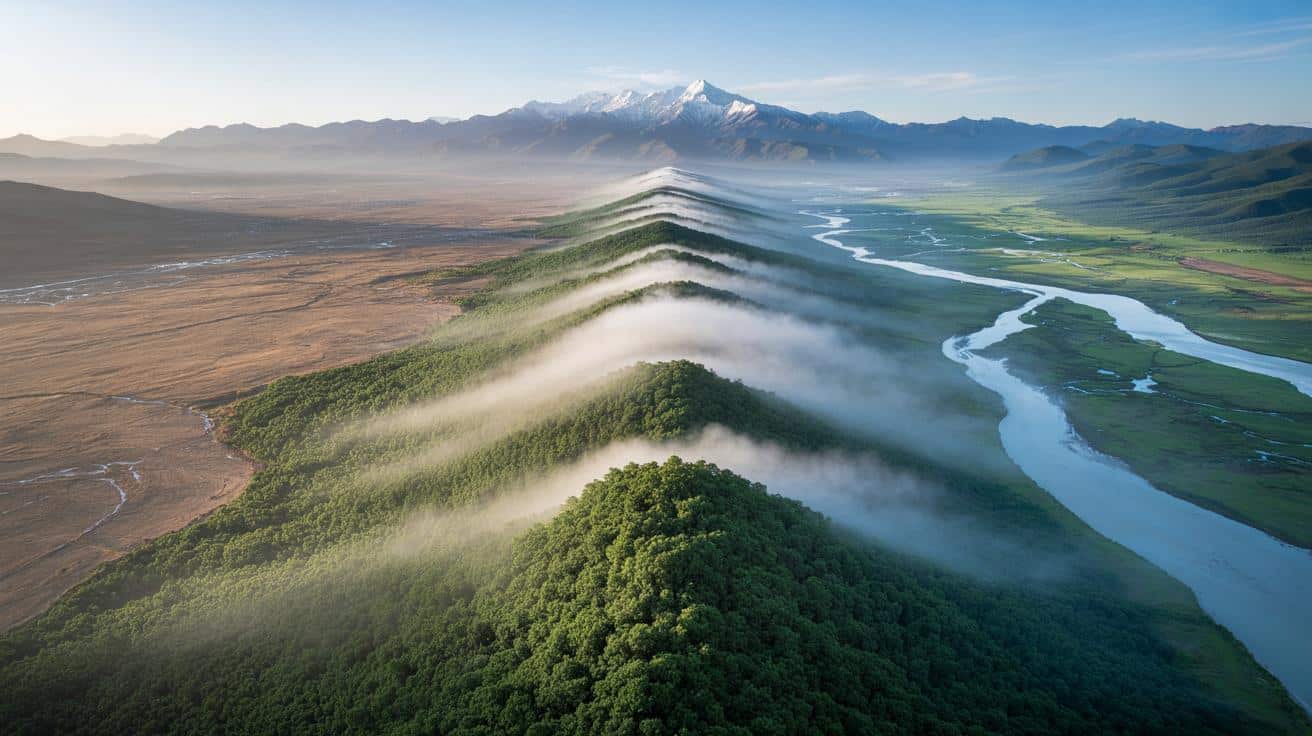
Over just two decades, an aggressive fight against dust storms, desert creep and climate change has transformed bare hills into forests. Those new trees have not only changed the scenery. They have started to redirect freshwater across almost an entire continent-sized country.
China’s great greening project that went further than planned
Since the late 1970s, Beijing has poured money, labour and political capital into an enormous reforestation drive. The goal was simple on paper: stop deserts from swallowing farmland and reduce air pollution and climate risks.
One of the flagship programmes is the so-called “Great Green Wall” in northern China, a belt of planted forest designed to block the advance of the Gobi Desert and cut dust storms that regularly choked Beijing. Launched in 1978, it has turned swathes of once-bare land into wooded areas.
Later came other major schemes, including Grain for Green and the Natural Forest Protection Programme, both rolled out in 1999. These paid farmers to abandon marginal cropland on steep slopes and encouraged planting trees instead of crops.
China’s forest cover has jumped from roughly 10% of its territory to more than 25% in about half a century, an area comparable to the size of Algeria.
According to the new research, these policies have been so extensive that China now accounts for about a quarter of the global increase in leafy vegetation recorded since the early 2000s.
How trees quietly rewrite the water cycle
Behind the latest findings lies a concept hydrologists know well: evapotranspiration. This is the combined effect of water evaporating from the ground and lakes, plus water released from plants through tiny pores in their leaves.
Grasslands and forests both increase this process, but forests do it more. Trees have deep roots that reach moisture hidden far below the surface, even in dry spells. They can keep sucking up water and sending it back into the air long after shallow-rooted plants have given up.
More trees mean more water pulled from soil and rivers, and more of that water ending up as vapour in the atmosphere.
➡️ Have you ever tried cloud eggs? This light way to cook them
➡️ The return of the aircraft carrier Truman is seen as a snub to the Navy in the war of the future
➡️ From perovskite to fusion: the energy breakthroughs finally leaving the lab in 2026
A team of six Chinese scientists and a Dutch researcher analysed changes in vegetation, rainfall and water availability between 2001 and 2020. They published their work in the journal Earth’s Future.
Their conclusion: China’s massive land-cover changes have not just greened hillsides. They have altered how moisture moves across the country, effectively “reactivating” parts of the water cycle in key regions.
Where the water is vanishing — and where it is piling up
The researchers found that evapotranspiration increased faster than rainfall over large parts of China during the last two decades. That means more water left the ground and surface waters than came back as local precipitation.
The trend is most worrying in two huge regions:
- Eastern China: the country’s main agricultural heartland, heavily populated and intensively farmed.
- Northwestern China: an already arid area where water is scarce and deserts dominate.
Together, these zones cover nearly three quarters of Chinese territory. Freshwater availability there has dropped measurably, despite the country becoming greener.
Locally, some places are losing more water to the atmosphere than they gain, even as the overall water cycle becomes more active.
At the same time, the study points to a striking contrast on the Tibetan Plateau, sometimes called Asia’s “water tower” because major rivers such as the Yangtze, Mekong and Brahmaputra rise there. In this high-altitude region, the availability of freshwater has increased, suggesting that some of the extra moisture is being recycled and falling as rain or snow far from where it first evaporated.
A country already split by water inequality
China’s water resources were unevenly spread long before the first saplings went in the ground. The north holds only around 20% of national freshwater supplies, yet hosts about 46% of the population and roughly 60% of the country’s arable land.
This imbalance has forced China to build huge engineering works, such as the South–North Water Transfer Project, a network of canals and tunnels pushing river water from the wetter south to thirsty cities and farms in the north.
Extra water loss through forests in some northern and eastern regions adds pressure to an already tight situation. The new findings suggest that any additional tree planting there needs to be weighed carefully against its impact on local rivers, groundwater and reservoirs.
Balancing forests and faucets: a complex trade-off
The study does not argue against reforestation. Forests bring major benefits: they store carbon, provide habitats for wildlife, stabilise soils, and can cool local climates. In China, they also help hold back dust and sand from deserts and reduce erosion on fragile slopes.
Yet those benefits do not arrive for free. Deep-rooted trees act almost like giant drinking straws. Where rainfall is modest and river flows are already strained, dense forests can reduce the water reaching streams and aquifers.
Whether a new forest is a net gain or a net loss depends not just on trees, but on where the water they release later falls back to Earth.
In some scenarios, extra evapotranspiration can eventually enhance regional rainfall, feeding back into river systems thousands of kilometres away. In others, the moisture is carried off by winds to fall over oceans or distant countries, offering little help locally.
| Effect of reforestation | Potential benefit | Potential risk |
|---|---|---|
| More evapotranspiration | Can boost rainfall in some downwind regions | Reduces local soil moisture and river flows |
| Deeper roots | Improves drought resilience of ecosystems | Draws down groundwater and stored soil water |
| Increased forest cover | More carbon storage and biodiversity | Competition with farming and water supply needs |
What this means for climate strategies worldwide
China is not the only country betting on trees. From Africa’s own Great Green Wall in the Sahel to massive planting campaigns in India and Latin America, large-scale reforestation has become a flagship climate solution.
The Chinese case offers a warning: planting trees at scale changes more than just carbon numbers and satellite photos. It can alter regional climate, water flows and even where droughts and floods occur.
For policymakers, that means tree-planting targets cannot be set in a vacuum. Hydrologists, climate scientists and local communities need to be involved in deciding what to plant, where, and at what density. In some dry areas, restoring native grasslands or shrublands might use less water while still bringing back life to degraded soils.
Key terms that help make sense of the science
Two concepts from the study are especially useful for readers trying to make sense of the debate.
- Evapotranspiration: the total water leaving land as vapour, both from bare surfaces and from plants. Higher values mean more water is being moved from ground to air.
- Land-cover change: the shift from one type of surface to another, such as cropland to forest, grassland to city, or desert to shrubland. Each surface has a different effect on temperature, moisture and wind.
By linking these two ideas, the researchers show how decisions about land use ripple out into river flows, rainfall patterns and long-term water security.
Looking ahead: scenarios for a drier, greener north
Imagine a northern Chinese county that converts most of its sloping wheat fields into fast-growing pine plantations. Within a decade, satellite images might show a great success story: greener hills, less erosion, more carbon absorbed from the atmosphere.
On the ground, farmers could face a different reality. Springs might weaken, shallow wells might need to be dug deeper, and irrigation canals might run lower through summer. Local authorities would then face a subtle dilemma: cut back on tree planting, or restrict water for farming and households.
Similar situations are already emerging in parts of northern China, South Africa, Australia and Spain, where introduced forests or dense plantations have shrunk stream flows. The new Chinese study reinforces the need to weigh these trade-offs before repeating the pattern on an even larger scale.
One option gaining attention is “water-smart” restoration. Instead of focusing only on the number of trees planted, planners look at species choice, spacing, and mixing forests with open areas or grasslands. Native species with moderate water needs, combined with patches of shrubs and grasses, can restore ecosystems without such a heavy impact on rivers and groundwater.
For countries racing to meet climate pledges through tree planting, China’s experience acts as a real-world experiment. Large-scale greening can succeed in restoring landscapes and locking away carbon, yet it can also move the very lifeblood of societies: their water.