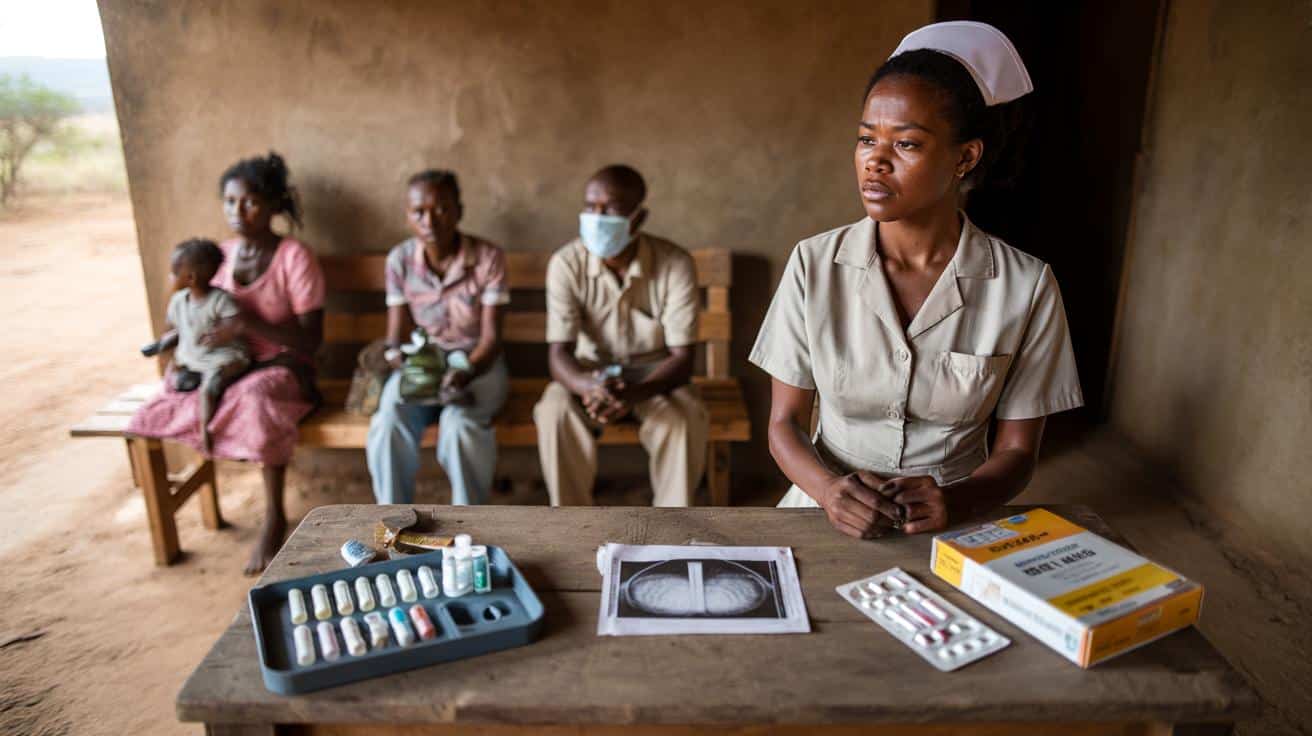
The French government has decided to sharply scale back what it gives to the Global Fund to Fight AIDS, Tuberculosis and Malaria, citing strained public finances. Health activists say the choice, taken just as new tools against HIV and TB reach clinics, risks unravelling hard‑won gains in some of the poorest countries on earth.
France steps back from its role as a major global health donor
Between 2022 and 2025, France pledged around €1.6 billion to the Global Fund. That commitment placed the country among the top donors worldwide, second only to the United States.
From 2026 to 2028, that will change dramatically. According to information leaked from within the French administration, Paris now plans to provide only €660 million across the three‑year period.
That represents a 58% reduction, stripping almost €1 billion from one of the core pillars of global health financing.
French officials argue the decision is driven by budgetary pressure and the need to rein in public debt. The government has already announced wide cuts to development aid, and the Global Fund contribution has been swept into that broader austerity drive.
The Global Fund: a key player in the fight against three major killers
Since its creation in 2002, the Global Fund has become the financial engine behind many national programmes tackling HIV, tuberculosis and malaria. Countries submit funding requests, and the Fund backs plans that are aligned with scientific evidence and local priorities.
The institution estimates that, over roughly 25 years of operations, its investments have helped save 70 million lives globally.
Its model channels donor money into:
- ARV treatment and prevention for people living with or at risk of HIV
- Diagnosis, treatment and community support for tuberculosis patients
- Insecticide‑treated bed nets, medicines and rapid tests to push back malaria
For many low‑income countries, Global Fund grants are not a bonus; they are the backbone of national responses. When a large donor steps back, the gap is rarely filled overnight by domestic budgets or new partners.
➡️ India watches nervously as its biggest rival moves to buy 50 new warships
➡️ China Has Planted So Many Trees It Has Changed The Water Cycle
➡️ Radioactive hybrid boars are thriving in Fukushima. Now scientists finally know why
➡️ SpaceX in merger talks with other Musk companies ahead of IPO
After Washington’s retreat, another heavy blow
The shock of France’s move comes on top of previous turbulence. Under Donald Trump, the United States reduced and at times threatened its contributions to the Global Fund, creating uncertainty around multi‑year planning.
With Washington’s earlier retreat and Paris’s new cut, the Global Fund risks losing a huge slice of the money it receives from its two largest historical backers.
That dual hit could force the Fund to shrink or cancel entire country programmes, rather than making small technical adjustments.
For governments in sub‑Saharan Africa or parts of Asia that rely on Global Fund grants, that means renegotiating priorities, postponing new projects and potentially cutting patients off from lifesaving care.
What could this mean on the ground?
Programmes at risk of stopping overnight
Non‑governmental organisations that implement Global Fund‑backed projects are sounding the alarm. Médecins du Monde, which runs TB and HIV interventions with Global Fund support, warns that some programmes might end “from one day to the next” if grants are not renewed.
That risk is particularly acute for services that already operate on thin margins, such as community‑based HIV testing, outreach for sex workers or migrants, or TB contact tracing in informal settlements.
| Area | Typical Global Fund support | Potential impact of cuts |
|---|---|---|
| HIV | Prevention, antiretroviral drugs, lab tests | Interrupted treatment, higher transmission rates |
| Tuberculosis | Screening, drug regimens, community workers | More untreated cases, rise in drug‑resistant TB |
| Malaria | Bed nets, rapid tests, medicines | Resurgence of cases, new outbreaks in high‑risk zones |
The timing is particularly bitter for health workers. In South Africa, for instance, nurses recently started using long‑acting HIV preventive treatments that can cut the risk of infection by more than 99%. These advances rely on stable funding for drugs, training and patient follow‑up. A sudden drop in money can slow the rollout of such innovations to the people who need them most.
Setback for fragile health systems
Beyond the three target diseases, the Global Fund often finances lab equipment, digital record systems, and training that strengthen entire health systems. Those investments help countries detect outbreaks faster and manage other conditions, from COVID‑19 to cholera.
When budgets are slashed, governments can be forced to choose between keeping basic TB treatment running and maintaining these wider system improvements. Short‑term survival needs usually win, but long‑term resilience suffers.
France’s wider pullback on development aid
The cut to the Global Fund sits within a broader shift in French aid policy. In its 2026 budget, the government has programmed an €800 million reduction in official development assistance, often abbreviated as ODA.
French ODA will stand at around €3.6 billion in 2026. That is an 18% drop compared with the previous year and a fall of 38% compared with 2024.
Such a rapid contraction is unusual among large donor countries, especially as global crises multiply, from climate shocks to conflicts and displacement. Countries that had come to rely on France as a long‑term partner now face uncertainty over future health, education and climate projects.
Why budget choices in Paris resonate worldwide
For a taxpayer in France, these numbers may feel abstract. For a rural clinic in West Africa or a TB ward in Eastern Europe, they are highly concrete. Global Fund grants pay the salaries of nurses, fund diagnostic machines and stock pharmacy shelves.
Once a nurse leaves a job because a project closes, that expertise is hard to rebuild. When TB treatment is interrupted, some patients develop drug‑resistant strains that are far more expensive and complex to treat. What looks like a short‑term saving can lead to higher global costs a few years down the line.
Health budgets are not just about financial spreadsheets; they shape the trajectory of epidemics for decades.
Key terms and what they actually mean
The debate around this decision is full of technical language. A few concepts help clarify what is at stake.
Official development assistance (ODA)
ODA is the term used for government money that flows from richer countries to support economic and social development in lower‑income nations. It can fund schools, roads, climate projects and health systems.
When ODA falls sharply, governments in poorer countries often have little room to replace it through taxes or private investment, especially in the short term. Health sectors, which rarely produce quick financial returns, are frequent victims.
Conditional grants vs national budgets
Global Fund money is usually provided as grants tied to specific health objectives. That makes it different from general budget support, which governments can spend more freely.
If a country loses a Global Fund grant, it cannot easily reassign money from other areas like infrastructure or security to cover the gap. The result can be abrupt cuts in services even when overall national spending still rises.
Possible scenarios: who fills the gap?
In the coming months, pressure will likely grow on other donors such as Germany, the UK, the European Union and private foundations to increase their contributions to the Global Fund. Some may step up, but matching a loss of nearly €1 billion from France will be difficult.
The Fund itself could respond by tightening eligibility rules, concentrating limited money on the countries with the highest burdens of HIV, TB and malaria. Middle‑income countries might be pushed to transition faster to domestic funding, even when inequality and weak tax systems make that shift painful.
Another scenario is that new financing mechanisms, from innovative taxes to pandemic preparedness funds, attempt to cover part of the shortfall. These instruments take time to set up and rarely move at the speed required to keep a nurse on a ward next month or a TB lab open this year.
For now, clinics, health workers and patients in dozens of countries are left waiting to see how a budget line in Paris will alter daily life on the frontlines of three still‑deadly diseases.