The French sociologist François Dubet argues that higher education has become both a near-obligatory passage and a shrinking guarantee of a good life, forcing families and policymakers to rethink what a degree is really worth.
The quiet revolution: how higher education became the norm
In the space of two generations, France has gone from an elite system to mass higher education. In the 1960s, the baccalauréat opened the doors of a rare and prestigious university world. Today, around eight in ten young people in France obtain the “bac”, and more than half move into some form of higher education.
For Dubet, this is no accident. Since the 1960s, “massification” of schooling has been the central compass of French education policy. The ambition sounded almost self-evident: by opening the school and pushing everyone further, social inequalities would fade.
The promise was simple: more diplomas, more equality, more prosperity, more democracy.
This vision drew on two powerful beliefs. Economists framed education as “human capital”: raise the skill level of the population and productivity, growth and innovation follow. At the same time, political leaders saw schools and universities as training grounds for enlightened citizens, strengthening democracy by making people better informed and more critical.
That project, at least on the surface, worked. Being a student is now the ordinary condition of youth, including in working-class families that, a generation ago, rarely set foot in lecture halls. Going to university, or a vocational college, or a business or engineering school, is no longer an exception. It is the default plan.
Degrees everywhere, hierarchy intact
Yet something in this apparent success story does not add up. If almost everyone climbs higher, do they really climb at all? Dubet’s answer is uncomfortable: the expansion of higher education has not erased hierarchies between different types of institutions and courses. It has largely reproduced them.
The French system, highly stratified, sorts students from an early age. General tracks, vocational streams, technologic pathways, selective grandes écoles, non-selective universities – each sits at a different rung of prestige. As more students progress, the ladder remains firmly in place.
The title may be the same – “graduate” – but the value attached to it varies sharply by institution and field.
➡️ A peek inside Physical Intelligence, the startup building Silicon Valley’s buzziest robot brains
➡️ After Replacing 90% Of His Staff With AI, An Indian Founder Reveals An Unexpected Outcome
➡️ Interior Design: Why going slow will save you money in the long run
➡️ If you’re over 60, this is why prolonged sitting feels harsher
In practice, access to the most selective and best-rewarded courses remains dominated by the most advantaged families. Children from professional and managerial backgrounds are over-represented in grandes écoles and elite business and engineering schools. Students from low-income households are more likely to crowd into under-funded university tracks or short vocational programmes with weaker labour-market connections.
Mass higher education has expanded participation, yet preserved the core structure of inequality. The game has more players, but the winners’ podium is not much bigger.
More indispensable, less profitable
This tension leads to Dubet’s striking diagnosis: the diploma is both more necessary and less rewarding than before. In mid‑20th‑century France, holding a degree almost automatically translated into a clear social and economic advantage. A university qualification sharply distinguished its holder from the majority.
Today, the degree functions as a basic filter. Without some sort of post‑secondary qualification, the chances of finding stable, decently paid work are slim. But with a degree, nothing is guaranteed. Under‑employment, precarious contracts and stalled careers are now common in graduate life.
The floor has risen for everyone, yet the ceiling has not moved much, and many find themselves stuck in between.
For many families, this creates a paradoxical pressure. They feel they cannot afford not to send their children into higher education, even though they are less sure than ever that the investment will “pay off”. The anxiety is sharper in working-class households, where the costs and risks are felt more keenly and where the cultural codes of selective institutions may feel remote.
Why the return on degrees is shrinking
Several forces sit behind this growing sense that degrees buy less than they used to.
- Credential inflation: Jobs that once required secondary school now demand a bachelor’s or even a master’s, without a fundamental change in tasks.
- Slower growth: In many advanced economies, including France, economic growth has decelerated, limiting the number of high-status, high-pay positions.
- Field mismatch: Students often cluster in popular disciplines with weak links to current labour-market needs, creating pockets of graduate unemployment.
- Territorial inequalities: Opportunities for internships, networks and first jobs concentrate in major urban centres, hurting graduates from smaller towns and rural regions.
This does not mean that education has lost all value. Graduates, on average, still earn more and face lower unemployment than those without degrees. The point, for Dubet, is that the relative advantage has narrowed and become more fragile.
Winners, strugglers and the new geography of diplomas
The massification of higher education has produced very different experiences across social groups. Three typical situations help illustrate the new landscape.
| Profile | Type of course | Typical outcome |
|---|---|---|
| “Insiders” from privileged families | Selective preparatory classes, grandes écoles, top business/engineering schools | High probability of well-paid, stable jobs and strong professional networks |
| “Mass” university students | Non-selective undergraduate degrees in humanities, social sciences, law | More uncertain job prospects; often require extra diplomas or professionalisation |
| Short vocational tracks | Two- or three-year technical courses, applied vocational programmes | Fast entry into labour market; outcomes depend heavily on sector and local ties |
For the first group, the diploma remains a powerful passport. For the second, it may feel like a ticket to a long queue. For the third, the diploma can be effective, but its value hinges on detailed local dynamics: a strong industrial region can absorb many technicians; a shrinking one leaves them adrift.
What this means for young people and parents
These shifts force families into complex calculations. A master’s degree, once seen as a near-certain shield against unemployment, now looks more like a necessary bet with uneven odds.
Many young people sense this tension and increasingly combine formal study with side jobs, entrepreneurial projects or extended internships. They try to build skills and networks outside the classroom to stand out in a crowded field of graduates.
The new rule is not just “get a degree”, but “get the right degree, in the right place, with the right experiences attached”.
Parents often find themselves caught between encouraging ambition and managing expectations. Pushing a child towards a long, academic route that leads to a saturated profession can be as risky as steering them away from higher education altogether. Clear information about employment outcomes by course and institution, still patchy in many countries, becomes a quiet form of social protection.
Degrees, democracy and disappointment
The mass expansion of higher education carried a democratic promise: a more educated citizenry, able to take part in public debates and hold leaders accountable. On some counts, this has materialised. Young people are more informed, more comfortable with complex issues, more connected.
Yet the gap between high expectations and real opportunities can breed resentment. When the message for decades has been “study and you will succeed”, the experience of precarious work or blocked careers feels like a broken contract. This sentiment feeds disillusion with institutions and mistrust towards elites who, often, still benefit from the old, secure pathways.
For Dubet, the issue is not only economic but civic. A society that floods its youth with diplomas while offering too few corresponding roles risks creating a layer of “frustrated graduates”, caught between promises and reality.
Key terms behind the debate
Several notions shape this conversation and are worth unpacking:
- Massification: The process by which access to schooling or university expands from a small elite to the majority of a generation.
- Human capital: The economic idea that education increases individuals’ productivity and, collectively, a country’s growth potential.
- Credential inflation: The tendency for more and more degrees to be required for similar jobs, reducing the distinctive value of each qualification.
Understanding these terms helps explain why a master’s degree today does not mean the same thing it did in 1980, even if the certificate looks similar.
Scenarios: the same degree in different futures
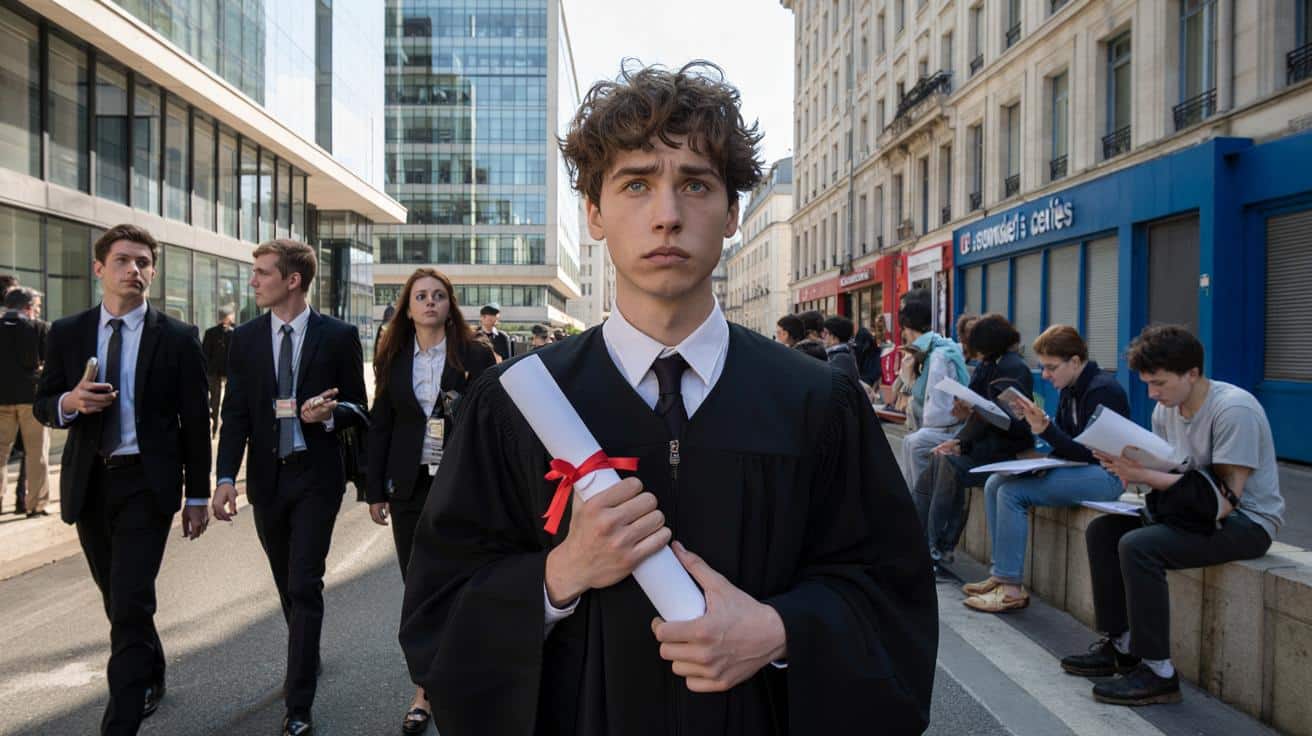
Imagine three students finishing the same master’s in economics and management, the kind celebrated at graduation ceremonies in places like Cergy.
The first, from a well-connected Parisian family, secures a prestigious internship through personal contacts, converts it into a permanent contract, and uses alumni networks to climb rapidly.
The second, from a provincial town, graduates with good marks but no strong network. After a series of short-term contracts and unpaid internships, she eventually stabilises in a mid-level job below her qualification level.
The third, facing financial pressure, works part-time throughout his studies, finishes late, and enters a weak local labour market. His degree remains useful, but he shifts into a different field altogether, relying more on his job experience than on what he learned at university.
All three hold the same diploma. Their lives, incomes and sense of fairness differ sharply. This is the landscape Dubet is describing: one where the diploma still matters, but where its power is filtered through social origin, territory, institutional prestige and timing.
For policymakers, teachers and families, the challenge is less about sending ever more young people into lecture halls, and more about ensuring that the pathways they follow, and the jobs they reach, match the hopes that have been invested in that fragile piece of paper.