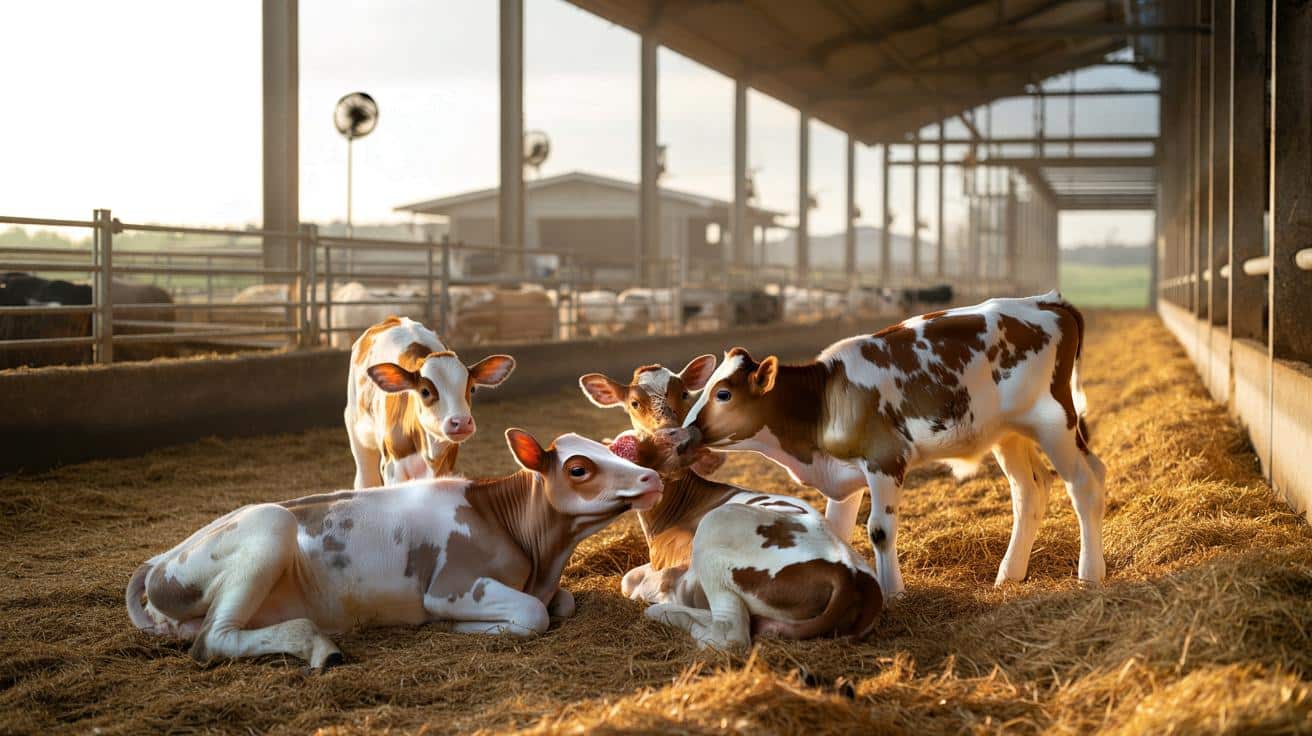
The way young calves are housed can quietly shape their health, growth and future milk yield. Behind every plastic hutch, straw bed and air vent lies a set of choices that make the difference between a thriving animal and one that struggles from the start.
Why housing shapes a calf’s entire future
Calves arrive in a world packed with germs, temperature swings and social stress. Their immune systems are still learning. Their rumens are barely starting to function. In this fragile window, the building they live in can protect them or expose them.
Good housing is less about fancy equipment and more about meeting the calf’s basic needs every single day.
Those needs are simple to list and harder to meet consistently: clean, dry bedding; fresh air without draughts; space to lie down and get up easily; a layout that keeps disease from spreading; and a routine that fits the way staff actually work.
Individual housing: a useful start, not a long-term plan
Why many farmers still start calves alone
From birth to around three weeks of age, individual pens or hutches remain common on European and North American farms. The logic is clear: separating calves cuts down direct nose-to-nose contact and reduces early disease transmission.
Used well, individual housing lets farmers:
- Watch each calf’s milk intake and faeces closely
- Spot early signs of scours or pneumonia
- Isolate weak or high-value animals when needed
- Schedule cleaning and disinfection between occupants
Regulation still sets limits. In conventional systems, long-term isolation is usually banned beyond eight weeks. Organic standards tend to be stricter, sometimes allowing only a few days of full isolation before calves must at least see and touch another animal.
Interaction still matters, even in single pens
Keeping calves alone does not mean cutting them off from all contact. Pens or hutches can be laid out so that calves can sniff, lick or at least see their neighbours through railings or mesh.
Calves raised in visual and tactile contact with peers often show better social behaviour and feed intake later on.
➡️ In The 80s everyone drank it, now it’s forgotten – and it quietly nourishes your gut
➡️ Before Trees, Earth Was Ruled By Giant Life Forms That Seem From Another World
➡️ 2,400-year-old Hercules shrine and elite tombs discovered outside ancient Rome’s walls
➡️ Expanding AI Career Access Through Skills Based Evaluation
➡️ France to cut its contribution to the Global Fund to Fight Aids, Tuberculosis and Malaria by 58%
Once a calf leaves an individual pen, the job is not finished. The empty space has to be cleaned, dried and left unused for a period, often called the “sanitary break”. Sunlight and dryness remain powerful, low-cost disinfectants, provided organic matter has been removed first.
Hutches, pens and the trade-offs behind each choice
Outdoor hutches: tiny microclimates on the yard
Plastic or fibreglass hutches have become a familiar sight on many dairy units. Each small “igloo” creates a microclimate that shelters a calf from wind and rain, while still offering plenty of fresh air at the front.
They are easy to install and move. Cleaning underneath and between occupants is fairly straightforward. Hutches can also be grouped in lines or pods, making feeding rounds efficient.
They come with constraints, though. A run of hutches eats up yard space. In hot summers, they can turn into ovens without shade or good orientation. And because each calf is outside and a little further from the main building, staff need tight routines to catch problems early.
Indoor pens: comfort and convenience, if air is right
Individual pens inside a calf barn change the balance again. Staff work under one roof, protected from the weather. Surfaces can be designed for easier scraping, bedding and washing. Lighting and feeding equipment can be centralised.
The risk shifts from rain and temperature shocks to indoor “ambience”: air quality, humidity and heat build-up. In a closed building, one sick calf coughing in a poorly ventilated row can expose the rest quickly.
Farmers who pick indoor pens often invest more time in:
- Checking temperature ranges throughout the day
- Monitoring humidity and ammonia smell
- Avoiding overcrowded nurseries in warm months
- Maintaining fans, inlets and outlets so air actually moves
Dedicated isolation space: not just for show
A separate corner for sick calves is one of the simplest biosecurity steps, yet it is still missing on many units. A basic isolation pen, easy to clean and clearly apart from the main group, helps contain outbreaks.
Some farms also keep male dairy calves in a distinct area, with a layout suited to buyers and transport. That separation reduces the risk of disease moving back and forth between replacement heifers and animals that will leave the farm earlier.
When it is time for calves to live together
Building groups that work, not just fill space
After a few weeks, calves move into group pens. Done right, group housing supports better social development, encourages starter intake and often cuts labour per calf.
Age spread inside each group matters. Many advisers recommend a maximum of three weeks’ difference from the youngest to the oldest. Beyond that, stronger calves can outcompete smaller ones at the trough and become a reservoir for bugs that younger animals have never met.
Homogeneous groups allow consistent feeding plans, fewer fights at the feed rail and calmer daily routines.
Space calculations go beyond simple floor area. There needs to be enough lying space for all calves to rest at once, plus enough room at the feeder so that shy animals still get their share.
Designing pens that are easy to clean, not just to build
Whatever the group size, pens only stay healthy if they can be cleaned properly. That means gates that open wide, alleys that machinery can access, and somewhere to park calves safely during mucking out.
Options include:
- Self-cleaning scrapers or slatted passages behind lying areas
- Longer pens with a temporary barrier to hold calves while one side is scraped
- Removable partitions that let staff move animals in a loop, always forward
A clear “one-way” movement pattern, where staff always check the youngest and healthiest calves first and sick pens last, limits the chance of carrying pathogens on boots or equipment.
Hygiene: a three-week window that pays off
From dirty straw to clean concrete
Between batches or individual calves, a full cleaning cycle brings disease pressure down sharply. Many advisers now push for at least a three-week gap where a pen stands empty.
The recommended sequence looks like this:
| Step | Purpose |
|---|---|
| 1. Remove bedding and manure | Get rid of organic matter that protects germs |
| 2. Wash with high-pressure water | Physically detach dirt and biofilm |
| 3. Use hot water if possible | Improve grease removal and kill more microbes |
| 4. Apply broad-spectrum disinfectant | Target bacteria, viruses, fungi and parasite eggs |
| 5. Leave surfaces to dry completely | Let time and dryness finish the job |
Skipping the drying phase often undermines the whole process. Many disinfectants work less well on wet, cold surfaces, and damp corners help pathogens bounce back.
Air: fresh, moving, but never blasting
Ventilation without chilling backs
Calf barns need oxygen-rich air to sweep out moisture and dust. Stagnant air with high humidity creates a double hit: germs linger longer, and wet bedding chills calves from below.
“Air, but no draughts” sums up modern calf ventilation.
As a rough guide, very young calves (under two months) are often housed with 5 to 7 cubic metres of air space each. Older calves, up to six months, need roughly double that. These are starting points, not fixed laws, and local climate has a strong influence.
Large daily swings in temperature also stress the immune system. Keeping changes to within around 6°C over 24 hours is a common target. Evening checks often reveal unexpected drops near doors or vents that felt fine at midday.
Creating microclimates inside bigger spaces
When a barn feels too cold or draughty, the answer is not always to shut every opening. Instead, many farmers create warmer “bubbles” inside a ventilated building.
Simple tricks include:
- Lightweight, removable false ceilings above calf pens
- Solid side partitions between groups to break air currents
- Calf jackets during the coldest weeks for the smallest animals
These measures keep cold air from dropping directly onto calves’ backs while still letting stale, humid air escape at higher levels.
Practical scenarios: what happens when things go wrong
Imagine a summer where the nursery fills up faster than planned. Extra calves are squeezed into an already busy shed. The building feels only “a bit warm” to humans, but humidity rises. Within days, a couple of calves start coughing. Staff treat them, but ventilation stays unchanged. Within two weeks, pneumonia runs through the group.
In another case, winter brings a cold snap. Doors are kept shut to keep heat in. The air turns heavy, and ammonia smell is strong by morning. Diarrhoea cases get harder to clear because calves breathe in germs all night. Yet bedding looks deep and golden, giving a false sense of security.
In both situations, the core problem sits in the housing design and routines: too many animals, not enough fresh air, no empty period to reset disease pressure.
Key terms and how they play out on farm
Two expressions come up again and again in calf housing: “sanitary break” and “forward flow”. Both sound technical, but they simply describe time and direction.
The sanitary break is the quiet gap between batches. No calves, no feeding, just an empty, clean pen drying out. Longer gaps mean fewer residual germs. Short gaps let infections smoulder between generations.
Forward flow is the idea that people, tools and animals always move in one direction: from the youngest and healthiest calves to the oldest and sickest, never backwards. This single change in routine can reduce cross-contamination even in old buildings that are far from perfect.
When farmers combine thoughtful housing design, strict cleaning and smart movement patterns, they tend to report the same pattern: fewer treatments, steadier growth rates and calves that reach weaning with less struggle. The investment sits as much in daily habits as in concrete and steel.