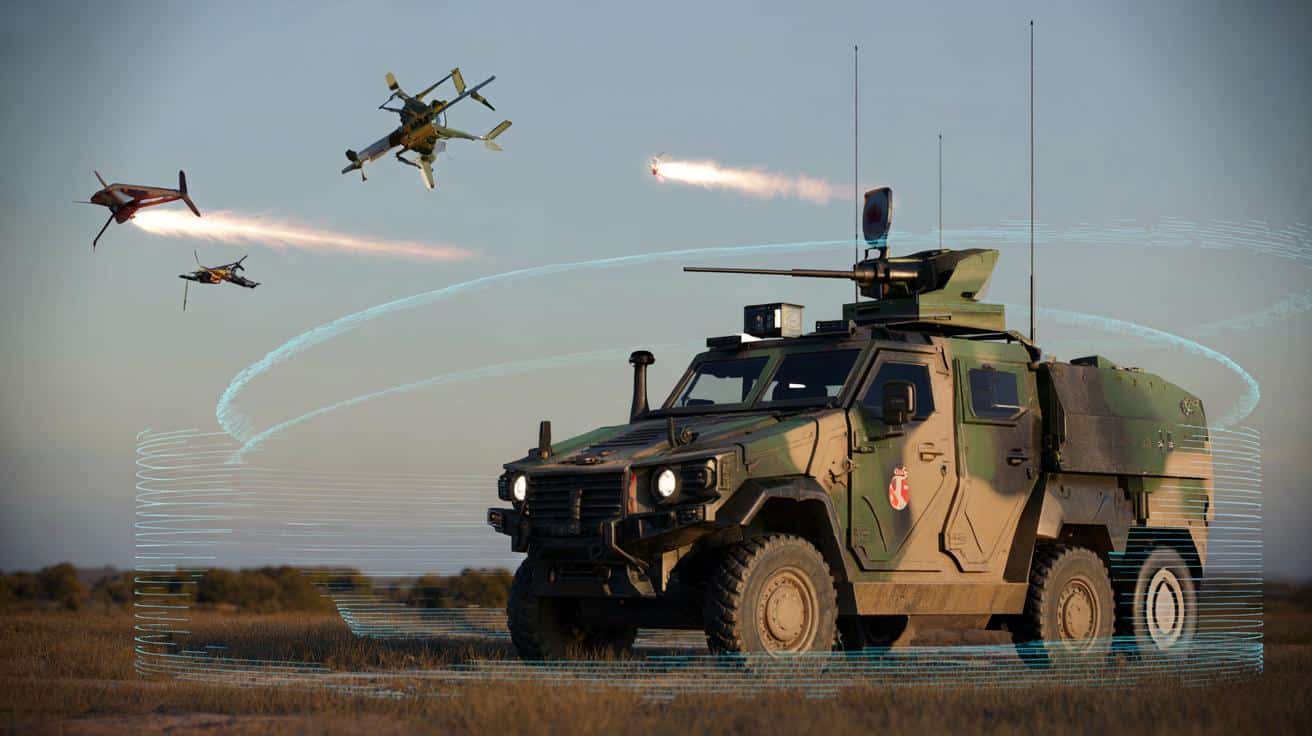
The vehicle looks like a compact troop carrier, but commanders see something else: a rolling data centre, an electronic shield and a frontline command post built for drone-saturated battlefields.
A new armoured brain for high‑intensity warfare
France’s army is fielding the Serval “Appui” variant, a 17‑ton class armoured vehicle designed from the ground up for high‑intensity, tech-heavy conflict. Thirty units have already been delivered, with 500 more due by 2033, making it one of the most ambitious land programmes currently underway in Europe.
Unlike traditional infantry carriers, the Serval Appui is built to fight in an environment filled with cheap drones, precision artillery and relentless electronic warfare. It is part of the broader French SCORPION modernisation programme, which replaces ageing vehicles and connects units through a shared digital architecture.
The Serval Appui acts as a mobile command node, an electronic warfare hub and an anti‑drone platform wrapped into a single 4×4 armoured chassis.
French planners want to move fast. Instead of long, isolated test campaigns, Serval Appui vehicles are being integrated directly into combat units. They will be trialled in real exercises in Europe, the Sahel and overseas territories, where lessons from Ukraine, Gaza and Nagorno‑Karabakh weigh heavily on doctrine.
An industrial push anchored in France
Behind the Serval lies a dense industrial network the French government sees as strategic. The vehicle is produced by KNDS France (the company formed around Nexter) and Texelis, with a contract covering 530 vehicles valued at over €1 billion.
Production lines in Satory, Roanne, Bourges and Limoges are running at pace, backed by about 30 key subcontractors. Groups such as MBDA and Safran provide sensors, effectors and mission systems, while smaller firms feed in specialist electronics and armour components.
The aim is to keep critical components under national control and to guarantee spare parts, software updates and upgrades without foreign pressure.
For France, this is not only about equipping its own army. A domestic, exportable vehicle in the 15–17 tonne class gives Paris an option to court partners in Eastern Europe, the Middle East and Africa who are looking for modern but relatively light armoured platforms.
➡️ From perovskite to fusion: the energy breakthroughs finally leaving the lab in 2026
➡️ Before Trees, Earth Was Ruled By Giant Life Forms That Seem From Another World
➡️ France and Germany plan a new “Airbus of military lasers” with MBDA & Rheinmetall joint venture
➡️ This 1,500 hp monster could put Turkey in an elite tank‑engine club France left years ago
Technical profile: compact, protected and configurable
A 17‑ton shell shaped for modern threats
The Serval’s weight varies between roughly 15 and 17 tonnes, depending on armour and mission kits. The vehicle is about 6.5 metres long and 2.5 metres wide, with space for eight fully equipped soldiers in addition to the driver and vehicle commander.
Its welded hull is designed to withstand small‑arms fire, shell splinters and roadside bombs. The floor is shaped and reinforced to deflect the blast of improvised explosive devices, echoing lessons from Afghanistan, Iraq and the Sahel.
- Combat weight: 15–17 tonnes
- Crew: 2 (driver, commander) + 8 infantry
- Length: ~6.5 m
- Width: ~2.5 m
- Role: command support, electronic warfare, air defence, anti‑drone
Additional armour kits can be bolted on for higher‑risk missions. Servals can also receive NRBC (nuclear, radiological, biological and chemical) protection packs, as well as pods dedicated to electronic warfare or counter‑drone operations.
Mobility tuned for rapid deployments
At the heart of the vehicle sits a 375‑horsepower diesel engine linked to a six‑speed automatic transmission. On road, the Serval can exceed 100 km/h, with a range of up to 800 km on a full tank. Its 4×4 chassis and independent suspension are designed for rough, broken terrain rather than purely urban use.
Strategic mobility has also been baked in. Two Servals can fit into an A400M Atlas transport aircraft, and a single one into a C‑130 Hercules, allowing French forces to airlift them to overseas theatres or NATO’s eastern flank within hours.
The French army wants a vehicle that can drive off a transport aircraft in the morning and be plugged into a complex digital battlespace by the afternoon.
Digital backbone: 360° eyes and constant connectivity
The Serval Appui is less about the thickness of its armour than the richness of its electronics. It is fully integrated into the SCORPION digital ecosystem, which also links the Griffon infantry carrier, Jaguar reconnaissance vehicle and upgraded Leclerc tank.
The vehicle is ringed with 360‑degree day and night cameras, thermal imagers and laser warning sensors. Inside, a digital battle management system shows friendly and enemy positions on shared maps and lets crews exchange data, video feeds and target coordinates with nearby units.
At the heart of its connectivity are CONTACT tactical radios and a satellite link compatible with the Syracuse IV constellation. That combination keeps the Serval connected even in regions where infrastructure is damaged or local networks are heavily jammed.
Jamming drones and defending the sky
The system that attracts most attention is BARAGE, a set of electronic warfare tools tailored to counter drones. French officers will not discuss precise ranges or frequencies, but the aim is clear: disrupt or break the control links of hostile UAVs before they can strike.
Equipped with BARAGE, a single Serval Appui can provide a protective electronic “bubble” against commercial quadcopters and more sophisticated reconnaissance drones.
In export or specialised variants, the Serval can also carry short‑range Mistral 3 missiles to engage low‑flying aircraft, helicopters or loitering munitions. Pairing radar, electro‑optical sensors and missiles on such a mobile platform turns it into a compact air‑defence node for manoeuvre units.
Variants tailored for firepower, defence and command
The Serval Appui is not a one‑off configuration but a base platform for several mission types. French planning documents outline at least three main families:
- Air‑defence variant: armed with Mistral 3 missiles, a 3D radar and target tracking systems to protect brigades from air threats.
- Anti‑drone / fire support variant: equipped with a 30 mm cannon, sensors and electronic warfare modules to spot and neutralise drone swarms.
- Communication and command variant: packed with radios, servers and antennas, acting as a resilient mobile headquarters in jammed environments.
By using a common chassis and many shared components, the army hopes to simplify maintenance and logistics while still offering very different capabilities on the battlefield.
Delivery schedule through 2033
| Delivery phase | Planned units | Status |
| Phase 1 (2026) | 30 vehicles | Delivered |
| Phase 2 (2027–2029) | 250 vehicles | In production |
| Phase 3 (2030–2033) | 250 vehicles | Planned |
This staggered schedule gives room to tweak later batches based on combat feedback, technology shifts and budget constraints.
How this changes combat on a drone-heavy battlefield
Recent conflicts have shown how quickly small drones can erode traditional advantages. Cheap quadcopters spot armoured vehicles. Loitering munitions hit command posts. GPS signals are jammed or spoofed. In that environment, vehicles like the Serval Appui serve as both shield and nervous system for ground forces.
On a typical operation, a Serval could sit slightly behind the frontline, antennas raised, monitoring the electromagnetic spectrum. When hostile drones appear on radar or cameras, its crew would trigger jammers, share coordinates with nearby tanks and infantry, and assign air‑defence shooters to engage. At the same time, commanders inside the vehicle would keep chat channels and digital maps alive, even if civilian networks collapse.
This kind of resilience is becoming a central metric of modern land forces. Armour and firepower still matter, but continuity of command and information flow often decide whether units can keep fighting after the first wave of strikes.
Key terms and risks worth watching
Some of the jargon around the Serval masks simple ideas. “Electronic warfare” covers any military use of the electromagnetic spectrum to sense, disrupt or deceive. “Counter‑drone” tools can be kinetic (guns, missiles) or non‑kinetic (jamming, spoofing GPS, hacking control links). “SCORPION” is essentially the French label for a network‑centric approach where every vehicle and soldier is a sensor and a data node.
There are, of course, risks. Heavily networked vehicles can become attractive targets for cyber attacks if software updates and encryption are not carefully managed. Powerful jammers may interfere with friendly systems if coordination is poor. And the more electronics a vehicle carries, the more it depends on a secure supply of chips and specialist components that are currently under global pressure.
Still, the Serval Appui offers a window into where Western land forces are heading: lighter than a main battle tank, more connected than older command vehicles, and built from the start to fight in a sky buzzing with drones and a spectrum thick with electronic noise.