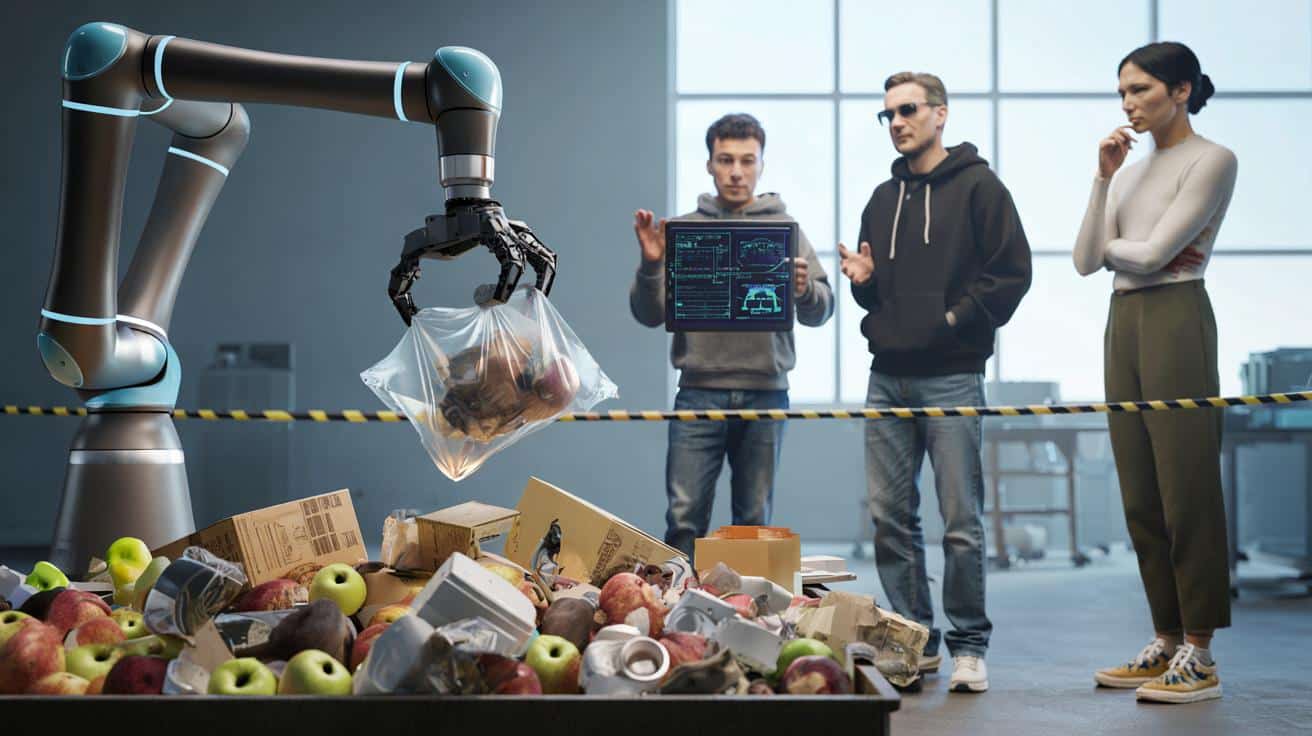
On a gray Tuesday in South San Francisco, a robot arm is quietly making a mess.
Plastic parts clatter into a bin, the arm hesitates, then changes its grip mid-air like a shortstop adjusting to a bad bounce. Two engineers watch from behind a safety line, half-proud, half-annoyed, as the robot “decides” to try a new motion on its own. No one typed that behavior in. The system felt its way there.
Ten minutes later, a venture capitalist in an Allbirds hoodie walks through the same lab and whispers, almost to himself: “This feels like the early days of Tesla Autopilot.”
Welcome to Physical Intelligence, the startup everyone in robotics is suddenly name-dropping, trying to sound like they discovered it first.
The quiet lab that’s freaking out Silicon Valley
Physical Intelligence doesn’t have the shiny showrooms or humanoid robots that rack up TikTok views.
Its offices sit in a low-key industrial block, squeezed between a biotech supplier and a warehouse that still smells faintly of cardboard and diesel. Inside, though, the mood is unmistakable: this is one of *those* places, the kind where you can almost taste the ambition in the air.
Whiteboards are covered in hand-sketched trajectories, equations collide with stick-figure robots, and someone has written “FEEL FIRST, THINK LATER” in red marker.
Not a bad summary of what the team is trying to do.
The company has already done the one thing that gets Silicon Valley truly buzzing: convinced serious people to write serious checks.
Investors who normally only chase AI foundation models are quietly slipping into Physical Intelligence demos, then calling their friends the second they step back outside.
One founder who visited told me the same story twice without noticing. He watched a robot pick up loose, slippery items on a conveyor that would stump most factory systems, then deliberately knock some of them out of position to see what happened next.
The robot didn’t freeze. It adapted on the fly, as if annoyed someone was messing with its flow.
That tiny moment – a machine failing, then recovering with something like grace – is what has everyone paying attention.
Classical industrial robots are control freaks.
You script every motion, you measure every angle, and if the real world nudges anything even a few millimeters out of place, the whole dance falls apart. Human workers compensate. Robots usually don’t.
Physical Intelligence flips that.
Instead of trying to model every possible scenario, their software leans into uncertainty. It combines fast simulation, learned control policies and dense sensor feedback so the robot can “feel” contact and adjust in real time, like a person sliding a key into a lock in the dark.
➡️ Asus permanently quits smartphones to go all‑in on AI
➡️ If you’re over 60, this is why prolonged sitting feels harsher
➡️ SPD district chief forces welfare recipients to work – and gets a surprise
➡️ The return of the aircraft carrier Truman is seen as a snub to the Navy in the war of the future
➡️ Here the 2026 Winter Olympics began and here ends the story of a legend of Italian stadiums
➡️ In The 80s everyone drank it, now it’s forgotten – and it quietly nourishes your gut
This sounds abstract until you see it.
Boxes aren’t perfectly aligned, parts aren’t identical, surfaces are dusty. The system treats those imperfections not as bugs, but as the whole point. That’s where value lives in the real world.
How do you teach a robot to feel?
The core trick inside Physical Intelligence isn’t a single magical algorithm.
It’s more like a tightly choreographed training pipeline where robots get thousands of lifetimes of practice in compressed time. The team builds rich simulations of real tasks – palletizing, kitting, sorting oddly shaped things – then hits them with randomized chaos: friction changes, dropped parts, slight delays, unexpected collisions.
The control policies that survive that storm, they deploy to real robot arms.
Once in the physical world, those policies keep learning on the edge, adjusting to tiny variations that no engineer would ever bother to code by hand.
This is where the “physical” in the name starts to feel literal, not just branding.
A concrete example: imagine a grocery distribution center dealing with an avalanche of products headed to delivery hubs.
Apples, cereal boxes, slippery bags of salad – each with its own geometry, weight, and tendency to roll away just when you don’t want it to. Traditional robots work fine with rigid boxes on clean conveyors. Throw a dented carton or a sagging plastic bag into the mix and you suddenly need a human.
Physical Intelligence’s system has been demoed on these messy tasks.
It watches how objects move when touched, not just how they look on a camera. If a bag sags, it tweaks its grasp. If a box shifts, it slides a supporting finger underneath, like a grocery worker instinctively catching a falling item.
This kind of adaptation doesn’t look flashy in a YouTube thumbnail.
It looks like reliability – the unglamorous superpower that can save millions in an actual warehouse.
Under the hood, the company is riding a timing wave. GPUs are cheaper per flop, sensors stream more data, and large neural networks are no longer just a toy for language. **A physical robot can finally afford to think as much as a web service.**
So Physical Intelligence ties three threads together: high‑fidelity simulation, reinforcement learning at scale, and tight low-latency control on real hardware.
Instead of a rule book, the system absorbs patterns: how different materials slip, how joints flex when overloaded, where errors usually creep in.
For years, robotics labs talked about “closing the sim‑to‑real gap” like it was this mystical canyon.
The company’s bet is that the canyon wasn’t mystical at all – we just didn’t have enough compute, data, or stomach for messy failure. And let’s be honest: nobody really does this every single day unless they’re slightly obsessed.
Why this matters far beyond cool warehouse demos
If you talk to the founders, they’ll steer the conversation away from robots doing backflips and toward something more mundane: labor hours, defect rates, downtime.
The target isn’t sci‑fi. It’s the everyday physical work that keeps cities humming and margins razor-thin.
Their method, in plain terms, is to drop a brain into existing robot arms and let that brain learn the rough edges of a specific site.
One facility might have slightly warped pallets, another might have fluctuating lighting, a third might deal with constant line jams. Instead of paying consultants to rewrite scripts every time something changes, the system tunes itself on the job.
If this approach holds, automation stops being a rigid project and starts feeling like a living system that grows with the factory.
That’s a different mental model for everyone from plant managers to CFOs.
There’s a reason so many earlier automation projects ended with expensive robots gathering dust in a corner.
The moment anything changed – packaging, product mix, even supplier tolerances – the carefully tuned motions broke. Teams burned out trying to maintain it all.
Physical Intelligence is tapping into that frustration.
We’ve all been there, that moment when a “smart” system becomes yet another fragile thing everyone tiptoes around. The promise here is the opposite: a robot that expects drift, dirt, and human improvisation and keeps working anyway.
The common mistakes for buyers?
Chasing the flashiest humanoid demo, underestimating integration time, and assuming “AI” means zero maintenance. The founders are pretty blunt that you still need patient technicians, clean data, and an acceptance that early days will be full of edge cases. That honesty is part of why people trust them.
“People imagine robot intelligence as this binary moment where one day the machines ‘wake up’,” one engineer told me between tests. “What we’re actually building is something much less cinematic and a lot more useful: systems that are just slightly less stupid every week they’re in your building.”
- Robots that improve with use
They start decent, but the real magic appears after weeks of on‑site learning, not in day-one demos. - Brains that fit existing hardware
The software is designed to sit on top of standard industrial arms, protecting past capital investments. - Focus on boring, high-value tasks
Think palletizing, depalletizing, kitting, bin picking – the repetitive jobs humans rarely enjoy and companies struggle to staff. - Shared learning across sites
Patterns discovered in one factory can feed improved policies that quietly upgrade others. - Transparent limits
The team openly calls out what the system can’t yet handle, which oddly builds more confidence than any glossy sizzle reel.
The bigger question: what happens when the world itself becomes “programmable”?
Spend an afternoon at Physical Intelligence and you start noticing a subtle shift in how people talk about work.
Not “robots versus humans”, but “robots doing the parts humans never wanted in the first place”. Long stretches of cold, repetitive precision that sap energy and attention.
If a new generation of robot brains really can handle messy reality – the bent metal, the half-torn barcode, the crate that someone stacked just a bit wrong – then the space of “automatable” starts to expand in quiet ways. Middle-of-the-night warehouse shifts, backroom sorting, low‑margin handling tasks in logistics and manufacturing.
None of it is glamorous. All of it moves the world.
The open question is what we do with the slack that creates.
Do we flatten jobs, or free people for more varied, judgment-heavy work on the same floor? Do small facilities get access to the same level of physical intelligence that tech giants already enjoy?
One plain-truth sentence hangs over the whole thing: **robot brains are only as transformative as the humans deciding where to point them.**
| Key point | Detail | Value for the reader |
|---|---|---|
| Physical Intelligence focuses on “feeling” | Its software leans on dense sensor feedback and learned control, letting robots adapt in real time to imperfect conditions. | Helps you understand why this startup matters more than flashy humanoid demos. |
| Sim-to-real at industrial scale | Robots are trained in chaotic simulations, then refined on the factory floor as they encounter real-world quirks. | Gives a realistic picture of how next-gen automation will actually get deployed. |
| Impact on everyday work | Targets repetitive, hard-to-staff physical tasks in logistics and manufacturing, not sci‑fi scenarios. | Lets you see where your own job, business, or city might quietly change first. |
FAQ:
- Question 1What exactly does Physical Intelligence build?
- Answer 1It builds the “brains” for robots: software that lets standard industrial arms sense, adapt, and learn in messy real-world environments, rather than just replaying pre-programmed motions.
- Question 2Is this about humanoid robots replacing people?
- Answer 2No. The focus is on practical tasks like palletizing, bin picking, and handling irregular items in warehouses and factories, mostly augmenting or relieving human workers from repetitive jobs.
- Question 3Why is Silicon Valley so excited about this company?
- Answer 3Because it mixes modern AI (simulation, reinforcement learning, large-scale training) with physical robots, aiming at huge, under-automated markets like logistics where small performance gains translate into big savings.
- Question 4What’s different from traditional industrial robotics?
- Answer 4Traditional systems rely on rigid scripts and perfect alignment; Physical Intelligence emphasizes adaptation, continuous learning on-site, and robustness to imperfect, shifting conditions.
- Question 5When could this affect ordinary people’s lives?
- Answer 5You may feel it first through more reliable deliveries, fewer stockouts, and quietly smoother logistics behind online orders, long before you ever notice the robots doing the work.