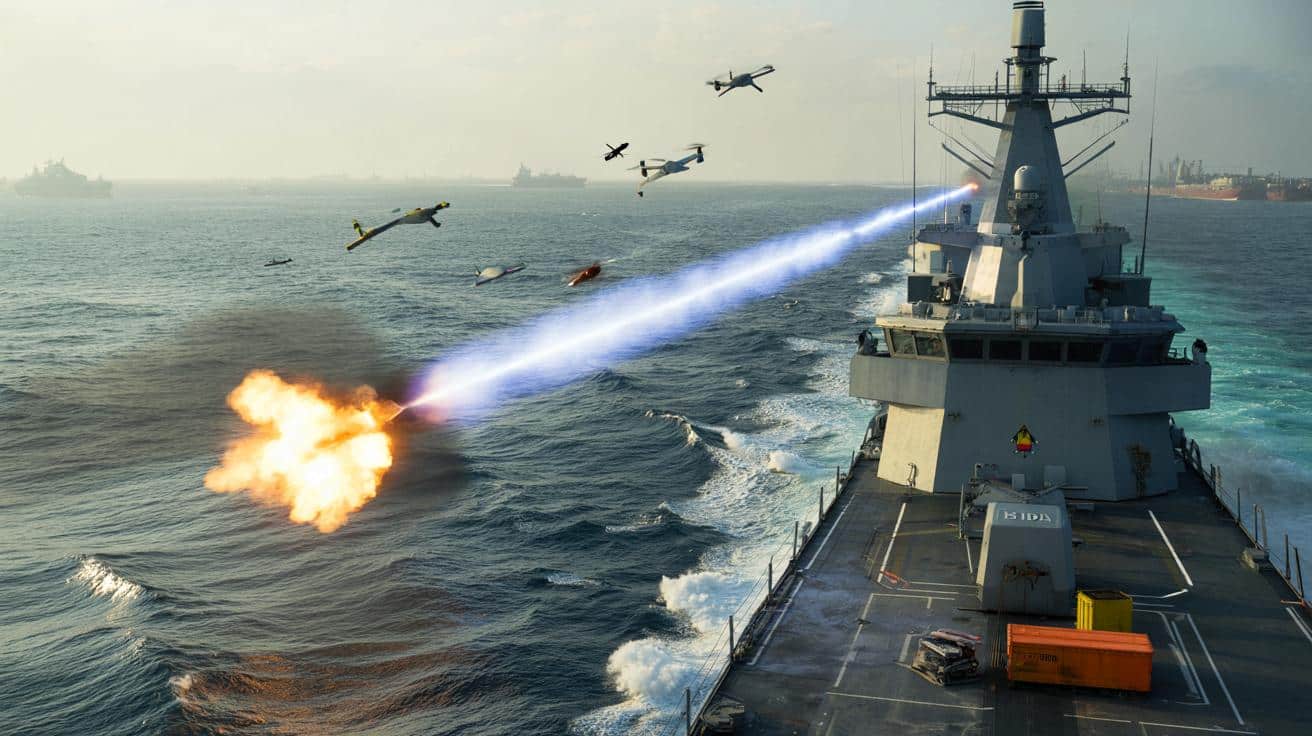
France and Germany are preparing to formalise a new industrial champion in a field once left to science fiction: high‑energy military lasers. Missile maker MBDA and German defence group Rheinmetall are setting up a joint venture to develop, build and deliver operational laser weapons, starting at sea for the German Navy and potentially spreading across European forces.
From costly missiles to beams of light
Short‑range threats have multiplied around warships over the past decade. Cheap drones, loitering munitions and fast swarms now challenge classic air‑defence doctrines. Firing a guided missile that costs hundreds of thousands of euros at a drone worth a few thousand leaves defence ministries with a painful cost curve.
Lasers aim to break that logic. A laser weapon uses electrical energy, focuses it into a coherent beam and sends it to the target at the speed of light. No explosive warhead. No magazine to reload. No debris falling back in crowded coastal waters.
For a ship able to generate enough electricity, a laser offers “deep magazines”: as long as the power flows, it can keep firing.
This is the gap MBDA and Rheinmetall want to occupy: a system that offers precise, repeatable shots at a fraction of the cost of each conventional interceptor, while reducing collateral damage around ports and shipping lanes.
A joint venture pitched as an “Airbus of lasers”
The new company will be incorporated in Germany as a GmbH, the rough equivalent of a French SARL or a UK limited company. The political message matters as much as the engineering one. Berlin signals that it wants laser know‑how, production and jobs to stay under European control, with Germany as the industrial anchor.
Rheinmetall contributes its experience in naval weapon integration, power management and ruggedisation. MBDA brings its command‑and‑control expertise, advanced sensors and track record in complex air‑defence architectures used by several NATO navies.
The ambition is not a lab demonstrator, but a serial product that can be ordered by navies and delivered within realistic timelines.
The formal creation of the joint venture is planned for the first quarter of 2026. Initial customers are expected to be the German Navy’s frigates and corvettes, with France and other European partners watching closely for export opportunities and joint programmes.
➡️ From Internship To Impact How Tech Careers Are Launched
➡️ Radioactive hybrid boars are thriving in Fukushima. Now scientists finally know why
➡️ Have you ever tried cloud eggs? This light way to cook them
➡️ This European country challenges its arms industry with a homegrown rival to the Tomahawk missile
A laser already tested at sea, not just a powerpoint concept
Unlike some high‑profile defence “revolutions” that live mostly on slides, the Rheinmetall‑MBDA system has already spent a year at sea. A naval demonstrator was embarked on a German warship and performed more than 100 tracking and firing tests.
The trials included engagements without clear visual landmarks on the horizon, as would be the case in open waters or bad weather. The system kept the beam locked on targets comparable in size to a one‑euro coin at long distance, despite roll, vibration, salt spray and atmospheric turbulence.
This level of stability matters. Laser weapons do not rely on blast radius. They must keep energy focused on a tiny spot for several seconds to burn through a drone’s skin, sensors or control surfaces. Any jitter wastes energy and reduces effect.
The ability to “paint” only the intended target also cuts the risk of collateral damage near busy harbours or civilian shipping routes. For navies increasingly operating in crowded littoral zones, that precision is a strong selling point.
From sea to land: protecting critical infrastructure
Once the maritime version reaches maturity, the same technology is expected to migrate ashore. Critical sites such as air bases, ammunition depots, power plants and ports all face the same challenge: frequent, low‑cost aerial threats that can overwhelm traditional defences.
After its sea trials, the demonstrator was moved to the WTD 91 test centre in Meppen, Germany’s key weapons testing hub. There, engineers are refining engagement scenarios against multiple types of targets and experimenting with layouts better suited to land platforms and fixed infrastructure.
- Naval use: defence of ships against drones and small fast craft
- Land use: protection of bases and infrastructure from drone incursions
- Urban use: security around major events without explosive interceptors
The underlying concept remains constant: fast detection, automated tracking, precise neutralisation and low marginal cost per shot.
Global race for operational laser weapons
Germany and France are not alone. The joint venture enters a crowded field where the US, Israel, the UK and China already claim progress on high‑energy laser systems for both land and sea platforms.
| Country | System | Approx. power | Platform | Main role |
| Germany (Franco‑German JV) | Naval High Energy Laser (HEL) | 50–100 kW (modular) | Frigates, corvettes | Anti‑drone, close‑in air defence |
| United States | HELIOS | ~60 kW | Arleigh Burke destroyers | Anti‑drone, sensor dazzling |
| Israel | Iron Beam | ~100 kW | Ground systems | Short‑range rockets and drones |
| United Kingdom | DragonFire | ~50 kW | Naval and land | Anti‑drone, air targets |
Yet raw power figures tell only part of the story. Real capability depends on beam quality, tracking algorithms, atmospheric compensation and integration with existing combat management systems. Many states have flashy prototypes; far fewer can field reliable, maintainable systems to regular units.
The Rheinmetall‑MBDA push focuses on industrialisation: turning a working prototype into something navies can order in numbers and keep running for decades.
Cost, logistics and sovereignty
Laser weapons shift several cost drivers in defence planning. Each “shot” uses electricity rather than a physical interceptor. That changes budgeting and logistics. Instead of storing large stocks of expensive missiles with finite shelf lives, navies must plan for robust power generation, cooling and maintenance of optical components.
For Germany and France, the new joint venture also acts as a hedge against dependence on US or Israeli technology. By pooling know‑how, the partners hope to control sensitive subsystems, from beam combiners to software, within European borders.
That sovereignty angle resonates in Warsaw, Rome and other capitals that are raising defence budgets but still worry about supply chain bottlenecks and export licence politics. A European “Airbus of lasers” could eventually offer common solutions for NATO and EU fleets, similar to how Airbus reshaped the continent’s aerospace industry.
How a naval laser engagement could play out
On a future German frigate equipped with the joint venture’s system, a typical engagement might unfold in seconds. A shipboard radar or electro‑optical sensor picks up a small quadcopter approaching at low altitude. Software classifies it as a hostile unmanned aircraft based on speed, trajectory and signature.
The combat system assigns the laser as the most cost‑effective effector. The beam director slews toward the target, fine‑tuned by high‑resolution optics. Once authorised by the operator, the laser fires, keeping the beam locked on a vulnerable point: sensors, rotors or wing root.
Within seconds, heat buildup degrades the drone’s electronics or structure. The aircraft falls into the sea, with no shrapnel shower and minimal risk for nearby merchant traffic. If another drone follows, the system can re‑engage almost instantly, limited mainly by thermal management and crew rules of engagement.
Benefits, risks and technical hurdles
Laser weapons bring several clear benefits: low cost per shot, near‑instant engagement at light speed, deep magazines and fine control over where energy is applied. They also offer silent, invisible action at certain wavelengths, which can be politically attractive in dense civilian environments.
Yet they come with constraints. Fog, heavy rain, dust or smoke can absorb or scatter energy, reducing range. High‑energy beams generate serious heat that must be removed through advanced cooling systems. Eye safety and deconfliction with civilian aircraft raise legal and operational questions.
There is also a risk of arms racing. As lasers become standard in air defence, adversaries may harden drones with reflective coatings, spinning designs or sacrificial surfaces. Others may counter with saturation tactics, betting that even a fast, cheap laser can only engage one target at a time.
For France and Germany, the joint venture is a bet that staying at the forefront of this race is better than trying to catch up later with off‑the‑shelf imports. If the “Airbus of military lasers” delivers as promised, European navies could gain a new tool to handle drone swarms and low‑end threats without burning through their most advanced missile inventories.