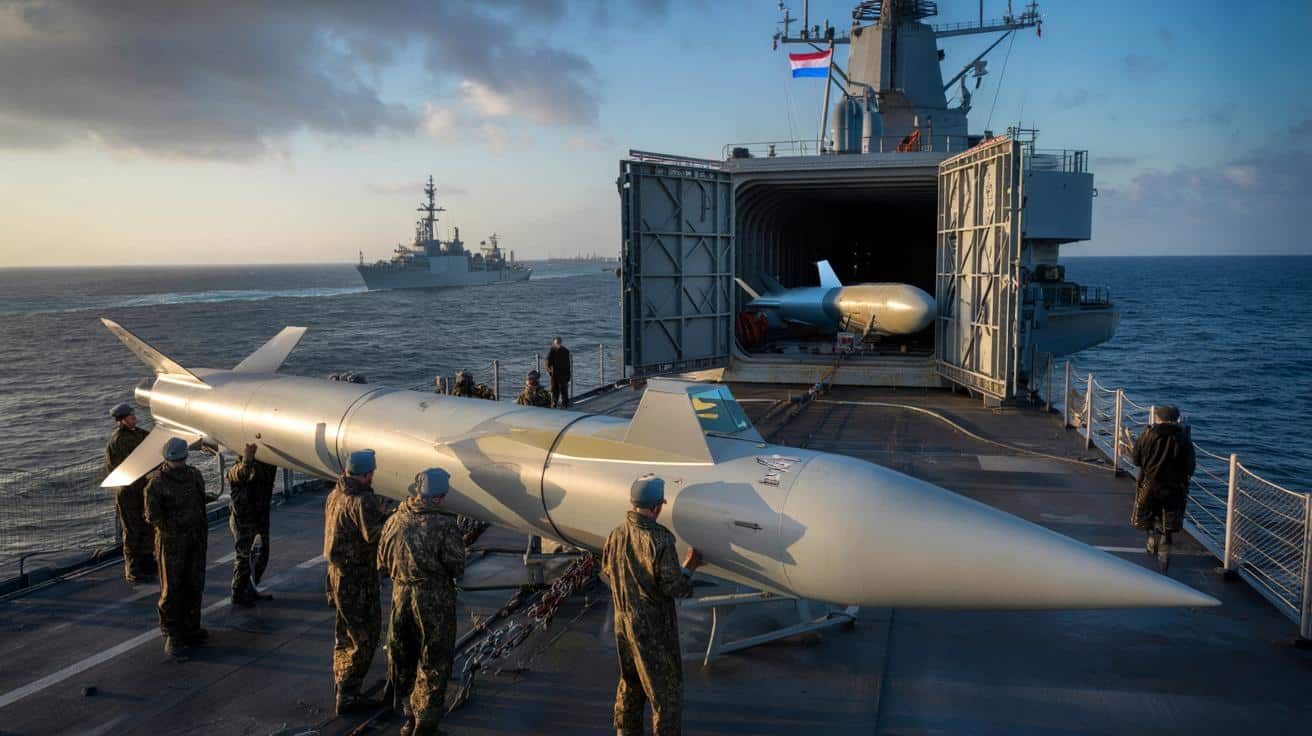
The Netherlands wants a long‑range cruise missile designed on home soil, fast. Not a copy of America’s legendary Tomahawk, but a cheaper, rough‑and‑ready alternative that can be built in Europe and sold abroad.
Dutch defence sets a six‑month clock ticking
The gauntlet was thrown at the NEDS defence exhibition in Rotterdam on 20 November 2025. Dutch State Secretary for Defence Gijs Tuinman stood before industry leaders and called for a locally designed cruise missile, with the first concept on his desk within half a year.
The request comes at a tense moment. Western missile production lines are backed up. Demand has exploded after Russia’s invasion of Ukraine and rising tensions in the Middle East and Asia. Delivery times stretch into years.
For smaller NATO countries such as the Netherlands, that means they slip to the back of the queue behind the US, UK, or major Eastern European buyers.
The Dutch plan is simple: if the big players cannot deliver in time, build something credible at home and guarantee a production run.
Tuinman’s offer to industry is a carrot as much as a challenge. If companies can team up and present a feasible design within six months, the Ministry of Defence will consider a multi‑year order. That sort of commitment is rare for a small country and could underpin a whole new industrial niche.
What the Netherlands actually wants from its “Tomahawk‑lite”
Officials in The Hague are not dreaming of a bespoke, gold‑plated missile program that drags on for decades. They want something relatively straightforward:
- Long range, potentially between 500 and 1,000 km
- High precision against fixed, high‑value targets
- Low production and maintenance costs
- Use of existing, commercially available components where possible
- Compatibility with NATO standards and Dutch warships
In practice, that means a subsonic cruise missile using modern GPS and inertial guidance, potentially complemented by an infrared seeker in the terminal phase. The design would need to fit into current naval launchers or future modular canisters to avoid expensive ship modifications.
The Dutch goal is not to rival US engineering, but to field a “good enough” cruise missile that can be built in quantity and delivered on time.
➡️ Twitter’s JavaScript roadblock: why you can’t use X.com without it
➡️ The plant that perfumes the home and repels mosquitoes : here’s why everyone wants it in spring
➡️ SpaceX in merger talks with other Musk companies ahead of IPO
Officials stress that the missile must remain relatively simple to integrate. Fancy features, such as advanced networking or swarming behaviours, are less of a priority than reliability, speed of production and predictable costs.
Why build a missile while buying 175 Tomahawks?
The homegrown project runs in parallel with a major American order. In April 2025, the Netherlands approved the purchase of 175 Tomahawk cruise missiles from the US: 163 of the newest Block V variant and 12 Block IV rounds.
These missiles will arm Dutch De Zeven Provinciën‑class frigates via existing Mk 41 vertical launch systems. A first test firing took place in March from the Zr.Ms. De Ruyter in coordination with the US Navy. The deal is worth around $2.19 billion.
In military terms, that purchase immediately gives the Royal Netherlands Navy a long‑range strike option of more than 1,500 km from the sea, something it has never had before.
Yet the Tomahawk has limits in the Dutch context. The submarine‑launched UGM‑109 variant is out of production, making it unrealistic to equip Dutch submarines with it. Reopening that line for just a handful of boats would be wildly expensive.
The European fix for Dutch submarines: JSM‑SL
For its future Orka‑class submarines, the Netherlands is looking to Norway instead. The plan is to adopt a submarine‑launched version of Kongsberg’s Joint Strike Missile (JSM‑SL), fired through standard torpedo tubes.
This missile will have a range of over 300 km, flying at low altitude with a stealthy profile. It is expected to combine GPS and inertial navigation with an imaging infrared seeker and passive radiofrequency guidance, allowing it to find targets even in contested electronic environments.
Integration on the new Orka boats is planned around 2032, creating a layered Dutch strike capability: Tomahawks from frigates for very long range, JSM‑SL from submarines for more discreet regional operations, and a national missile to fill the gap in between.
The Tomahawk benchmark the Dutch cannot ignore
The Tomahawk remains the yardstick for Western cruise missiles. Roughly 5.5 metres long and weighing about 1,300 kg, it uses a small turbofan engine to cruise at around 880 km/h, hugging the terrain to avoid radar.
Its warhead of roughly 450 kg and sophisticated guidance package – combining GPS, inertial navigation, terrain contour matching and digital scene‑matching – allow it to strike deep inside defended territory with high precision. It can loiter, change targets in flight, and carry out complex routing.
Since the first Gulf War in 1991, the Tomahawk has opened nearly every US-led campaign, from Iraq and the Balkans to Syria and Libya. It has become a political as well as a military symbol.
For mid‑sized countries, the Tomahawk’s performance is attractive, but its price tag and scarcity are becoming hard to swallow.
Each missile costs around €2 million, and US production lines face growing pressure. For the Netherlands, relying solely on such imports would lock national defence policy to American industrial schedules and congressional decisions.
Targeting the European export market
Dutch officials make no secret of their ambitions. A successful homegrown missile would not only equip their own navy and air force, but also be pitched across Europe.
Potential customers include Belgium, Germany, France, Italy and Spain – all NATO members looking for more long‑range precision weapons without paying the premium for the most advanced US systems.
If designed with NATO standards and shared infrastructure in mind, a Dutch missile could be integrated into European ships and possibly ground‑based launchers, giving allied forces more options in a crisis.
| Model | Origin | Approx. range | Launch platform | Indicative unit cost |
|---|---|---|---|---|
| Tomahawk Block V | United States | ≈1,600 km | Vertical launch cells (Mk 41) | ≈€2 million |
| JSM‑SL | Norway | >300 km | Submarine torpedo tubes | ≈€1 million |
| Planned Dutch missile | Netherlands | ≈500–1,000 km (goal) | Modular naval / land launch | ≈€0.5–1 million (goal) |
| MdCN | France | ≈1,000 km | Naval vertical launch / submarines | ≈€3 million |
Why cruise missiles matter for a small country
For states with modest armed forces, long‑range cruise missiles are a force multiplier. They let a navy or air force hit key sites far beyond their borders without sending pilots or ships into the densest air defences.
In NATO planning, such weapons can threaten enemy command centres, air bases, ammunition depots or air defence radars early in a conflict. That creates room for jets and ground troops to move later.
For a coastal country such as the Netherlands, missiles launched from frigates or submarines also act as a deterrent. Any hostile power has to factor in the risk that Dutch ships at sea could strike deep into their territory from hundreds or thousands of kilometres away.
Key terms that shape the debate
Several technical concepts keep recurring in Dutch discussions:
- Cruise missile: A guided weapon that flies like a small aircraft at low altitude for much of its journey, usually subsonic, designed for precision strikes.
- Vertical launch system (VLS): A set of vertical cells in a ship’s hull that can hold and fire missiles, allowing different weapons to be mixed in the same launcher.
- Inertial navigation system (INS): A guidance method using gyroscopes and accelerometers inside the missile to track its movement without external signals.
- Imaging infrared seeker (IIR): A sensor that compares the thermal image of the target area with stored reference images to refine the final strike.
Understanding these basics helps explain why the Netherlands is pushing for a “good enough” design that uses mature technologies rather than chasing experimental features that would slow everything down.
Scenarios and risks around a Dutch cruise missile
If the industry meets Tuinman’s challenge, the first concept within six months will not yet be a flyable missile. The real work comes later: aerodynamic testing, software, guidance algorithms, warhead design, and certification for use at sea.
Several scenarios are being discussed privately by analysts. One involves a modular missile that can be adapted for ship launch, truck‑mounted batteries, or possibly air launch from Dutch F‑35s, giving maximum flexibility from a single core design.
Risks are obvious. Budgets could balloon, as they often do with domestic weapons projects. Political support might fade if costs rise or if export customers fail to appear. There is also the question of how a Dutch system would compete with established players, from Norway’s JSM to future Franco‑British cruise missiles.
The bet is that a relatively modest, tightly scoped program can stay on track – and that Europe’s appetite for long‑range weapons will keep growing.
For now, the clock is ticking. Dutch engineers have a few short months to sketch out a missile that can slot between the Tomahawk at the high end and shorter‑range systems at the low end. If they succeed, a small country on the North Sea could end up reshaping a key segment of Europe’s arms market.