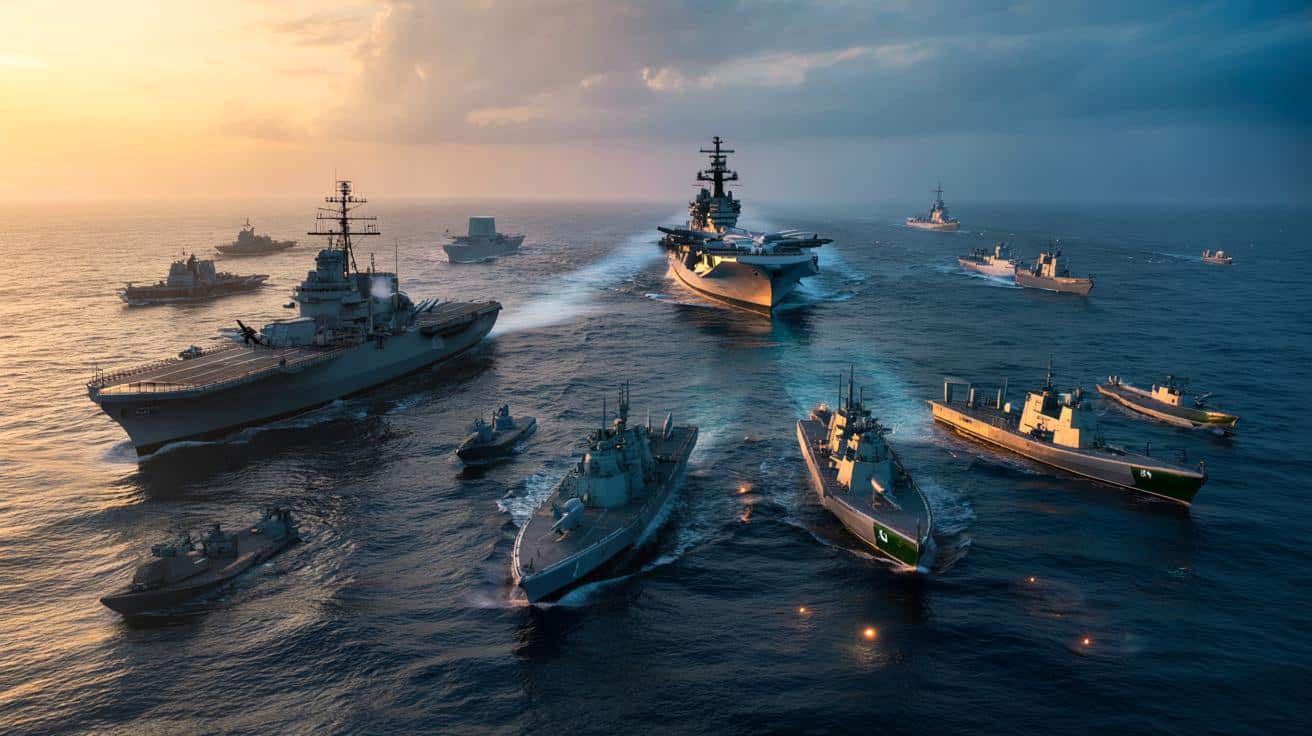
Far from the headlines about land borders and fighter jets, Pakistan is pursuing a long-term naval overhaul that is finally taking form. India, long dominant at sea, now faces a rival betting on numbers, missiles and submarines rather than prestige carriers and heavy tonnage.
Pakistan’s silent naval build-up finally takes shape
In 2021, then naval chief Admiral Zafar Mahmood Abbasi laid out a surprisingly bold blueprint for the Pakistan Navy. The plan called for the acquisition of 50 new ships over roughly two decades.
At first, the announcement drew limited attention. Strategic debates focused on the Himalayan border, Kashmir and the air balance. The sea was seen as India’s safe backyard, with Pakistan stuck in a permanent second tier.
Pakistan’s naval planners now want a fleet designed to make any hostile move in the Arabian Sea costly, risky and uncertain.
Three years on, that vision is no longer theoretical. Contracts have been signed, shipyards in China and Turkey are busy, and domestic yards in Karachi are being nudged into a more ambitious role. The figure of “50 ships” is less a slogan than a roadmap guiding procurement choices and diplomatic partnerships.
The broad breakdown is clear: around 20 major combatants and some 30 lighter, fast-attack and support ships. The overall aim is not to match India ship for ship, but to build a fleet that can contest key waters, shield trade routes and complicate any Indian naval campaign.
A deliberate answer to India’s naval rise
India’s navy has been modernising at pace for more than a decade. It operates two aircraft carriers, INS Vikramaditya and the domestically built INS Vikrant, alongside modern destroyers and frigates equipped with long-range cruise missiles and vertical launch systems.
New Delhi now fields roughly 293 combat vessels, backed by a naval budget estimated at €18–19 billion a year and a growing domestic shipbuilding sector. Close cooperation with Russia, France and the United States feeds a steady pipeline of new technologies, from carrier operations to advanced sonar.
India is shaping a blue-water navy built for regional control and long-range power projection; Pakistan is building a sea-denial force.
➡️ If you’re over 60, this is why prolonged sitting feels harsher
➡️ From perovskite to fusion: the energy breakthroughs finally leaving the lab in 2026
➡️ This European country challenges its arms industry with a homegrown rival to the Tomahawk missile
Islamabad has opted for a different playbook. Rather than chasing aircraft carriers or massive destroyers, its planners talk about “distributed lethality”: more hulls, smaller footprints, and a heavy reliance on anti-ship missiles and submarines.
The logic is simple. Against a larger navy, the best chance of survival lies in making key zones too dangerous to operate in freely. That means corvettes, missile boats, patrol vessels and submarines working together to threaten Indian ships approaching Pakistani waters or key maritime chokepoints.
A fleet designed as a layered system
The 20 major combatants outlined in the plan include frigates, large corvettes and potentially light destroyers. These ships are meant to operate as a network, sharing radar data, sonar tracks and targeting information.
The remaining 30 ships fill the gaps. These are fast missile craft, patrol vessels, logistics and support ships. They may lack the glamour of a carrier, but in a crisis they provide the day-to-day presence, coastal surveillance and quick-reaction firepower that can turn a contested sea into a danger zone for intruders.
- Frigates: core escorts for trade routes and task groups
- Corvettes: coastal fighters packed with missiles
- Fast attack craft: small, hard-to-target launch platforms
- Support ships: tankers, repair vessels and auxiliaries
This layered structure aims to keep Pakistani ships at sea more often without overstretching crews or budgets. It also makes the fleet harder to neutralise in one blow, since combat power is spread across many platforms rather than concentrated in a few large ones.
Economic lifelines push Islamabad to sea
Behind the naval rhetoric lies a hard commercial reality: about 90% of Pakistan’s trade moves by sea. Oil, gas, manufactured goods and key imports all pass through a handful of ports, including Karachi, Gwadar and Port Qasim.
These ports are now central nodes in the China–Pakistan Economic Corridor, a flagship element of Beijing’s Belt and Road Initiative. Industrial zones, new roads and pipelines tie Pakistani ports not just to domestic markets, but to Chinese strategic planning.
For Islamabad, the 50-ship target is less about prestige than about protecting an economic lifeline that can no longer be left exposed.
Memories of past vulnerabilities still weigh on Pakistani strategists. In previous crises with India, the threat of blockades, disrupted fuel supplies and pressure on ports loomed large. A stronger navy is seen as a hedge against those scenarios, giving Islamabad more leverage and room for manoeuvre in any future conflict or standoff.
Submarines remain Pakistan’s sharpest sword
While surface ships send signals above the waterline, Pakistan’s most potent capability lurks below. Submarines have long been central to its doctrine and that is not changing.
Islamabad is acquiring Chinese-built Hangor-II (Type 039B) submarines, modern boats designed to be quiet and relatively long-ranged for operations in the Arabian Sea. These will sit alongside its existing conventional submarine fleet.
In the confined waters between the Gulf of Oman and India’s western seaboard, submarines are powerful tools. They can threaten warships and tankers without revealing their positions, forcing the Indian Navy to commit valuable assets to anti-submarine warfare instead of purely offensive missions.
How the two navies stack up
| Aspect | India | Pakistan (planned) |
|---|---|---|
| Overall naval role | Regional control, blue-water projection | Sea denial, coastal defence, trade protection |
| Combat ships | ~293 | Existing fleet + 50 new ships over two decades |
| Flagship assets | 2 aircraft carriers, large destroyers and frigates | Modern frigates, corvettes, submarines |
| Submarines | Approx. 18 (including nuclear options) | Conventional fleet + new Hangor-II class |
| Annual naval budget | €18–19 billion (estimate) | Significantly lower, flexible pacing |
The numbers still favour India by a wide margin. But raw counts do not fully capture the changing risk calculus. A denser web of Pakistani sensors, missiles and submarines could force Indian planners to allocate more ships, aircraft and time to even limited operations off Pakistan’s coast.
Flexible timelines, firm direction
One striking feature of Pakistan’s expansion plan is the lack of a rigid public timetable. Officials talk about a 20-year transformation window, but avoid locking themselves into precise dates or headline budgets.
That ambiguity is deliberate. It leaves room to adapt to economic shocks, political shifts or changing technology. It also complicates foreign assessments: analysts can track new hulls entering service, but not always predict when the next wave will appear.
What is not vague is the trajectory: Islamabad no longer accepts being permanently overmatched at sea with no credible means of deterrence.
For India, this creates a more complex maritime picture. New Delhi must continue its own naval modernisation while also reassessing assumptions about how quickly it could pressure Pakistan along sea lines of communication during a crisis.
What “sea denial” actually means
The phrase “sea denial” appears often in this discussion and is worth unpacking. It does not mean controlling an ocean. Instead, it means making certain areas too dangerous or unpredictable for an opponent to use freely.
Typical sea denial tools include:
- Submarines armed with torpedoes and anti-ship missiles
- Coastal or ship-based anti-ship missile batteries
- Fast, hard-hitting missile boats
- Sea mines laid in key approaches
Used together, these systems create layers of threat that increase the cost of operating near an adversary’s shores. For a trade-dependent country like Pakistan, that approach aims to deter coercion without matching India’s more expensive and expansive ambitions.
Potential flashpoints and regional risks
The growing density of firepower in the northern Indian Ocean does not automatically lead to war, but it does raise the stakes of miscalculation. Close encounters between ships or submarines can escalate quickly when both sides sit on high alert.
There is also a risk that peacetime signalling—such as naval exercises near contested waters or “freedom of navigation” patrols—could be misread as preparation for a strike. In that environment, even technical mishaps, from sonar glitches to GPS errors, can carry political consequences.
On the other hand, a more balanced equation at sea might discourage outright adventurism. If both sides calculate that any attempt at blockade or surprise strike would be messy and uncertain, they may lean harder on diplomacy and backchannel pressure rather than overt naval confrontation.
For outside observers, two concepts are worth tracking: “escalation ladders” and “chokepoints”. Escalation ladders describe how actions like shadowing an enemy frigate, targeting it with fire-control radar, or conducting live missile tests can each raise tension a notch. Chokepoints, such as the Strait of Hormuz or the approaches to Karachi and Gwadar, concentrate risk and attention, making them natural hotspots in any crisis simulation.