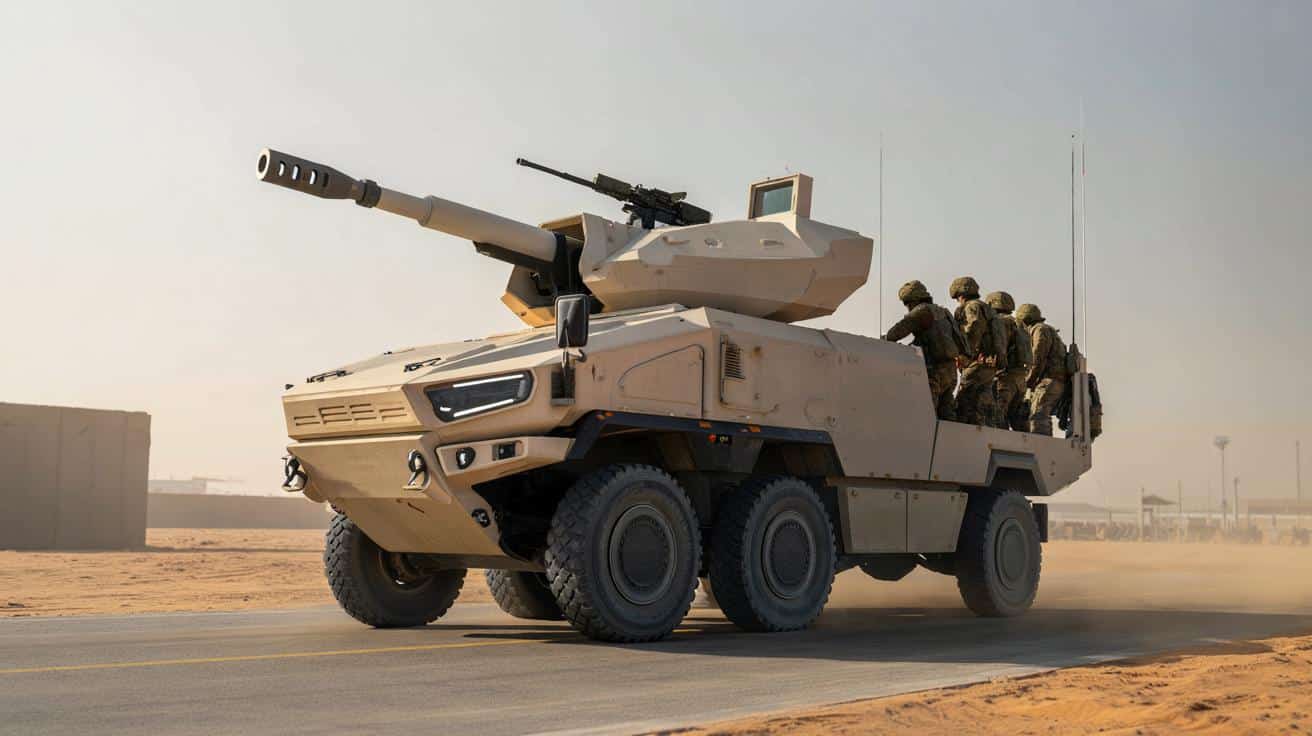
The scene looks routine, almost dull. Yet behind this new armoured truck lies a sharp industrial message: if you bolt the gun on later, you pay for it for the next 30 years.
A 19‑tonne 4×4 that refuses to be “just a truck”
At the World Defense Show 2026 in Riyadh, most eyes usually go to massive 8×8 vehicles and main battle tanks. This year, a more compact machine from ARQUUS and Belgium’s John Cockerill Defense quietly stole part of the spotlight.
The concept, called MAV’RX, is a 19‑tonne armoured 4×4. It can move a full infantry team and, crucially, it can fight. On the roof sits a remotely operated turret armed with a 20 or 30 mm automatic cannon.
That combination targets a painful gap many armies have rediscovered in Ukraine, the Sahel and the Middle East: they need vehicles that are more than soft‑skinned patrol cars, but lighter, cheaper and more deployable than heavy 8×8 infantry fighting vehicles.
The French‑Belgian MAV’RX is built around its turret from day one, turning a troop carrier into a combat tool instead of a rolling target.
In practical terms, the vehicle aims to move a full section, shield it from the most common battlefield threats, and support it with serious fire the moment soldiers dismount. That shifts the role from “taxi” to “partner in the fight”.
A market rediscovering the “missing middle”
Land forces traditionally divide their fleets into neat families: light 4×4s for patrol and logistics, and heavy 8×8 or tracked vehicles for frontline combat. The in‑between space has often been handled through improvisation.
That improvisation tends to look like this: start with a standard armoured personnel carrier, then add a heavier gun and sensors once troops start taking casualties. The result is often disappointing. Weight creeps up, balance suffers, and the electronics bay turns into a spaghetti bowl of mismatched systems.
Why retrofitted turrets are so costly
For industry engineers, “just add a turret” is almost a meme. Every extra kilo on the roof changes the centre of gravity. That means new suspension work, revised braking, and fresh roll‑over testing. Power demand from stabilised cannons, thermal cameras and advanced sights quickly outstrips what the original alternator and cooling system can safely provide.
➡️ “I didn’t notice how irregular my days were”: until fatigue settled in
➡️ I tried this comforting dish and knew I’d make it again
➡️ This 1,500 hp monster could put Turkey in an elite tank‑engine club France left years ago
➡️ After Replacing 90% Of His Staff With AI, An Indian Founder Reveals An Unexpected Outcome
When that happens after the vehicle has already entered service, fixes are clumsy and slow. Units lose vehicles to long upgrades, maintenance staff juggle different sub‑variants, and spare parts inventories explode.
Designing the turret in from the start avoids a vicious cycle: every “simple” upgrade triggers hidden costs in stability, power, cooling and software.
With MAV’RX, ARQUUS and John Cockerill are trying to freeze those choices early. The chassis, hull, powerpack and digital backbone have been sized and arranged from the outset around the CLWS remote weapon station and its sensors. That is the “detail” in the project’s message – and it is exactly where armies tend to bleed budget once wars expose earlier shortcuts.
Mobility first: built for deserts, not brochures
The Riyadh show is unforgiving for vehicles that only look good under air‑conditioned spotlights. Clients from the Gulf and beyond expect something that can live years in heat, dust and abrasive sand.
The MAV’RX is pitched as a full‑size armoured 4×4: about 6.98 metres long, 2.55 metres wide and 2.73 metres high. With a combat weight at 19 tonnes, it sits at the upper end of the 4×4 segment, but remains air‑transportable and road‑legal in many countries.
Propulsion comes from a straightforward recipe: a 6‑cylinder 8‑litre diesel with around 400 horsepower and an automatic gearbox. No exotic hybrid or experimental powertrain. That choice targets customers who prioritise predictable fuel consumption, easy maintenance and long‑term availability of parts.
Independent suspension and big 14.00 R20 tyres support the mobility pitch. The published figures are in line with serious off‑road work: 60% gradients, 30% side slopes, a 0.5 m vertical step, 1 m trench and 1.2 m fording depth.
- Top weight: 19 tonnes
- Engine: 8‑litre diesel, ~400 hp
- Crew and passengers: up to 10 personnel
- Mobility: 4×4, independent suspension, large tactical tyres
- Armament: remote‑controlled 20–30 mm cannon (CLWS turret)
The aim is clear: a vehicle that can leave the asphalt, escort convoys over long distances, and reposition quickly without waiting for specialist recovery support every time the terrain turns nasty.
Protection: surviving the likely threats
On protection, the MAV’RX sits in the pragmatic middle ground as well. It is not built to trade blows with tanks. Instead, it follows NATO’s STANAG 4569 standard for ballistic and mine protection, which defines levels of resistance against small arms, shell fragments and blasts under the hull or wheels.
The designers pair this armour package with a set of survivability aids tailored for harsh climates: a strengthened air‑conditioning unit, central tyre inflation, run‑flat inserts and a rear camera to keep situational awareness while reversing in tight urban or desert compounds.
Armour plates keep rounds out, but climate control, tyres and cameras keep the crew alive, alert and moving long enough to fight.
Beyond steel and Kevlar, the option list hints at where land combat is going. Customers can add CBRN filtration, laser warning receivers, acoustic or optical shot detection, and a digital network architecture that ties radios, GPS, intercom and tactical battle management into one interface.
This type of “Battlenet” system turns the vehicle into a node, not just a shell. If a laser designator locks on, the crew knows. If a neighbouring unit spots an ambush or drone swarm, the position appears on the map automatically. For forces used to analogue radios and shouted updates, that shift is almost as significant as the extra centimetres of armour.
A remote‑controlled cannon as the central feature
From troop carrier to fighting vehicle
The CLWS turret from John Cockerill Defense is the cornerstone of the concept. It can mount either a 20 mm or 30 mm automatic cannon, plus sensors for day and night, and a laser rangefinder.
Because the station is fully remote‑controlled from inside, the gunner stays under armour. That matters against snipers, artillery fragments and, increasingly, small attack drones that target exposed crew members.
Mounted on a chassis designed around it, the turret is not just extra firepower. It is the main reason the vehicle exists. The cannon can pin down enemy infantry, disable technicals, suppress firing points in urban alleys, and create a quick curtain of fire if an ambush hits a convoy.
In drone‑dense battlespaces, its sighting system also becomes an intelligence asset. Thermal imagers and stabilised optics can scan far beyond the range of the soldier’s naked eye, feeding threat data back to the section or company level.
Ten seats that change how units operate
Capacity is another telling number: up to ten personnel including crew. That suggests a vehicle built for full sections or reinforced squads, not just small reconnaissance teams.
Fitting that many people while carrying a turret and keeping decent protection forces tough design choices. Room for body armour, weapons, rucksacks and electronics has to be carved out without raising the vehicle profile too far or squeezing legroom to the point of exhaustion.
If the layout works, the payoff is strong. A battlegroup can cover more missions with a single family of vehicles: convoy escort, rapid reaction, checkpoint security, route clearance support or quick reinforcement of threatened positions.
A well‑designed “one chassis, many roles” fleet can be a greater advantage than adding yet another specialised vehicle type to the motor pool.
For logisticians, that simplification counts. Fewer different platforms mean fewer stocks of unique parts, less fragmented training for mechanics, and a clearer picture of fleet health over decades.
Why Riyadh matters for this French‑Belgian bet
The World Defense Show has rapidly become more than a flashy expo. It acts as a reality check for vehicles wanting a place in Gulf inventories and, by extension, in other hot, sandy theatres.
For MAV’RX, that means proving it can sustain long desert patrols, cope with sudden sandstorms, and keep its electronics alive when the thermometer climbs. Buyers have learned the hard way that systems validated in temperate Europe do not automatically survive in the Arabian sun or the Sahel’s dust.
| Date / period | Event | Capability impact |
| 8–12 February 2026 | World Defense Show, Riyadh | Desert proving ground and benchmark against global competitors |
| 8–12 February 2026 | Public debut of MAV’RX with CLWS turret | Signals a firm “transport + fire support” positioning from day one |
The industrial pairing also plays into the sales pitch. Instead of a vehicle from one supplier and a turret from another, with integration headaches landing on the customer, ARQUUS and John Cockerill present a joint package. That can simplify negotiations, warranties and long‑term support, an area where many armed forces have been badly burned.
Anti‑drone, ambush and grey‑zone roles
The conflicts that shape procurement decisions today are not classic tank battles. They are long campaigns of patrols, roadside bombs, loitering munitions and rapid strikes by small, agile enemy groups. Drones watch convoys, mark them for artillery or bomb them directly. Ambushes spring from villages, wadis or tree lines along seemingly quiet roads.
MAV’RX is tailored for that “grey zone”. It is not meant to replace big infantry fighting vehicles in frontal assaults. Instead, it gives logistics convoys and light units a way to react fast and with precision when the fight comes to them.
The remote turret can shoot down low‑flying drones at short ranges, punch through unarmoured vehicles used as suicide bombs, and lay suppressive fire without sending someone to stand behind an exposed pintle‑mounted gun. With a good sensor suite and decent training, a section in MAV’RXs can create overlapping bubbles of observation and fire along vulnerable routes.
What “integrating the turret from the start” really means
The central argument behind this vehicle touches on a theme that runs across defence procurement: architecture. When engineers speak of “turret integration”, they mean much more than cutting a hole in the roof.
A modern remote weapon station draws power like a small house. It needs clean, stable electricity for servos, gyros, computers and cooling. The cables must be routed through protected channels and shielded from electromagnetic interference. Software has to talk cleanly with navigation units, radios and any higher‑level battle management system.
If those aspects are accounted for in the original blueprint, each new sensor or weapon option can be plugged into a known, tested digital backbone. If they are not, every upgrade turns into a mini‑development project, with custom brackets, bespoke wiring looms and unpredictable side effects on reliability.
Over a 20‑ to 30‑year life, the difference in cost, downtime and operational readiness between those two paths can be huge. That is the price gap the French‑Belgian team is hoping commanders and finance ministries will see when they look beyond brochure photos.
Practical scenarios and trade‑offs on tomorrow’s battlefield
Picture a mixed convoy in the Sahel: fuel tankers, supply trucks and a handful of armoured escorts. A drone spots the column and relays its position to an insurgent group with technicals and mortars. Without integral fire support, the escorts can shield crews but not really reach out to neutralise firing points fast.
Swap in vehicles like MAV’RX and the picture changes. The lead and rear vehicles can scan ahead through sensors on the turret, mark likely ambush sites, and plot alternative tracks off the road. If a contact occurs, they can shoot back with stabilised fire while moving, giving the commander a few precious minutes to push the rest of the convoy out of the kill zone.
None of this comes free. A 19‑tonne 4×4 with a 30 mm cannon is more complex and expensive than a simpler mine‑resistant truck with a machine gun ring. There is a training burden for gunners, drivers and maintainers. Spare barrels, specialist tools and ammunition logistics all add weight to the support chain.
For many countries, the real decision will lie in the balance between that extra complexity and the growing cost of being outgunned by nimble adversaries armed with drones, rockets and cheap technicals. The French‑Belgian bet is that integrating the turret and its brain from day one makes that balance easier to hold over the long haul, instead of trying to patch it together under fire a decade later.