Behind closed doors in Ottawa, planners are rethinking how Canada would fight on its own soil, from frozen tundra to vulnerable border towns. The result is a sweeping land forces overhaul centred on 250 new armoured vehicles and a deep modernisation of its Leopard tank fleet, designed to handle everything from Russian advances to a nightmare scenario: a crisis with the United States.
Canada’s armoured gamble for a harsher century
Canada’s army has long been built around light infantry and peacekeeping deployments. That model no longer looks safe. Military planners now assume that a major crisis in the Arctic, or a confrontation between great powers, could unfold with little warning.
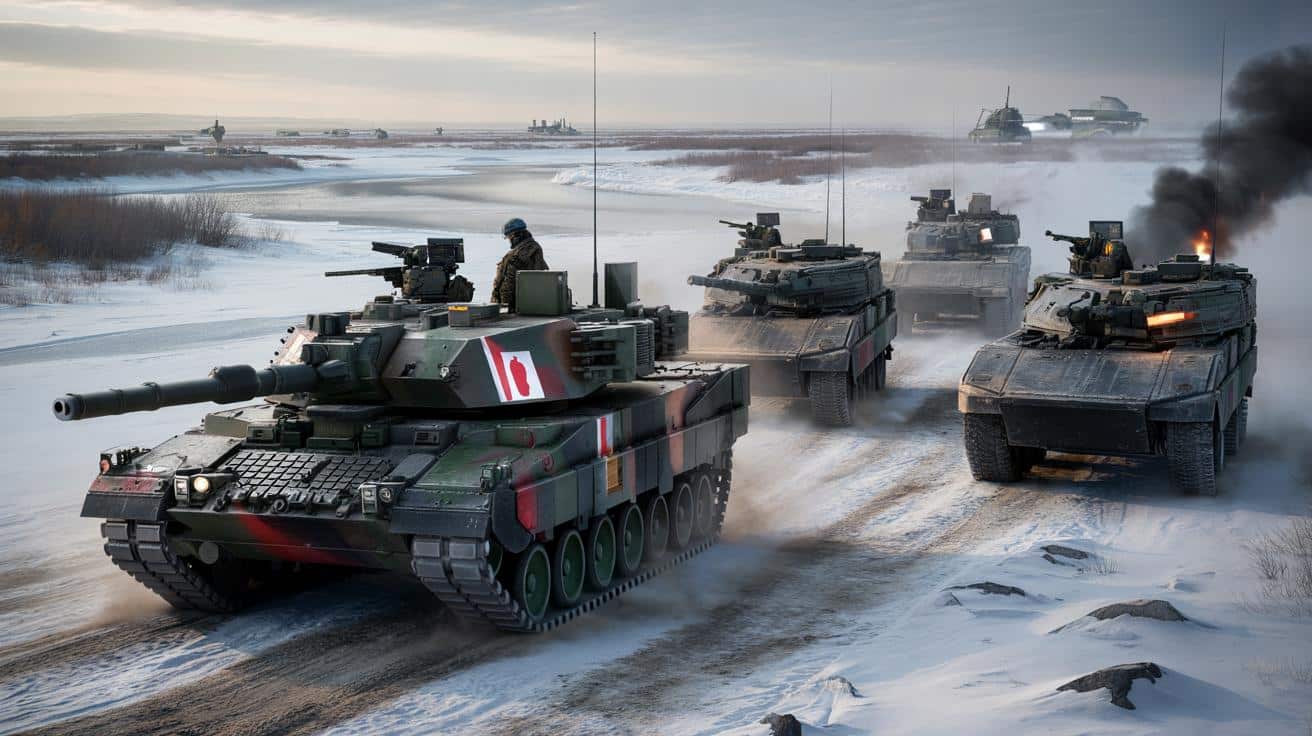
Ottawa’s answer is bold: by 2031, the country aims to renew almost its entire tracked combat fleet and reshape how its armoured units fight. The centrepiece is a new generation of medium-weight tracked armoured fighting vehicles (AFVs) and a parallel overhaul of its Leopard 2 main battle tanks.
Canada wants an armoured force able to move fast, hit hard and survive alone in a contested Arctic, even without US support.
The political message is clear. Canada no longer assumes that geography and alliances will shield it from high-end conflict. It wants options if those assumptions fail.
250 new armoured vehicles to rebuild the cavalry
The first leg of the plan is a massive tracked AFV programme scheduled for 2029–2031. The army expects to buy around 250 vehicles to form the backbone of two new “medium cavalry” battalions.
These units, known internally as MEDCAV, sit between light infantry and heavy tank formations. They are meant to move faster than tanks, survive more than wheeled vehicles, and adapt to a wide spectrum of missions, from high-intensity combat to grey-zone border incidents.
What the new vehicles must do
Canada’s requirements are demanding and tailored for future wars rather than old ones.
- High tactical mobility on snow, mud, and broken permafrost
- Strong armour protection, expected around NATO STANAG Level 6 (resisting 30 mm rounds and nearby explosions)
- Modular armament, allowing different turrets and mission kits
- Survivability against modern threats, including drones and top-attack munitions
- Full operation at extreme cold, down to around -40°C
Ottawa is looking at designs already in service or in trials elsewhere: BAE Systems’ CV90, South Korea’s AS21 Redback and Germany’s Lynx are among the candidates under discussion. All are tracked, heavily armed and highly digitalised platforms.
➡️ What does making your bed right after waking up mean, according to psychology?
➡️ After Replacing 90% Of His Staff With AI, An Indian Founder Reveals An Unexpected Outcome
➡️ Before Trees, Earth Was Ruled By Giant Life Forms That Seem From Another World
The future Canadian AFV is expected to be less a simple troop carrier and more a “Swiss Army knife” for ground combat, able to change roles in days rather than years.
A toolbox on tracks, not a single-purpose tank
Modern conflicts in Ukraine, the Middle East and the Caucasus have shown that rigid vehicle fleets struggle against fast-changing threats. Canada wants its new armour to function as a modular toolkit.
Planned variants include:
- Direct fire support with 30–50 mm automatic cannons
- Platforms for launching loitering munitions and “kamikaze” drones
- Command posts and electronic warfare nodes
- Armoured logistics and casualty evacuation versions
- Short-range anti-drone and air defence configurations
This approach turns the MEDCAV battalions into flexible combat groups. In an Arctic crisis, they could screen the border, guard remote infrastructure and support heavy tanks without waiting for foreign reinforcements.
Leopard tanks: upgrade now, replace next
Alongside the new vehicles, Canada is overhauling its 103-strong Leopard 2 fleet through the Heavy Direct Fire Modernization (HDFM) programme. The tanks include older A4 and A4M models and more recent A6M versions, many of which served in Afghanistan.
The plan is to squeeze a final decade of relevance from the Leopards while preparing their successor.
| Year | Planned step |
| 2024 | Support contract for existing Leopard 2 fleet launched |
| 2029–2031 | Delivery of 250 new tracked AFVs for medium cavalry units |
| 2030 | Start of acquisition process for a new main battle tank |
| 2033 | Completion of Leopard 2A6M modernisation |
| 2035 | Gradual retirement of remaining Leopard 2s begins |
| 2037 | New armoured structure expected to be fully operational |
Upgrades for the current Leopards focus on sensors, fire control and battlefield connectivity. Night vision, thermal imaging and digital command systems will be brought up to a level closer to the latest European standards.
By the mid‑2030s, Canada aims to field a mixed heavy force: upgraded Leopards holding the line while a new generation of tanks enters service.
The Leopard replacement is not yet chosen, but Canadian officers privately admit they are watching German, American and possibly South Korean projects closely. A joint programme with allies is on the table, though Ottawa wants more say than in past procurement deals.
Arctic front line and a shadow from the south
Canada’s defence establishment now treats the Arctic as an active theatre, not a distant backdrop. Russian forces have re-opened Soviet-era bases, tested new missile systems and held large-scale exercises in the High North. China, framing itself as a “near-Arctic state”, is seeking access routes and investment projects along northern sea lanes.
At the same time, trust in automatic US support has been shaken. While formal defence agreements remain in place, recent American political swings have forced Ottawa to question worst-case scenarios once considered unthinkable.
Canadian war games have discreetly modelled a crisis scenario involving a hostile move by US forces against Canadian territory, treated as an extreme stress test.
In one such tabletop exercise, staff officers worked through the consequences of a sudden US incursion under the pretext of securing Arctic resources. The exercise did not predict war with Washington but forced planners to face a blunt question: could Canada delay or deter any aggressor long enough for diplomacy or alliances to catch up?
Terrain, temperature and the return of tracks
The Arctic focus shapes almost every requirement of the new armoured fleet. Wheeled vehicles struggle in deep snow, on thawing permafrost or on half-frozen river crossings. Tracked machines spread weight better and can follow tanks across broken ground.
The new AFVs must start reliably in extreme cold, keep electronics functioning under ice fog and freezing rain, and shelter crews from both the elements and precision strikes. Fuel consumption, maintenance and logistics in areas with no roads are getting as much attention as armour thickness.
Force 2040: more than just new hardware
The armoured overhaul feeds into a larger blueprint known as “Force 2040”. This vision assumes a harsher strategic climate, with cyber attacks, drone swarms and contested sea lanes affecting how Canada moves troops across its own territory.
Force 2040 calls for higher manning levels, more realistic Arctic training and closer integration between land, air and naval assets. The new AFVs and tanks will be nodes in a larger network: linked to surveillance drones, long-range artillery and satellites providing live targeting data.
The goal is an army that can operate as a self-contained Arctic projection force, not just an attachment to US or NATO formations.
Budget pressures remain real, and parliament will have to back multi‑billion‑dollar contracts over the next decade. Yet the political mood has shifted: repeated warnings about Arctic vulnerability, and the visibility of Russia’s war in Ukraine, make armoured investment easier to defend to voters.
What “STANAG 6” and heavy direct fire actually mean
Several technical terms sit at the core of this transformation. STANAG 6 refers to a NATO protection standard, roughly meaning that a vehicle can withstand hits from powerful 30 mm autocannons and serious nearby blasts. It does not make vehicles invulnerable, but it gives crews a fighting chance against common battlefield weapons.
“Heavy direct fire” describes the role filled by main battle tanks and some heavily armed AFVs. These platforms fire large-calibre guns along a direct line of sight to destroy enemy tanks, bunkers or urban strongpoints. Canada’s HDFM programme is about keeping this punch credible, even as anti-tank missiles and drones grow more lethal.
Scenarios planners are quietly working through
Inside Canada’s defence college and planning cells, several practical scenarios drive the spreadsheets and simulations:
- A Russian-backed crisis in the Arctic, with sabotage against northern radar sites and shipping routes
- A hybrid campaign using drones and proxies against energy infrastructure in remote provinces
- A cross-border political dispute with the US that escalates into military posturing and limited incursions
- Simultaneous natural disasters and cyber attacks, stretching domestic response forces while an adversary tests NATO’s resolve
In each case, mobile armoured groups able to move independently, sustain themselves in harsh terrain and hold critical ground for weeks become a central tool. The new 250 AFVs and the revamped Leopards are meant to give Canada that option, in a century where geography no longer guarantees safety, even between neighbours.