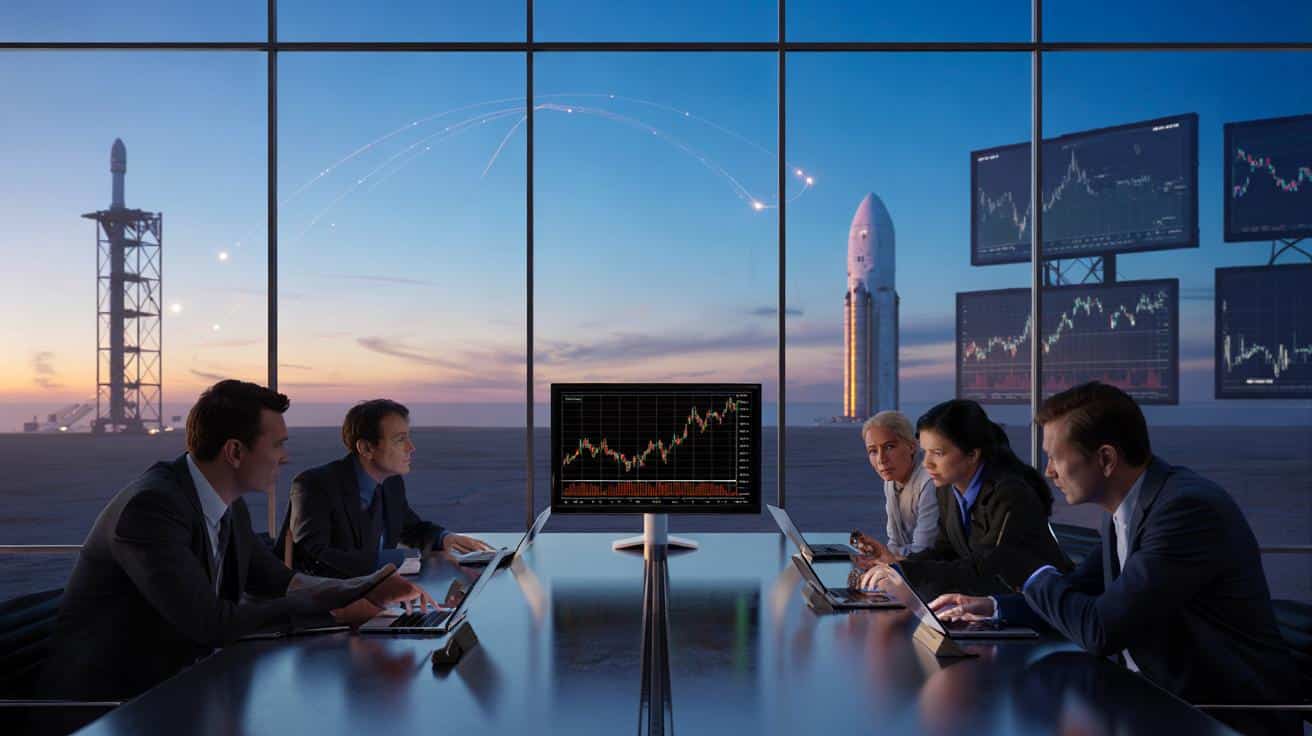
On a gray California morning, a handful of SpaceX engineers huddle around a laptop in a crowded Hawthorne meeting room. The Starship launch replay is on mute in the corner, but nobody’s really watching. They’re refreshing internal dashboards instead, staring at slides marked with a word that almost never appears in SpaceX decks: “IPO.”
Rumors have been swirling for months. Now, another bombshell has slipped out of the boardroom chatter: SpaceX is quietly exploring a merger or tighter alignment with some of Elon Musk’s other ventures — from Starlink to Tesla tech, even the X “everything app” dream. For staff whose stock options are their life savings, the conversation suddenly feels very real.
There’s a sense that something big is being stitched together behind closed doors.
Why SpaceX is suddenly flirting with a mega-merger
SpaceX has spent two decades acting like the scrappy outsider of the aerospace world. Private, fast, slightly chaotic, and proud of it. Going public was always a “someday, maybe” topic, parked somewhere after “build a city on Mars.”
Now the numbers are too big to ignore. SpaceX is valued north of $200 billion on the private markets, Starlink revenues are climbing, and early investors are hungry for liquidity. An IPO would be a massive financial event on its own. Merging in pieces of Musk’s other empires before that moment could turn it into something closer to a tech–space–telecom monster.
Inside the company, people whisper about scenarios that sound like sci‑fi. One version has Starlink carved out and merged cleanly into a separate public entity, with SpaceX holding a chunky stake. Another vision is wilder: a “Musk Tech” supergroup that bundles rockets, satellites, AI, and maybe even Tesla software under a single roof.
Investors are gaming out combinations. SpaceX + Starlink. SpaceX + parts of Tesla’s AI and robotics stack. SpaceX + data pipes for X, the social platform Musk is trying to bend into a payments-and-streaming hub. Each mix changes the story Wall Street will tell — and the price it might pay.
The logic is blunt and almost uncomfortable. A pure-play rocket company, even one as groundbreaking as SpaceX, still looks cyclical and hardware-heavy to public markets. Add Starlink’s recurring subscription revenue, plus a Musk-branded narrative around AI, autonomy, and global infrastructure, and suddenly it feels like the next trillion-dollar “platform.”
Regulators won’t love the concentration of power. Nor will some Tesla shareholders thrilled with a car/energy brand but wary of Mars dreams. Yet the alignment would solve a core Musk problem: his empires feed each other technologically, while their capital structures have been stuck in different universes. A merger ahead of an IPO is a messy way of saying, “Let’s admit these companies were merged in spirit all along.”
Where Musk might actually connect the dots
The quiet play, according to people close to the ecosystem, is Starlink. It already sits inside SpaceX legally, yet behaves like a separate beast. Different customers, different growth curve, different risk profile. Locking Starlink more tightly into the IPO story is the cleanest financial move on the board.
➡️ Have you ever tried cloud eggs? This light way to cook them
➡️ Expanding AI Career Access Through Skills Based Evaluation
➡️ French prosecutors to set up special team to review Epstein files
➡️ Why varying the intensity and frequency of physical activity is better for your health
Picture the pitch deck: rockets enabling cheap satellite deployment, satellites feeding global internet, global internet feeding data for AI and autonomous systems. One industrial loop, sold as a single growth graph. It’s elegant. It’s also exactly the kind of story that gets big funds to click “buy” on day one of a listing.
Where things get trickier is with Tesla and X. Tesla is already public, with its own governance dramas and a shareholder base that signed up for an EV and energy transition saga, not orbital refueling depots. Sliding key Tesla software, AI models, or robotics IP into a merged SpaceX structure would trigger loud debates and, almost certainly, lawsuits.
X, on the other hand, is privately held but politically radioactive. Bundling a social network that hosts everything from war footage to presidential rants with a defense-adjacent rocket company is the kind of move that keeps antitrust lawyers employed for a decade. Still, the strategic temptation is clear: Starlink as the distribution pipe, X as the front-end platform, SpaceX as the infrastructure backbone. A vertically integrated Musk stack, from orbit to your phone.
Underneath the noise, the pattern is simple. SpaceX needs patient, enormous capital to pull off Mars-scale projects. Public markets can provide that, but only if they see more than a launch business. Merging in adjacent Musk assets, even selectively, offers the chance to rebrand SpaceX as **the central nervous system of Musk’s entire vision**.
We’ve all been there, that moment when a complicated life suddenly begs to be reorganized into one clean folder. That’s what this looks like on a corporate scale. The risk: tidy on paper can turn explosive in real life when regulators, employees, and retail investors collide.
How this could change things for everyday investors (and fans)
For retail investors watching from the sidelines, the main “method” in this chaos is timing. An IPO after a merger or restructuring tends to re-price the whole story before you even get a shot at buying. The cleanest angle is tracking when SpaceX formally discloses any reorganization: SEC filings, leaked deal terms, or Musk’s not-so-subtle posts.
The playbook, if you’re curious rather than reckless, is simple. Follow the corporate structure, not the memes. If Starlink stays wrapped inside SpaceX for the listing, you’re buying space + internet in one ticket. If it’s spun off separately, you’re choosing between launch exposure and telecom-style growth. Two very different risk appetites, hidden under the same celebrity CEO brand.
A lot of people will try to trade the headlines. “Musk mega-merger!” will spike volume on day one. Then reality hits: integration delays, regulatory probes, internal culture clashes. *The market loves a story and hates a hangover.*
If you’re one of the thousands of SpaceX employees whose net worth is mostly options, this moment is even more emotional. You’re not just reading filings. You’re wondering if years of 90-hour weeks are about to crystallize into public stock — or be reshuffled into some structure that locks you in longer. Let’s be honest: nobody really reads every line of those equity plans in real time.
“Elon’s companies already behave like a loose federation,” says one venture investor who has backed Musk ventures for over a decade. “The question is whether he finally formalizes that in the capital markets, or keeps playing 4D chess between public and private balance sheets.”
- Watch the Starlink carve‑out language
If documents start describing Starlink as a distinct, dividend-capable unit, that’s a tell about future listings and spin‑offs. - Track regulatory murmurs
Signals from the SEC, FTC, and EU competition authorities will hint at how far a merger can actually go without being blocked or heavily conditioned. - Separate the Musk effect from the fundamentals
Stock spikes on hype can feel thrilling, yet the long-term value still rests on launch cadence, Starship reusability, and Starlink’s path to real profitability.
What this moment really says about power, risk, and the future of space
Beneath the speculation about ticker symbols and valuation bands, something more subtle is happening. SpaceX inching toward a public listing, potentially tied to other Musk assets, marks a shift in who really owns the future of space infrastructure. Governments are no longer the sole gatekeepers. One man’s corporate web is.
That prospect thrills some and terrifies others. If the merger talks crystallize, the next decade of spaceflight, global connectivity, and orbital data could be steered by a single integrated behemoth. If they stall, we may end up with a patchwork: rockets here, satellites there, social platform over there, with value leaking at the seams. Neither path is clean, both are consequential.
For now, the story is unfinished. SpaceX employees are refreshing their internal dashboards, investors are refreshing their news apps, and regulators are quietly refreshing their briefings. Somewhere between Mars dreams and quarterly earnings, a new kind of company is trying to be born. Whether we cheer, worry, or buy the dip, we’re all about to find out what happens when the most ambitious private space firm on Earth decides it’s finally ready for the public spotlight.
| Key point | Detail | Value for the reader |
|---|---|---|
| SpaceX–Starlink alignment | Using Starlink’s subscription revenue to smooth out SpaceX’s capital‑intensive launch business before an IPO | Helps readers see why a merger could boost stability and long‑term growth potential |
| Regulatory and governance friction | Any merger with Tesla tech or X raises antitrust, national security, and shareholder‑rights questions | Signals where political and legal risks might hit future share prices |
| Retail investor strategy | Watching structure changes, not hype, to understand what exposure an IPO really offers | Gives readers a concrete lens for judging if and how to participate once SpaceX hits public markets |
FAQ:
- Will SpaceX definitely merge with other Musk companies before the IPO?
No. Talks and scenarios are real, but nothing is guaranteed. SpaceX could list largely as‑is, with only internal reshuffling around Starlink.- Could Tesla be directly merged into SpaceX?
A full Tesla–SpaceX merger looks unlikely due to Tesla already being public, its distinct mission, and the legal headaches of forcing that kind of combination on existing shareholders.- Is Starlink going to IPO separately?
Musk has hinted at a future Starlink listing once cash flows are more predictable. Right now, the smarter read is that Starlink stays under the SpaceX umbrella for at least the first phase of any IPO plan.- What does this mean for SpaceX employees with stock options?
A merger and IPO could finally give them liquidity, but timelines, lock‑ups, and new structures matter. Some may have to wait longer or see their equity converted into different classes of shares.- Should retail investors rush into a SpaceX IPO if it happens?
That depends on risk tolerance. A combined space–satellite–tech story could be powerful, yet launch risk, regulatory pushback, and Musk’s volatility mean this would be a high‑beta, long‑horizon bet, not a safe haven.