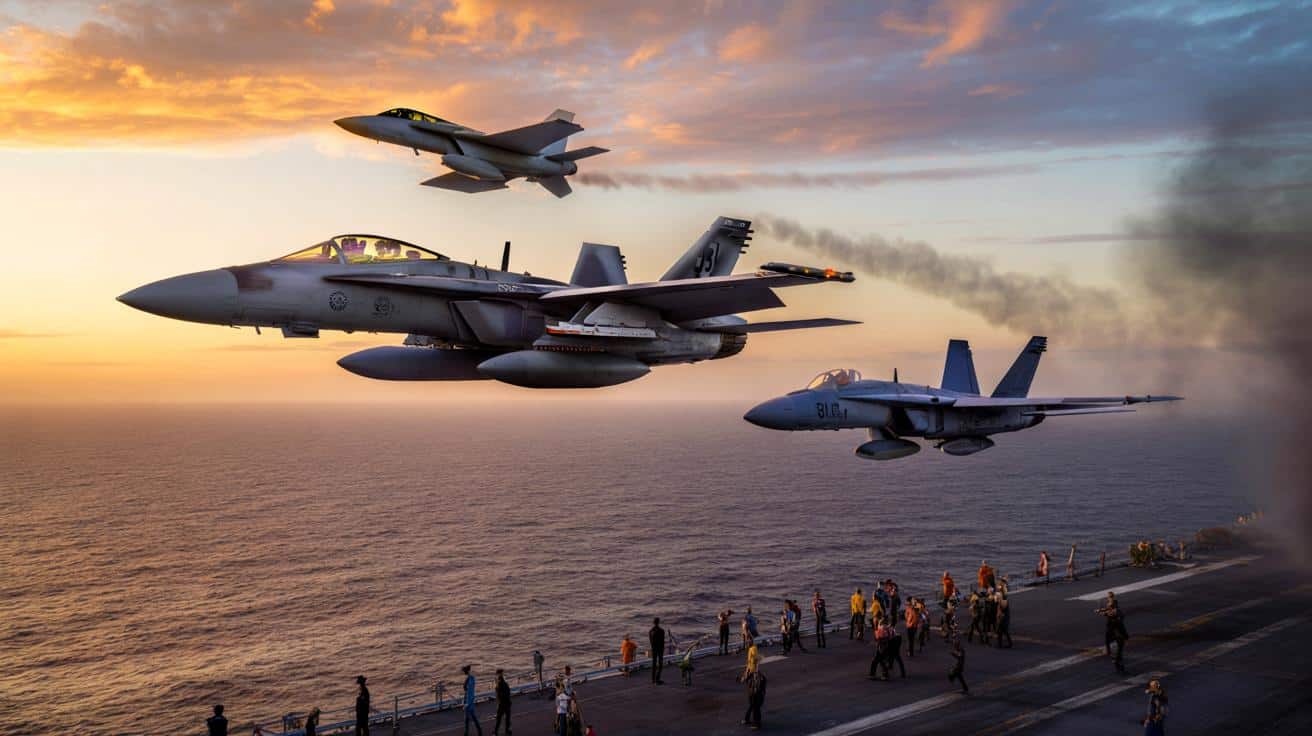
Rejected by the US Air Force in the 1970s, the Northrop YF‑17 “Cobra” should have disappeared into the footnotes of aviation history. Instead, its DNA powered the rise of the F/A‑18 Hornet and Super Hornet, carrier‑borne fighters that armed Western allies for decades and repeatedly sidelined French rivals from Dassault.
From loser to blueprint: the strange fate of the YF‑17
In the early 1970s, the US Air Force launched a competition for a new lightweight fighter. Two prototypes faced off: General Dynamics’ YF‑16 and Northrop’s twin‑engine YF‑17.
The YF‑16 won in 1975. It was cheaper, easier to maintain, and fit perfectly with USAF priorities. The YF‑17 was shelved, its programme effectively dead for the Air Force.
The YF‑17 lost the contract it was built for, yet its design went on to shape one of the longest‑serving carrier fighters in history.
On paper, the verdict made sense. The YF‑16 offered exceptional agility and reduced operating costs. For a service planning to buy thousands of airframes, every dollar counted.
The YF‑17, with two engines and a more complex structure, looked like the wrong answer to the USAF’s budget problem. But those same features caught the eye of another service with very different needs.
Rescued by salt water: how the navy revived the “dead” fighter
While the Air Force moved ahead with the F‑16, the US Navy was looking for a new aircraft to replace ageing A‑7 Corsair IIs and complement its heavy F‑14 Tomcats.
Carrier aviation is brutal. Jets slam onto decks, catapults wrench them into the air, salt and humidity attack every surface. For admirals and engineers, a twin‑engine design promised better safety and resilience over water.
Northrop teamed up with McDonnell Douglas to adapt the YF‑17 for naval use. The result was radical:
➡️ If you’re over 60, this is why prolonged sitting feels harsher
➡️ Radioactive hybrid boars are thriving in Fukushima. Now scientists finally know why
➡️ This European country challenges its arms industry with a homegrown rival to the Tomahawk missile
➡️ SPD district chief forces welfare recipients to work – and gets a surprise
- Stronger landing gear for carrier landings
- Enlarged wings and control surfaces for low‑speed handling
- Reinforced structure and folding wings for deck storage
- Redesigned avionics and radar for multirole missions
This collaboration birthed the F/A‑18 Hornet, with the “F/A” label signalling its dual role as both fighter (“F”) and attack aircraft (“A”). It was conceived from day one as a flexible workhorse, not a specialist thoroughbred.
The Hornet turned the YF‑17’s supposed weaknesses – complexity and twin engines – into strengths tailored for carriers and multirole tasks.
Global success: when the Hornet beat Dassault
The F/A‑18 entered service in the early 1980s. Quickly, it carved out a central role in US naval air power. It flew from carriers in the Gulf War, the Balkans, Afghanistan and Iraq, often acting as both air‑defence fighter and precision bomber in the same sortie.
With Washington’s backing, the Hornet began to spread beyond US decks. Several countries signed up, often after comparing American and French offers head‑to‑head.
Hornet versus Mirage: a quiet Western rivalry
At roughly the same time, France was pushing its own star: the Mirage 2000. Highly respected and exported to countries such as Egypt, Greece, India and Taiwan, the Mirage gave Dassault solid credibility.
Yet within the NATO family, the picture looked different. When key partners went shopping for fighters, many opted for the F/A‑18 or, later, its bigger cousin, the F/A‑18E/F Super Hornet.
Among the countries that chose Hornets instead of French designs were:
| Country | Model selected | Main role |
|---|---|---|
| Canada | CF‑18 Hornet | Air defence and NORAD duties |
| Australia | F/A‑18A/B then F/A‑18F | Strike and regional air superiority |
| Spain | EF‑18 Hornet | NATO air policing and strike |
| Finland | F/A‑18C/D | National air defence |
| Kuwait | F/A‑18C/D then F/A‑18E/F | Regional security and coalition ops |
The Mirage 2000 and later Rafale competed in several of those tenders. French aircraft were rarely judged inferior on pure performance. Instead, the decision frequently hinged on politics, alliances and industrial offset deals.
Why American jets kept winning allies
The Hornet’s appeal was not just about its handling or combat record. Buying an American jet often meant plugging directly into a US‑led ecosystem.
For many NATO states, a fighter contract buys much more than an airframe: it buys interoperability, shared weapons and guaranteed logistics.
With F/A‑18s, air forces gained access to US weapons such as AMRAAM air‑to‑air missiles, advanced guided bombs and targeting pods. Training pipelines, maintenance support and shared software upgrades were bundled in.
Dassault, by contrast, typically arrived with a smaller industrial and diplomatic machine behind it. French diplomacy promoted the Rafale strongly in the 2000s and 2010s, but often against a tide of US influence and locked‑in alliance structures. In crucial NATO tenders in Switzerland, Canada, Finland and Spain, American offers prevailed, first with Hornets and later with the F‑35.
Fifty years of relevance: the Hornet’s surprising longevity
Few would have predicted in 1975 that the “loser” derived from the YF‑17 would still be rolling off production lines decades later. Yet the Super Hornet variant, introduced in the late 1990s with a larger airframe, new engines and updated avionics, extended the family’s life dramatically.
US decisions have kept the assembly lines open into the late 2020s, partly driven by delays and cost pressures surrounding the newer F‑35C carrier variant. For the US Navy, the Super Hornet remains the backbone of day‑to‑day carrier aviation.
This longevity has few parallels. The F‑16 has been produced in greater numbers, but the Hornet holds a special place as the main carrier‑borne multirole jet of several navies for decades.
From its YF‑17 origins in the 1970s to Super Hornets scheduled to fly well into the 2040s, the design has spanned multiple technological eras.
French frustration and the politics of airpower
From Paris, the Hornet’s success looks like a case study in missed chances. France produces sophisticated aircraft, yet often fails to convert them into large contracts inside the Western alliance.
The Rafale eventually gained traction abroad, including deals with India, Egypt, Qatar, Greece and others. Those sales reversed the narrative that France could no longer export high‑end fighters.
But in the core NATO market, the pattern persists. When alliance members seek new jets, they now tend to gravitate toward the F‑35, following the same logic that once favoured the F/A‑18: interoperability, shared training and Washington’s political backing.
What “interoperability” really means for fighter jets
The term gets used constantly in defence debates, but often without explanation. For combat aircraft, interoperability usually includes:
- Common data links so jets can share radar tracks and targeting information
- Compatible weapons, fuel systems and refuelling standards
- Shared procedures, tactics and mission planning tools
- Access to common spare parts pools and maintenance procedures
For a government worried about a crisis on its borders, the ability to plug seamlessly into US‑led operations can outweigh differences in performance or cost between rival airframes.
What the YF‑17 story says about future programmes
The curious journey from YF‑17 to Hornet offers a few practical lessons for how fighter programmes might evolve in the coming decades.
First, a design rejected in one context can thrive in another. The YF‑17 was a poor fit for a mass‑produced, budget‑sensitive USAF project. It turned out to be almost ideal as the seed of a rugged, twin‑engine carrier fighter.
Second, political and industrial ecosystems often beat clean technical comparisons. Countries weighing the F‑35, Rafale or future European fighters face similar trade‑offs: national autonomy versus alliance convenience, bespoke solutions versus integration with US systems.
Finally, long‑running aircraft families reshape air forces gradually. A state that has flown Hornets for 30 years has pilots, technicians, depots and doctrine built around that type. Switching away carries costs and risks, which often push decision‑makers toward follow‑on American designs.
For readers trying to understand tomorrow’s airpower debates, the YF‑17 episode offers a useful simulation exercise: imagine which current “loser” prototypes might, with the right partner and the right mission, return later as the next long‑lived backbone of Western air forces.