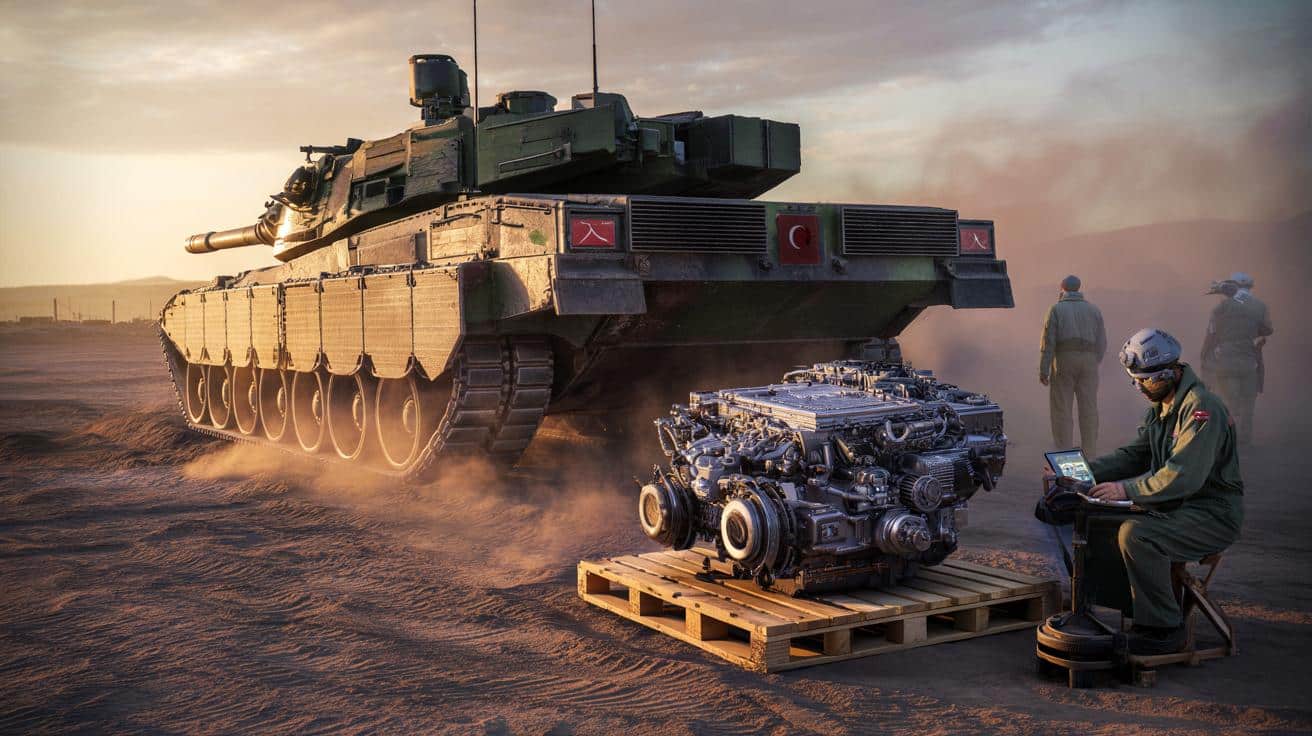
The BATU engine, built for Turkey’s Altay main battle tank, has passed its final factory trials and is now cleared for industrial production. Behind that technical step lies a much bigger story: Ankara’s push to shed foreign dependence, join a tiny group of tank‑engine manufacturers, and quietly reshape the balance of power in the global armoured‑vehicle market.
From stalled prototypes to a homegrown 1,500 hp engine
The Altay tank has been one of Turkey’s most ambitious defence projects for more than a decade. But progress has been repeatedly slowed by one stubborn bottleneck: the powerpack.
Early Altay prototypes relied on foreign engines and transmissions subject to export licences, political bargaining and last‑minute vetoes. Every diplomatic chill, every embargo threat, had a direct impact on production lines in Turkey.
The BATU engine aims to break that cycle. Designed by BMC Power, it is a 1,500 hp V12 diesel, the power level that has become the benchmark for modern main battle tanks weighing over 60 tonnes.
With BATU, Turkey is moving from “tank buyer and integrator” to “tank heart manufacturer”, a far harder club to join.
During factory acceptance, Turkish engineers tested the BATU’s endurance under sustained heavy load, its performance in extreme heat and dust, and its behaviour when run hard for long periods with limited cooling. The idea was simple: push the engine to failure point, then keep it there and see what breaks.
So far, nothing critical has. That’s what allowed Ankara to declare the engine ready for series production.
Why a tank engine is such a strategic weak point
A modern main battle tank is useless if it cannot move. Armour, sensors and advanced fire‑control systems all depend on an engine that starts, runs and survives abuse day after day.
Tanks operate in conditions that would kill most commercial engines: long hours idling in place, sudden bursts of full power, steep climbs over broken ground, and constant exposure to dust, mud and battlefield shock.
➡️ How to house dairy calves properly?
➡️ After Replacing 90% Of His Staff With AI, An Indian Founder Reveals An Unexpected Outcome
➡️ France to cut its contribution to the Global Fund to Fight Aids, Tuberculosis and Malaria by 58%
➡️ I tried this comforting dish and knew I’d make it again
➡️ Evicted after $22,000 in unpaid rent, a tenant leaves behind a massive aquarium “and a hefty bill”
For a country like Turkey, relying on foreign engines meant that every major tank purchase or export deal came with strings attached.
Propulsion sits among the most tightly controlled subsystems in any armoured vehicle, often more restricted than guns or armour.
The move to a national engine therefore has two intertwined dimensions: technical independence and political freedom of action. When the engine is local, foreign governments lose one of their main levers over your tank fleet.
Engine ready, powerpack not yet complete
The missing piece: a fully national transmission
There is still a wrinkle. BATU has been validated as an engine, but the complete powerpack – engine plus automatic transmission – is not fully qualified yet.
Turkey is developing an indigenous automatic gearbox to pair with BATU, but that transmission is still working through its own test campaign. In a tank, the engine and transmission are an inseparable duo. One cannot go to war without the other.
Until the gearbox passes all stages of certification, mass production of a 100% national Altay powerpack remains on hold. Turkey could, in theory, pair BATU with a foreign transmission as a stop‑gap, but that would blunt the sovereignty benefits.
Even so, from an engineering risk perspective, clearing the engine is a major step. The engine is generally the most complex, most stressed component. Integration work on the transmission, cooling, and control systems is demanding, but less of a leap than designing a modern tank engine from scratch.
What BATU actually changes on the battlefield
With the engine validated, the Altay programme can shift to full‑vehicle integration, dynamic trials, and field evaluations. Those phases involve running the tank in realistic combat scenarios: high‑speed road moves, cross‑country runs, firing on the move, and prolonged idling in heat and dust.
If BATU performs as advertised once inside the Altay hull, the Turkish Army stands to gain several practical advantages:
- Higher operational availability: more tanks able to move and fight at any given time.
- Local maintenance: repairs and overhauls carried out in Turkish facilities without relying on foreign depots.
- Predictable logistics: spare parts managed through national supply chains, less exposed to diplomatic crises.
- Tailored upgrades: the engine can be tweaked over its lifetime to match Turkish operational needs.
A national engine does not just power the tank; it powers planning, logistics and long‑term force design.
Export ambitions and a loosening of political handcuffs
The export angle matters almost as much as Turkey’s own army requirements. Engines and transmissions are often the key reason a tank deal stalls or dies. Supplier nations insist on end‑use monitoring, veto rights on resale, or geographic restrictions.
By fielding BATU, Ankara gains breathing space. The country still needs to finish its national transmission to reach full autonomy, but it no longer faces a single foreign “off switch” on the entire Altay programme.
That shift could reshape Turkey’s sales prospects in regions that feel hemmed in by US or European export controls, such as parts of the Middle East, Africa or Asia.
A tiny global club – and why France is no longer in it
Who can actually build a tank engine?
Despite the number of countries operating tanks, very few can build a modern 1,500 hp tank engine from design to production.
| Country/region | Key players | Notable engines/tanks |
|---|---|---|
| Germany | MTU (Rolls‑Royce Power Systems) | MB 873 for Leopard 2 |
| United States | Honeywell, Cummins, GDLS | AGT1500 turbine for M1 Abrams |
| Russia/Ukraine | Kharkiv Morozov, Chelyabinsk Tractor Plant | Engines for T‑64, T‑80, T‑90 families |
| South Korea | Doosan | DV27K for K2 Black Panther |
| China | NORINCO and partners | Engines derived from Ukrainian/German designs |
| India | DRDO and partners | Gen‑1 for indigenous programmes |
| Turkey (emerging) | BMC Power | BATU for Altay |
France is a special case. It designed the V8X‑1500 “Hyperbar” engine for the Leclerc tank, an innovative high‑performance powerplant. But production has long been tied into foreign industrial chains, including a Finnish‑owned company, and France has not maintained a fully sovereign, large‑scale heavy tank engine line.
Turkey’s move with BATU, if it reaches full maturity and volume, would place it where France once aspired to be: in the core group that can make a tank’s “heart” at home, not just integrate someone else’s.
Why building a 1,500 hp tank engine is so hard
On paper, a tank engine is “just” a big diesel. In practice, it is a completely different beast.
The engine must run for thousands of hours under violent acceleration, harsh shocks, and constant vibration. It must start in freezing cold, survive desert heat, and cope with air filters clogged by dust and sand. Crews expect full power even when the tank is packed with extra armour and equipment far beyond the original design weight.
Getting 1,500 hp is easy on a test bench. Getting 1,500 hp for years, in combat, is what makes nations fail or succeed.
That is why so many countries buy engines from a tiny set of suppliers. The engineering, tooling, metallurgy and quality‑control demands are high, and the sales volumes are modest compared with commercial trucks or ship engines. Few governments are willing to spend decades and billions to join this niche.
What this means for future conflicts and buyers
If BATU proves reliable, Turkey could pitch the Altay as an option for countries that want a Western‑compatible tank but face political limits with US or EU suppliers. Some states may accept a younger, less “combat‑proven” design in exchange for fewer end‑use strings and a partner more willing to transfer technology.
There are risks as well. Early generations of new tank engines often suffer from teething troubles: overheating, oil leaks, electronic bugs, or unexpected wear. South Korea’s own K2 engine experience showed how long it can take to stabilise a design. Export customers will watch BATU’s performance closely before committing in large numbers.
For readers following defence news, a few terms are worth unpacking. A “powerpack” is the combined engine, transmission, cooling and related systems built as a single removable unit. Modern tanks are designed so that this block can be swapped in a few hours in the field, instead of rebuilding the engine inside the hull. Reliability is measured not just in raw hours, but in “mean time between failures” under real combat‑like conditions.
Scenarios in Eastern Europe, the Middle East or the Caucasus now increasingly assume that regional powers will field more indigenous equipment, not just imported fleets. A Turkey able to sell tanks with its own engines feeds that trend. It also adds a new competitive pressure on traditional suppliers like Germany and the US, who have long dominated the tank‑engine market.