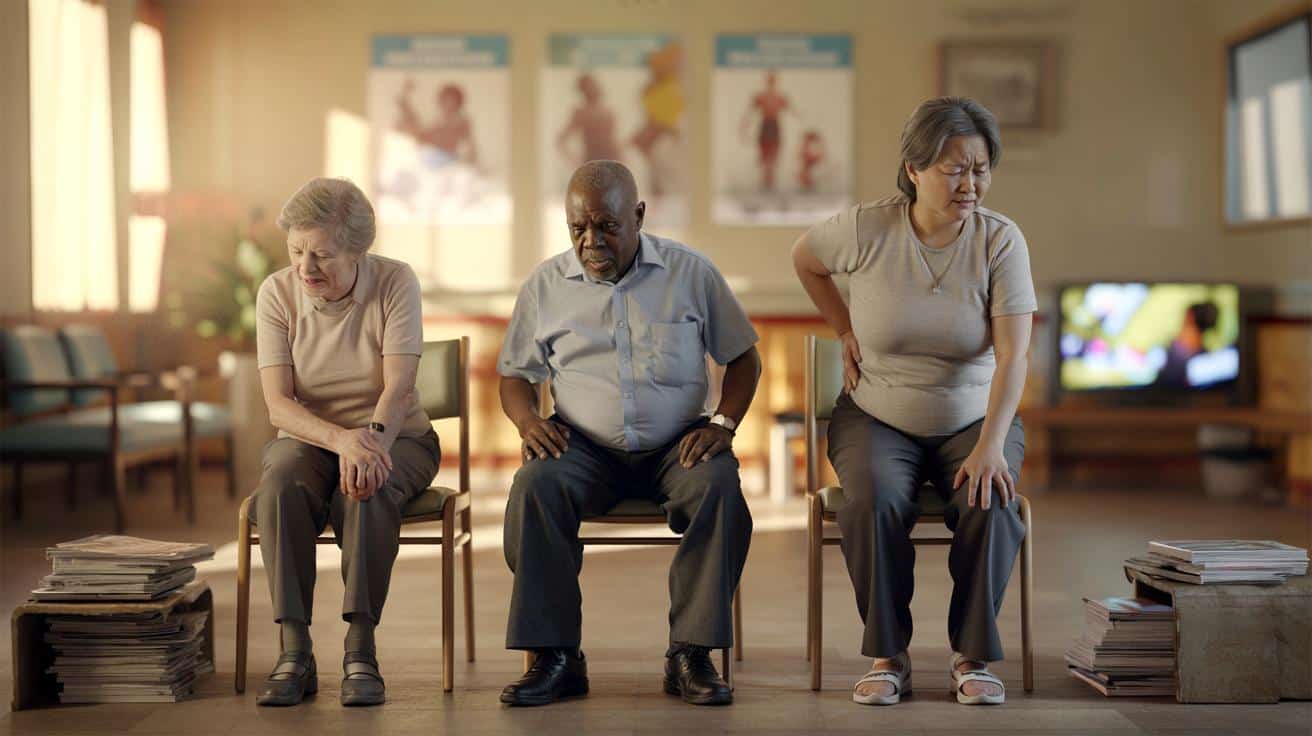
Late afternoon in a waiting room. The TV is murmuring in the corner, magazines are stacked in a tired pile, and three people over 60 shift on their chairs in almost perfect sync. First a hip adjusts. Then a lower back. Then someone stands up “just to stretch,” pretending to look at the posters on the wall. Nobody’s running a marathon. They’re just… sitting. Yet the discomfort builds like a slow, dull storm. Legs feel heavier. The back complains louder. Time itself seems to stick.
At 30, sitting for an hour feels like nothing. At 60, the same hour can feel strangely harsher, as if the chair has changed overnight.
The chair hasn’t changed.
What really changes in your body after 60 when you sit too long
The first surprise for many people past 60 is how quickly sitting starts to “hurt”. Not in a dramatic, ambulance-level way. More like a creeping stiffness that sneaks in after just one TV episode or a long car ride. The knees feel rusty. The lower back feels pinched. Standing up turns into a mini negotiation with your joints.
There’s a quiet shock in realizing that what used to be a moment of rest now feels like a trap. The body doesn’t bounce back the same way, and it lets you know it, sometimes very clearly.
Picture this. You sit down “for a bit” after lunch to scroll on your phone. A news video, a couple of emails, a quick look at photos of the grandkids. You glance at the clock: 50 minutes gone. You stand up and suddenly your hips feel glued to the chair. Your thighs protest, your ankles feel stiff, and there’s that familiar pinch right above the tailbone.
Studies back this up. Research on older adults links sitting more than 8–9 hours a day with higher pain levels in the knees, hips, and lower back. Not just more pain, but pain that lingers longer once you finally get moving.
What’s happening under the surface is brutally simple. After 60, muscles lose mass faster, tendons lose some elasticity, and cartilage has already taken a few decades of pressure. Blood flow slows down when you stay in the same position, so joints and tissues get less fresh oxygen and nutrients. Nerves in the lower back and legs get slightly more sensitive with age, so they “complain” sooner.
So prolonged sitting becomes a perfect storm: weaker muscles support you less, stiffer tissues adapt badly to stillness, and more sensitive nerves send louder messages. The result is that one ordinary chair can feel twice as harsh as it did 20 years earlier.
Small changes that make long sitting less punishing after 60
One of the most effective gestures is ridiculously simple: break the sitting spell every 25–30 minutes. Not a workout. Just 60–90 seconds of standing up, walking to the kitchen, circling your shoulders, or gently rolling your ankles. Think of it as pressing “reset” on your joints before they lock in.
➡️ French prosecutors to set up special team to review Epstein files
➡️ SpaceX in merger talks with other Musk companies ahead of IPO
➡️ Microwaving a lemon : A simple kitchen trick you’ll keep using
➡️ Have you ever tried cloud eggs? This light way to cook them
You can link it to real life: stand during TV ads, march in place while the kettle boils, walk the hallway during phone calls. *Your body reads these micro-breaks like a promise that you’re not abandoning it to the chair for hours on end.*
Plenty of people over 60 think they need a full gym routine to protect their joints, so they wait for the “right day” to start… and it never quite comes. Meanwhile, the everyday sitting hours keep stacking up. Let’s be honest: nobody really does this every single day.
A softer, more realistic approach works better. Slightly firmer chair instead of a saggy sofa. A small cushion at the lower back. Feet flat on the floor, not tucked under the chair. If you forget to stand, set a gentle reminder on your phone or your watch. Not as a punishment, but as a friendly nudge from your future self.
“Once I started getting up every half hour, my back didn’t magically heal,” laughs 68‑year‑old Marie, “but the days didn’t feel so heavy in my body. I didn’t dread long dinners anymore. My chair stopped feeling like the enemy.”
- Stand up at least once every 30 minutes, even for 1 minute.
- Keep your hips slightly higher than your knees when you sit.
- Use a small cushion behind your lower back for support.
- Gently flex and point your feet while seated to boost circulation.
- Alternate “sit time” and “move time” all day, not just during exercise.
Rethinking your relationship with sitting after 60
There’s a quiet shift that happens when you stop seeing your body as “betraying” you and start seeing it as sending data. Pain after long sitting is data. Stiffness is data. Tired legs are data. They’re not signs of failure. They’re signals that your muscles, joints, and blood flow now operate with a smaller margin for error than at 30.
Once you accept that, the chair stops being the villain and becomes a tool you can negotiate with. You can choose when to sit, how to sit, and for how long, instead of sliding into hours without noticing.
Many people over 60 say the same thing in different words: “I just don’t feel as free in my body when I sit too long.” That’s the real story behind the harsher feeling of prolonged sitting. It’s about freedom of movement, confidence in standing up, trust that your legs will follow without a jolt of pain.
You won’t turn back the clock, but you can absolutely change the script. Tiny, steady adjustments in how you sit, stand, and break up your day can decide whether your 60s and 70s feel cramped or expansive. That’s not a miracle. That’s design.
| Key point | Detail | Value for the reader |
|---|---|---|
| — | — | — |
| Age changes how sitting affects muscles and joints | Less muscle mass, stiffer tissues, and more sensitive nerves make long sitting feel harsher | Helps explain discomfort and removes guilt or confusion |
| Short, frequent breaks beat rare big workouts | Standing and moving 1–2 minutes every 30 minutes eases stiffness and improves circulation | Offers a realistic, easy strategy for daily life |
| Small posture tweaks reduce pain | Hips slightly higher than knees, lower-back support, feet flat, and active ankles | Gives concrete tools to feel better without special equipment |
FAQ:
- Is it “normal” to hurt more from sitting after 60?Yes, it’s very common. Age-related muscle loss, joint wear, and slower circulation all make long sitting feel harsher, but you can still improve comfort with movement breaks and better support.
- How long can I safely sit at a time?Research suggests aiming to break sitting every 25–30 minutes. You don’t need to stop your activity, just stand, stretch, or walk briefly before sitting back down.
- Does a special ergonomic chair solve the problem?A good chair helps, especially with lower-back support and seat height, but it doesn’t replace movement. Even the best chair becomes uncomfortable if you stay in it for hours without a break.
- Are my joints damaged if I feel pain when I stand up?Not necessarily. Pain can come from stiffness, weak muscles, or irritated tissues, not always from severe damage. Persistent or intense pain deserves a check-up with a health professional.
- What’s one simple exercise I can do while seated?Try slow ankle pumps: sit tall, then alternately flex and point your feet 20–30 times. This boosts blood flow in your legs and can reduce that heavy, “cement” feeling when you stand.