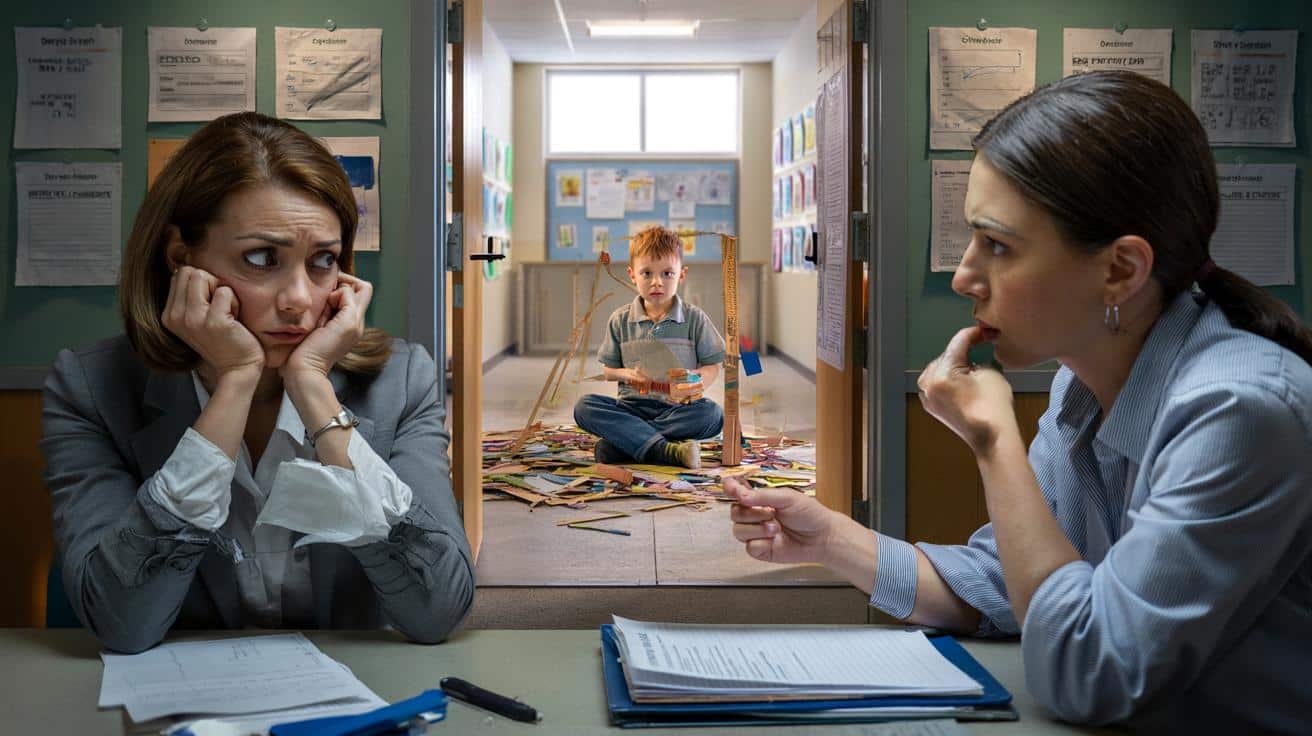
The teacher’s voice is calm, almost rehearsed. Across the small table, a mother twists a crumpled notice from school between her fingers. “He’s clearly bright,” the teacher says, “but he refuses to work. He’s disruptive. We can’t keep going like this.” The boy they’re talking about is down the hall, bored out of his mind, building an elaborate spaceship out of scrap cardboard in the corridor.
At home, he recites obscure science facts and asks questions that stump adults. At school, he “forgets” homework, rolls his eyes, picks fights with group projects.
Two worlds. One child.
The label changes from “gifted” to “lazy” in the time it takes to sign a disciplinary form. And something starts to crack.
When brilliance looks like sabotage
In a lot of families, the story starts the same way. A child talks early, reads everything, asks questions that sound like they’re coming from someone three grades up. Adults smile and say “future genius” at family dinners. For a while, that’s the whole picture.
Then real school begins. Suddenly this same bright child can’t finish worksheets, forgets basic instructions, refuses simple tasks. Teachers complain about attitude, parents lecture about wasted potential. The kid hears one message on repeat: “You’re so smart, why aren’t you trying?”
Take Léa, 10, tested with a very high IQ after her parents couldn’t understand the daily battles over homework. At home she devours fantasy sagas and learns song lyrics after hearing them once. At school, she “loses” her math book, doodles during lessons, and answers the teacher with a tone that sounds dangerously close to contempt.
Her mother spends nights between anger and guilt, Googling “gifted child lazy” under the duvet. Her teacher, exhausted, talks about sanctions and consequences. The school counselor mentions defiance. Nobody mentions that Léa’s brain is running so fast in class that she’s mentally checked out after three minutes.
Here’s the uncomfortable twist: a lot of gifted kids don’t “look” gifted in a classroom. They look scattered, messy, oppositional. When tasks feel too easy or senseless, their nervous system reacts like it’s under attack. Boredom hits them harder than it hits other children. That’s when you see refusal, clowning, long bathroom breaks, endless negotiation.
Adults interpret that behavior through a moral lens: respect, effort, discipline. The child is living something entirely different: cognitive dissonance, sometimes anxiety, often a raw feeling of not fitting anywhere. **High intellect with low tolerance for repetition can be a social disaster.** And that disaster tends to explode right in the middle of the family–school relationship.
➡️ Interior Design: Why going slow will save you money in the long run
➡️ India watches nervously as its biggest rival moves to buy 50 new warships
➡️ If you’re over 60, this is why prolonged sitting feels harsher
➡️ The plant that perfumes the home and repels mosquitoes : here’s why everyone wants it in spring
➡️ This European country challenges its arms industry with a homegrown rival to the Tomahawk missile
What changes when we stop calling them lazy
The first big shift is almost invisible from the outside. It’s not a new curriculum or a miracle app. It’s a quiet decision at the kitchen table: “We’re going to look at what’s behind this behavior, not just the behavior.” That means becoming a kind of detective.
Parents start noting when the “defiance” shows up. Only with homework? Only with certain teachers? Only when tasks are repetitive? Sometimes a pattern jumps out: the child crashes on easy tasks but lights up with complex challenges or debates. That contradiction is a massive clue.
The hardest part is resisting the daily temptation to turn every conflict into a moral battle: “You’re disrespectful, you never listen, you’re lazy.” Those sentences land deep, and they rarely produce what adults hope for.
Real change often starts with small, specific tweaks. Shorter worksheets with one “challenge” question at the end. Letting the child choose between two ways to show what they know. Negotiating a five-minute “off ramp” after school before starting any homework. None of this is magical, but it sends one crucial signal: “I see you’re different, and I’m willing to adjust a bit.”
At some point, an honest conversation with the child becomes unavoidable. Not a lecture. A real talk, at eye level, maybe while walking the dog or sitting in the car. That’s when a sentence like this lands with surprising force:
“I see that your brain needs more challenge, and at the same time, there are boring things you still have to do. How can we make those boring bits more bearable for you?”
From there, a few practical anchors help parents stay grounded when school calls or homework explodes:
- Ask first: “Is this a can’t or a won’t?” (skills vs. motivation)
- Separate the child’s worth from their school performance, out loud
- Use consequences that teach, not just punish (repair, redo, rethink)
- Keep one daily moment with zero talk about school or behavior
Let’s be honest: nobody really does this every single day. You’ll snap. You’ll say the thing you promised not to say. You’ll send an email to the teacher at midnight that reads more like a cry for help than a message. *That doesn’t mean you’ve failed.* It just means you’re raising a child whose brain doesn’t fit the pre-printed boxes.
When school and family pull in different directions
There’s a specific kind of loneliness that hits parents of gifted kids who are always “on the edge” at school. At home, they see a curious, intense, often funny child who builds universes out of Lego and asks whether infinity has layers. At school, they hear words like “provocative”, “unmanageable”, “unmotivated”.
Over time, that gap becomes painful. Parents feel judged for “not setting enough limits”. Teachers feel abandoned with a student who drains the class’s energy. Meetings become battlefields. The child, sitting in the hallway or outside the office door, gets the clear message: “You are a problem everyone is arguing about.”
Some families react by siding entirely with the school. They double down on punishments, remove screens, cancel extracurriculars, lock the system down. Others do the opposite. They decide the school “doesn’t get” their child and undermine every sanction, every remark. Both strategies come from love. Both often backfire.
The middle path is slower and less dramatic. It looks like asking for very concrete things at school: one adult reference point, clear written expectations, one adaptation at a time instead of a grand plan that never happens. It also looks like parents being transparent about their own limits: “We can support homework up to 30 minutes. Past that, it stops being useful for anyone.”
There’s a plain-truth sentence that many parents of gifted, struggling kids discover late: **no single adult can carry this alone, not even the most dedicated one.**
The children who do better over time are rarely those whose parents found the “perfect method”. They’re the ones whose environment slowly shifted from blame to collaboration. Where a teacher could say, “He’s driving me crazy” and still add, “but I see his potential.” Where a parent could admit, “I’m lost,” without being seen as weak. Where the child was allowed to be gifted and messy and immature and still worthy of investment.
What if we stopped trying to “fix” them?
Imagine changing the central question. Not “How do we force this kid to behave?” but “What does this brain need to function without self-destructing?” That doesn’t erase limits or expectations. It just moves the starting point.
A gifted child who resists easy tasks may need more complexity, but also more explicit teaching in executive skills: planning, prioritizing, tolerating boredom. A gifted teen who debates every rule might need spaces where debate is welcome, so they don’t turn every math exercise into a philosophical war. School rarely has time for this nuance, yet small doses of it can change the whole climate.
For parents, there’s another tough layer: grief. Grieving the fantasy of the “perfectly gifted child” who gets top grades, plays an instrument, and wins science fairs. The real child in front of them might be brilliant and failing math. Or a voracious reader who refuses any handwriting task. Or the kid who could wow everyone in oral exams but tanks anything multiple-choice.
When parents let go of the fantasy, something relaxes. The relationship can breathe. The child is no longer a broken version of an ideal; they’re a complicated human whose intelligence sits next to vulnerabilities. **Brilliance and fragility are not opposites.** They’re often roommates.
These stories rarely have clean endings. Some kids eventually land in a school that fits them better. Some don’t. Some adults will never really “get” why a mind that sharp keeps tripping over simple things. Yet each time a parent, a teacher, or a relative shifts from “lazy and defiant” to “overwhelmed and misfitted”, the child’s world gets a bit wider.
The bad news is that outstanding intelligence doesn’t protect families from conflict or schools from crisis. Sometimes it amplifies both. The quiet, stubborn good news is that a different look, one conversation, one small adjustment can bend the whole storyline, even if the system around them barely moves.
| Key point | Detail | Value for the reader |
|---|---|---|
| Behavior is a signal | “Laziness” and defiance often mask boredom, anxiety, or lack of skills in gifted kids | Reduces guilt and opens the door to targeted, realistic changes |
| Collaboration beats blame | Parents and teachers need shared language, clear limits, and specific adaptations | Helps lower daily conflict and protects the child’s self-esteem |
| Letting go of the fantasy child | Accepting both strengths and weaknesses of the real child in front of you | Strengthens connection and makes problem-solving less emotional and more effective |
FAQ:
- How do I know if my “lazy” child might be gifted?
Look for strong curiosity, rapid learning in areas of interest, sophisticated vocabulary or humor, and big reactions to boredom or injustice. Testing can help, but daily behavior across different contexts often gives the first clues.- Can a child be both gifted and have learning difficulties?
Yes. Many gifted kids also have ADHD, dyslexia, or other specific learning disorders. This “twice-exceptional” profile is often missed because strengths hide weaknesses and vice versa.- Should I push my gifted child harder at school?
Pressure alone usually backfires. Raising expectations works better when paired with support, choice, and at least a bit of meaningful challenge in their day.- What do I tell teachers without sounding like “that parent”?
Stay concrete. Share specific examples of how your child learns and what triggers meltdowns. Ask for one or two small trials instead of a full plan: a challenge problem, a reading choice, a seat change.- What if the school refuses any adaptation?
Focus on what you can change at home: routines, emotional support, meaningful activities outside school. Document issues, look for allies (counselor, pediatrician), and explore other schooling options if that’s on the table for your family.