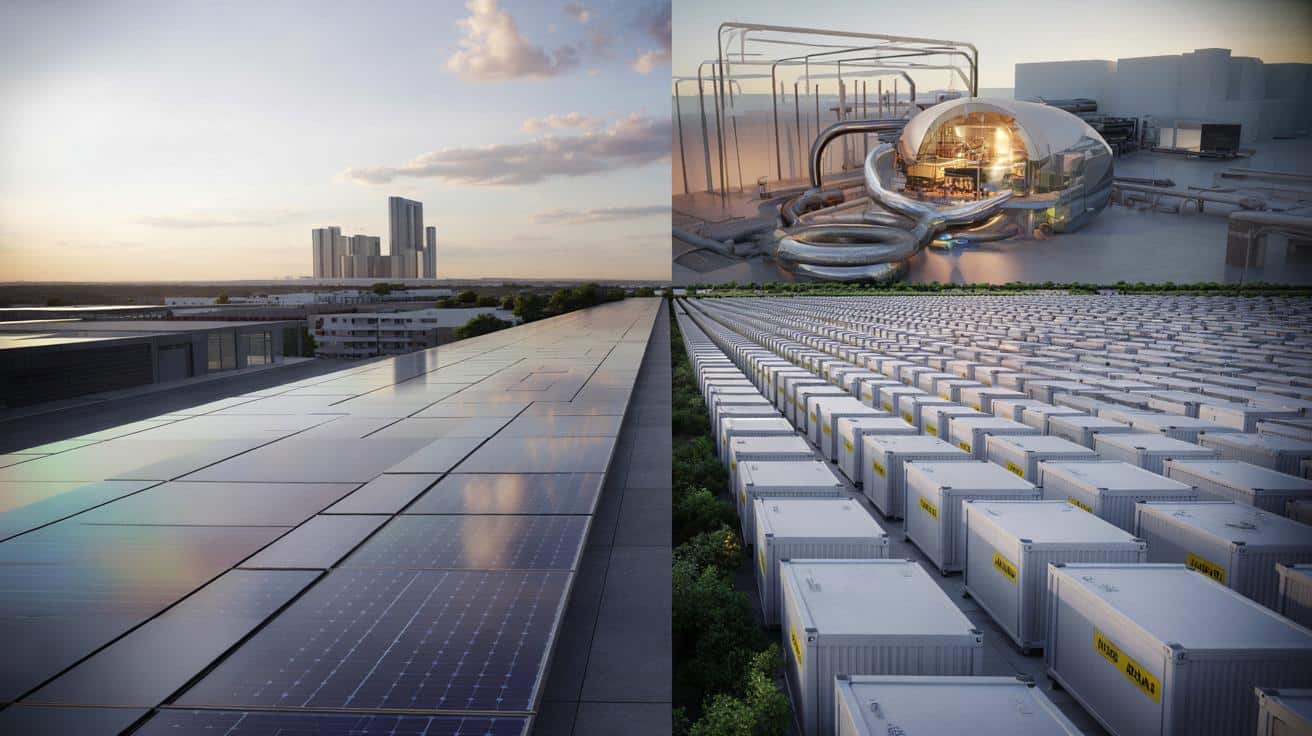
Across research centres and factory floors, a handful of once-hyped technologies are finally crossing into real life. They will not replace fossil fuels overnight, but they are starting to attack the hardest problems in clean energy: efficiency, storage and constant supply.
Perovskite solar: beyond the silicon ceiling
For years, silicon solar panels have carried the clean energy boom on their backs. Yet they have a hard physical limit. Even in perfect lab conditions, conventional silicon cells stall at around 25% efficiency. Sunlight simply arrives with colours silicon cannot use well.
Perovskite-silicon “tandem” cells change that equation. Instead of relying on one material to do everything, they stack two complementary layers:
- A top layer made of perovskite, tuned to grab high-energy blue and green light
- A bottom layer of silicon, which handles red and near‑infrared wavelengths
This sharing of the solar spectrum cuts waste and boosts output from the same panel area.
Recent tandem prototypes have pushed efficiency to about 34%, a jump that would have looked unrealistic a decade ago.
That number comes from peer‑reviewed work published in Nature, and it is not staying on paper. The first commercial perovskite-silicon modules are slated to reach the market in 2026, with pilot production already underway in Europe, China and the US.
From rooftops to backpacks
Higher efficiency is only part of the story. Perovskites can be processed at lower temperatures than silicon, and can be deposited onto flexible substrates. That opens up formats that classic glass panels struggle with.
In practice, manufacturers are working on three key product families:
- High‑efficiency rooftop and utility‑scale panels, replacing or complementing existing silicon modules
- Lightweight, rollable films for industrial roofs that cannot bear heavy loads
- Portable, foldable panels for camping, emergency response and defence applications
None of this erases the unresolved issues. Perovskites are still sensitive to moisture and oxygen, and some formulations use lead. Companies are racing to improve encapsulation layers, extend lifetimes beyond 20 years and reduce toxic content.
➡️ What does making your bed right after waking up mean, according to psychology?
➡️ If you remember these 10 moments from decades ago, your memory is sharper than most in their 70s
The bet for 2026 is not perfection, but “good enough” stability to justify real‑world deployment and drive learning-by-doing.
Storage steps up: from lithium-ion to long-duration
Intermittent sources like solar and wind do not match human habits. Peak production often arrives at midday, while demand spikes in the evening and during cold snaps. Lithium‑ion batteries help smooth short‑term fluctuations, yet they lose their economic edge when storage must last for days.
Iron-air batteries stretch storage to days
Iron‑air batteries are one of the most closely watched contenders for long‑duration storage. Instead of shuttling lithium ions between electrodes, these devices rely on a much simpler and cheaper reaction: iron rusting and then being “un‑rusted”.
During discharge, iron plates exposed to air oxidise, releasing electrons. During charging, an applied current reverses the process, turning rust back into metallic iron and consuming oxygen.
US-based Form Energy reports that its latest iron-air systems can store electricity for up to 100 hours, targeting multi‑day gaps in wind and solar output.
The company started production at a dedicated plant in 2025 and plans to ramp up shipments to grid operators through 2026. Early projects in the US Midwest and on coastal grids aim to replace some gas‑fired peaker plants used only a few days per year.
Sodium-ion batteries chase the mass market
While iron‑air focuses on very long durations, sodium‑ion technology goes after lithium‑ion itself. Sodium sits just below lithium on the periodic table, and behaves in a similar way inside a battery. The big difference lies outside the lab: sodium is abundant in seawater and common salts, while lithium supply is geographically concentrated and more expensive to mine.
Chinese battery giant CATL announced that its second‑generation sodium‑ion cells, marketed under the Naxtra name, enter mass production in 2026. Early technical data points to several advantages:
| Feature | Lithium-ion | Sodium-ion (new gen) |
|---|---|---|
| Raw material cost | Higher | Lower |
| Energy density | Higher | Moderate |
| Cold temperature performance | Can degrade | Generally stronger |
| Safety (thermal runaway risk) | Well-managed but non‑negligible | Reduced |
Because sodium‑ion cells store slightly less energy per kilogram than high‑end lithium‑ion, they fit best in use cases where size and weight matter less than price and safety: grid storage containers, two‑wheelers, small city cars and home batteries.
The spread of sodium-ion in 2026 could ease pressure on lithium supply chains and stabilise battery prices after years of volatility.
Fusion’s quiet pivot: solving the tritium puzzle
Behind the headlines about record fusion temperatures and flashy private reactors lies a more mundane problem: fuel. Most proposed power‑scale fusion devices use a mixture of deuterium and tritium, two isotopes of hydrogen. Deuterium is cheap and plentiful in seawater. Tritium is not.
Global tritium stocks sit at just a few tens of kilograms, with annual production measured in single‑digit kilograms, largely from heavy‑water fission reactors. A single 1‑gigawatt fusion plant could need 50–60 kilograms of tritium each year.
Without a way to breed and recycle tritium, the dream of large‑scale fusion power stalls before it starts.
Unity-2: closing the tritium loop
In 2026, Canadian nuclear laboratories and Japanese start‑up Kyoto Fusioneering are launching an R&D installation known as Unity‑2. The project’s aim is not to smash new energy records but to show that tritium can move through a closed fuel cycle.
The basic idea is to embed lithium in so‑called “breeding blankets” around a fusion plasma. High‑energy neutrons generated in fusion reactions hit the lithium, which then produces tritium. The tritium must then be extracted, purified and fed back into the plasma in a controlled way.
Unity‑2 will not operate as a full power plant. Instead, it tests the plumbing: pumps, filters, membranes and safety systems needed to handle radioactive hydrogen at scale and recycle it continuously.
If Unity-2 meets its performance targets, the project could remove one of the least glamorous but most decisive obstacles on the path to commercial fusion.
What these shifts mean for homes and grids
For households, the near‑term effects will be subtle rather than dramatic. Early perovskite-silicon panels will likely appear first on premium installations and commercial roofs, where every extra percentage point of efficiency justifies a higher upfront price. Over time, economies of scale and competition tend to bring those gains to mainstream rooftop markets.
Grid operators stand to benefit sooner from new storage options. Long‑duration batteries allow transmission system operators to lean harder on solar and wind without relying as much on expensive backup plants. That can translate into fewer blackout risks during calm, cloudy periods and more stable wholesale electricity prices.
Risks, trade-offs and what to watch in 2026
Every technology on this list carries its own set of risks and trade‑offs:
- Perovskite panels still face questions on durability, especially under heat, UV exposure and humidity over decades.
- Iron-air systems require large physical footprints and complex balance‑of‑plant engineering, which may limit where they make sense.
- Sodium-ion batteries depend on building new supply chains for cathode and anode materials, even if sodium itself is abundant.
- Fusion fuel cycles must handle tritium, a radioactive gas that demands strict safeguards to protect workers and the environment.
Regulators and investors are watching three main indicators: cost per kilowatt‑hour, field failure rates and scalability. Lab records spark headlines, but long‑term contracts and repeat orders decide whether these technologies anchor the next phase of the energy transition.
Key concepts worth unpacking
Several technical terms will keep surfacing over the next few years.
Energy efficiency in solar cells describes the fraction of incoming sunlight turned into electricity. A jump from 20% to 30% may sound small, yet it means 50% more power from the same panel area. That can cut land use and balance‑of‑system costs, such as mounting structures and cabling.
Long-duration storage generally refers to any technology able to hold energy for more than eight hours at reasonable cost. That category includes pumped hydro, compressed air, hydrogen, iron‑air and others. As grids push towards higher shares of renewables, the value of storing electricity over days or weeks grows sharply.
Fusion gain often makes news: it measures whether a fusion experiment produces more energy than the power put into the plasma. Yet without a sustainable fuel cycle, even high‑gain experiments cannot scale into commercial plants. That is why projects like Unity‑2, which look prosaic next to glowing plasma shots, matter just as much.
Put together, perovskite breakthroughs, new battery chemistries and tritium loop experiments point to a slow but tangible shift. In 2026, the clean energy debate is moving from “can this work at all?” to “can this work reliably, affordably and at scale?”. The answers emerging from labs and factories over the next few years will shape not just carbon curves, but also who controls the key infrastructure of the 21st century.