The night I stumbled on this dish, the world outside my window looked slightly blurred. Rain on the glass, laptop glow a bit too bright, that tired feeling that sits between your shoulders and refuses to leave. I wasn’t planning to cook anything special. Honestly, I was two clicks away from a sad delivery burger and a guilty scroll through my bank app.
Then I opened the fridge, spotted a few potatoes, a sleeping rotisserie chicken, half an onion, and a small block of cheese.
Twenty-five minutes later, I was sitting on the couch with a bowl so warm and comforting it felt almost indecent.
Halfway through the first bite, I already knew something: this was going to be one of those dishes that quietly moves into your life and never leaves.
I didn’t plan a recipe that night.
I just needed to feel okay for a moment.
The dish you cook once and then crave forever
The dish was simple: a kind of lazy chicken and potato gratin, somewhere between a casserole and a hug. I sliced the potatoes thin, tossed them with olive oil, garlic, salt, and a bit of smoked paprika. I shredded the leftover chicken with my fingers, scattered it in, added onions softening in a pan, poured a quick cream-and-broth mix over everything, then covered it with grated cheese.
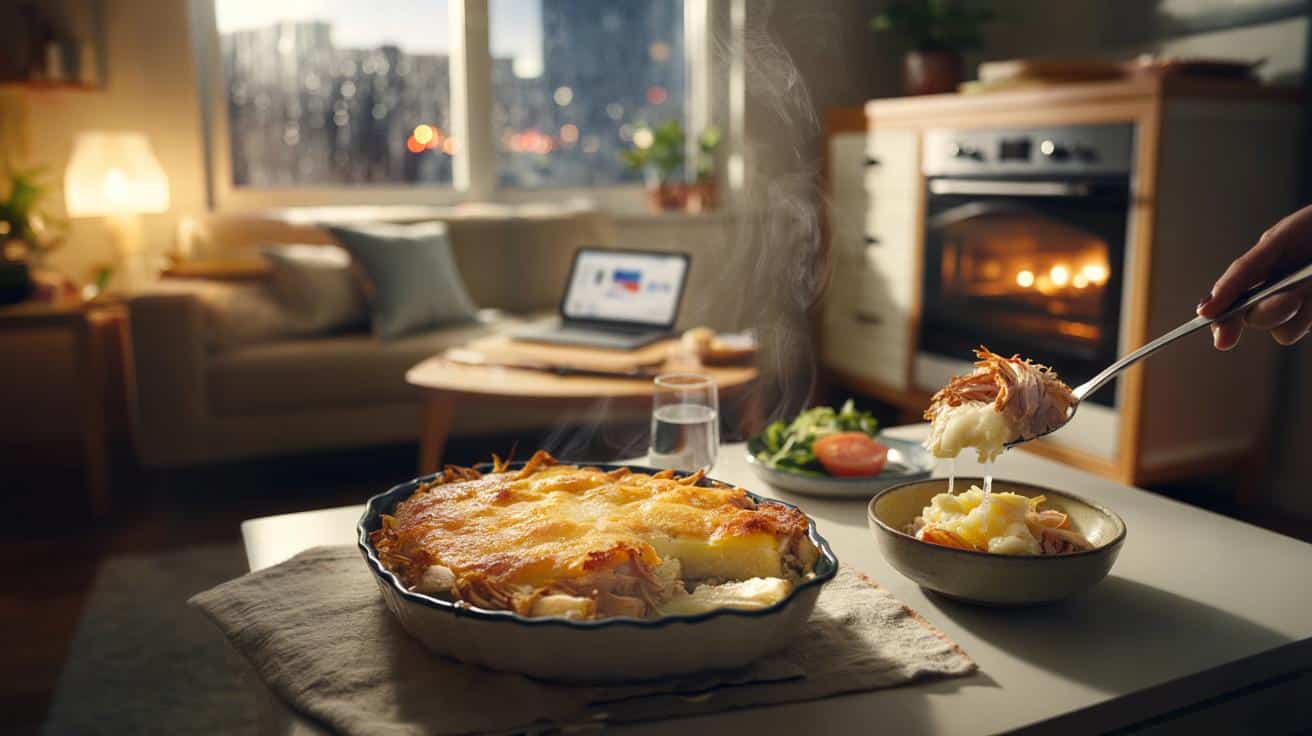
When it came out of the oven, the top was bubbling and slightly browned, edges crinkled like toasted paper.
The kind of smell that makes you forget your phone in another room.
We’ve all been there, that moment when the day has been just a bit too heavy and somehow dinner feels like one more test you’re about to fail. That evening, this dish passed for me. It reminded me of childhood meals without being exactly anything my family used to cook. The potatoes had softened into this creamy, almost velvety layer, the chicken stayed juicy, and the cheese formed that stretchy, golden lid you secretly hope will burn your tongue just a little.
I ate a first portion, then a very unprofessional second, straight from the dish.
The next day at lunch, cold from the fridge and reheated, it was even better.
Part of why I knew I’d make it again was practicality. It used what I had, didn’t demand precise measurements, and forgave my slightly distracted mood. Another part was more subtle. The dish didn’t just taste good. It slowed everything down. It was warm, salty in the right way, filling without feeling heavy, familiar yet not boring.
Some meals whisper: “You’ll forget me by tomorrow.”
This one quietly said: “See you next week.” *That’s the secret category of recipes we’re all secretly looking for.*
How this kind of comfort dish actually comes together
There’s a kind of relaxed choreography behind this gratin, and that’s what makes it so repeatable. First, you preheat the oven so the room already starts to feel cozier. Then you slice two or three potatoes as thin as you reasonably can, no need for perfection, just roughly even. Toss them in a bowl with olive oil, crushed garlic, salt, pepper, and a pinch of smoked paprika or dried herbs.
Spread half the potatoes in a baking dish, forming a loose base.
On top, scatter shredded leftover chicken and a few thin onion slices or leeks if you have them.
Cover with the rest of the potatoes like a slightly messy blanket.
For the “comfort sauce”, I whisk together a small pot of cream or milk with a splash of chicken broth or water, then add a spoon of mustard or a dash of nutmeg. It doesn’t look glamorous at this stage. It looks like something you might doubt. Still, you pour that mixture over the potatoes and chicken, watching it slowly settle into the layers. On top, a generous handful of grated cheese: cheddar, Gruyère, or whatever is lurking in your fridge.
Into the oven it goes for 25–35 minutes, until the top is golden and the edges are bubbling.
That’s the entire ceremony.
Let’s be honest: nobody really does this every single day. Sometimes you’ll still tap your delivery app and call it a night. But this kind of dish becomes an anchor on the evenings when you do have 30 minutes and a bit of energy. It asks very little and gives something real back.
You get to throw things together, walk away while the oven does the emotional labor, then return to a small miracle that smells like you tried much harder than you actually did.
It’s the kind of low-effort ritual that slowly upgrades your everyday life without asking you to become a different person.
Turning a one-off success into your go-to comfort ritual
The easiest way to turn this dish into a regular is to treat it like a flexible formula instead of a strict recipe. Start with three pillars: something starchy (potatoes, gnocchi, leftover rice), something with protein (chicken, beans, sausage, lentils), and something that melts or softens (cheese, cream, tomato sauce, even yogurt). Once you’ve got those, the rest is detail.
You can swap potatoes for sliced zucchini in summer, trade chicken for white beans on a meatless night, or throw in spinach that’s about to give up in the crisper.
The oven doesn’t judge.
It just bakes everything into something that tastes like you had a plan.
Common mistake number one: drowning the dish. When you pour the liquid, you want it to come almost to the top of the layers, not swim over them. Too much and you get soup; too little and the potatoes stay annoyingly firm. Another trap is rushing the baking time. Pulling it out too early is tempting when you’re hungry, but those extra 7–10 minutes turn “pretty good” into “wow, I needed this.”
And if your top is browning too fast, cover the dish with foil and let the inside keep doing its slow magic.
Cooking for comfort isn’t about performance; it’s about patience with yourself and the food.
On the third time I made this gratin, a friend dropped by “just for a quick chat” and ended up staying for dinner. Halfway through her plate, she put her fork down and said, “I don’t know what’s in this, but it tastes like the kind of evening I keep promising myself and never take.” That sentence has lived rent-free in my head ever since.
➡️ You don’t need to be an expert to make this foie gras: I use my microwave and it costs me far less
➡️ From Internship To Impact How Tech Careers Are Launched
➡️ The return of the aircraft carrier Truman is seen as a snub to the Navy in the war of the future
➡️ Twitter’s JavaScript roadblock: why you can’t use X.com without it
➡️ Before Trees, Earth Was Ruled By Giant Life Forms That Seem From Another World
➡️ If you’re over 60, this is why prolonged sitting feels harsher
- Keep a loose “comfort kit” at home: potatoes or pasta, a can of beans, some broth cubes, cheese that lasts in the fridge.
- Use leftovers on purpose: roast a slightly bigger chicken on Sunday so this dish basically cooks itself on Tuesday.
- Let the oven do the work: once it’s in, step away, take a shower, change clothes, reset your brain.
- Season twice: once with the potatoes, once with the sauce, so every layer tastes like something.
- Serve it simply: a green salad or just a sliced tomato with salt is enough; the main dish is already doing the heavy lifting.
Why this dish stays with you long after the plates are washed
What surprised me was not that the dish was good. What surprised me was how quickly it turned into a habit. A few weeks later, I caught myself buying potatoes “just in case”. Grabbing cream without a plan. Saving half a roast chicken automatically. Somewhere between that first rainy evening and the third or fourth batch, this gratin stopped being a lucky accident and became a quiet coping mechanism.
Food does that sometimes.
It slips between survival and small luxury.
When I talk to friends about their go-to comfort dish, the details change but the pattern doesn’t. Someone has a tomatoey pasta they can throw together blindfolded. Another has a rice bowl with eggs, soy sauce, and frozen peas. A colleague swears by toast with avocado, chili flakes, and an egg on top, eaten standing at the counter. None of these dishes are revolutionary. Yet they all share that same role: softening the edges of a hard day.
They’re proof you can still take care of yourself, even when you feel like you’re running on fumes.
Maybe you already have a recipe that does this for you. Maybe you don’t, and this story nudges you to experiment with what’s hiding in your fridge tonight. Either way, there’s something strangely powerful about that moment when a new dish crosses the line from “random dinner” to “this is mine now”. It doesn’t require a perfect kitchen or a perfect life. Just a bit of heat, a simple list of ingredients, and the quiet decision to feed yourself with kindness.
The rest slowly bubbles into place under a layer of cheese.
| Key point | Detail | Value for the reader |
|---|---|---|
| Simple formula | Base of starch + protein + something creamy or saucy | Easy to adapt with whatever is already in your kitchen |
| Low effort, high comfort | Oven does most of the work in 25–35 minutes | Perfect for tired evenings when energy is low but you still want real food |
| Repeatable ritual | Becomes a flexible “house dish” you can tweak endlessly | Gives you a reliable, soothing go-to meal you’ll want to cook again |
FAQ:
- Question 1Can I make this dish without cream?
- Answer 1Yes. Use milk thickened with a spoon of flour, or mix broth with a bit of cream cheese or yogurt. The idea is to have something slightly rich that can soak into the potatoes.
- Question 2What if I don’t eat meat?
- Answer 2Swap the chicken for white beans, chickpeas, or cooked lentils. Add a bit more seasoning and maybe extra cheese or olive oil for richness, and bake the same way.
- Question 3Can I prepare it ahead of time?
- Answer 3You can assemble the dish a few hours in advance and keep it in the fridge, tightly covered. When you’re ready, bring it out, let it sit 10 minutes, then bake until the top is golden and the center is hot.
- Question 4How do I reheat leftovers?
- Answer 4Reheat in the oven or air fryer so the top crisps again. If using a microwave, add a tiny splash of milk or water and cover the dish so it doesn’t dry out.
- Question 5Can I freeze this gratin?
- Answer 5Yes. Let it cool completely, portion it, and freeze in airtight containers. Reheat in the oven from frozen or thawed until hot in the middle and lightly bubbling at the edges.