On a grey Tuesday morning in November, the line at the downtown café is strangely short. The barista leans on the counter, scrolling her phone, while a few lonely suits tap at laptops. Two years ago, this place buzzed at 8:45 a.m. with the sound of heel strikes, nervous laughter, and people sneaking in one last espresso before the office grind. Today, most of those workers are somewhere else. At their kitchen tables. On their couches. In converted closets with ring lights and sticky notes on the wall.
What looked like a temporary emergency experiment has quietly turned into a four–year global study of what happens when work walks through the front door.
And scientists say the verdict is simple: people are just… happier.
Four years of data that many bosses don’t want to hear
The new research doesn’t come from a single quirky startup or a feel‑good survey on social media. It comes from longitudinal studies tracking thousands of employees across countries, industries, and job levels since 2020. Over and over, the same pattern shows up. When people regularly work from home, reported happiness rises. Stress drops. Sleep improves.
The big twist is not the data. It’s the reaction. A lot of managers hear these results, nod politely, then send out yet another “back-to-office” memo with carefully crafted corporate language about “culture” and “serendipitous collaboration.”
Take the case of a global financial firm that quietly took part in one of these four‑year studies. Employees who worked from home at least three days a week reported a 20% increase in life satisfaction, lower burnout, and stronger family relationships. Sick days fell. Voluntary turnover eased.
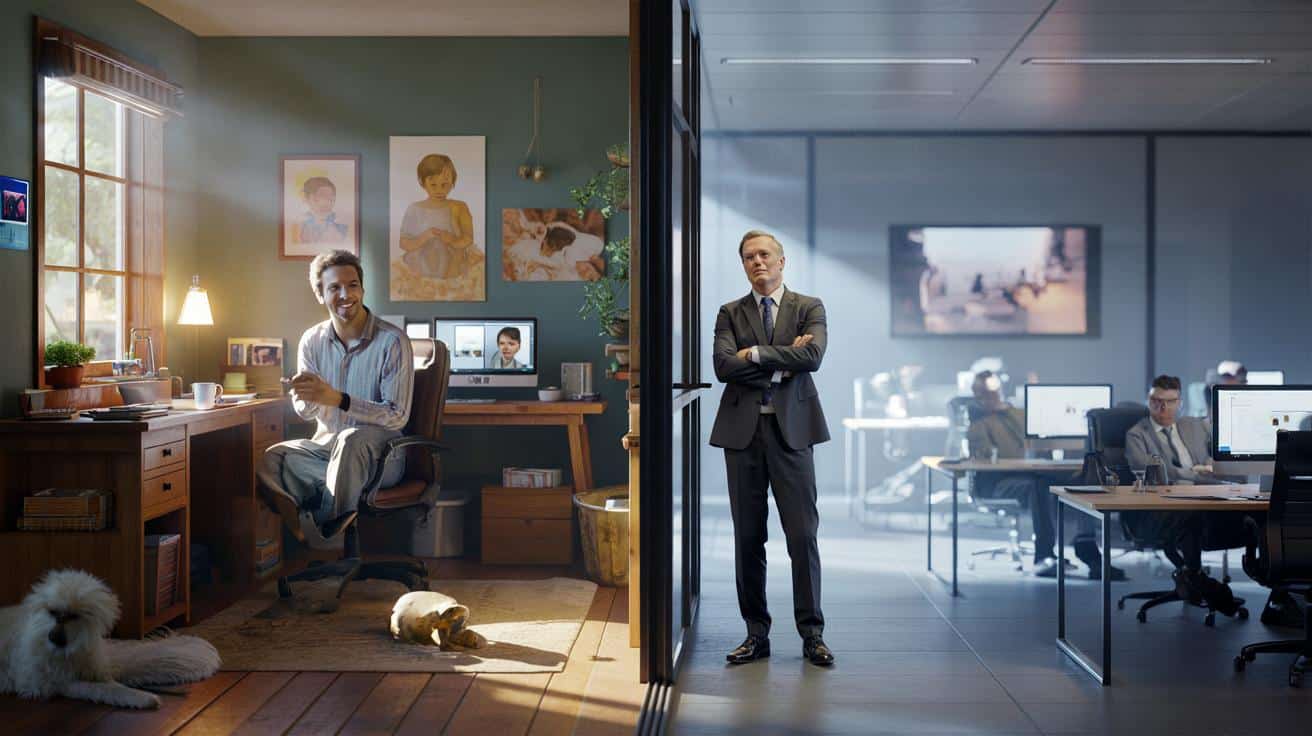
Then senior management flew everyone into a hotel ballroom and announced a mandatory four‑day office return. The slide deck proudly showed rising stock prices, not a word about the wellbeing charts the research team had just presented to them. In the back row, people exchanged glances that said more than any Q&A session could.
Scientists describe the pattern with clinical calm: remote work correlates with improved wellbeing, especially for caregivers, people with long commutes, and those with chronic health conditions. Happiness gains don’t come from working less, but from working with fewer pointless frictions. No more two‑hour daily commutes. Fewer interruptions. The ability to throw in laundry between meetings or walk a dog at lunch.
For many managers raised in a world where “presence” equals “performance”, this is quietly threatening. If people are happier and just as productive away from the office, the old mental model of control starts to wobble. *That tension now shapes countless policies, performance reviews, and awkward “camera on, please” reminders.*
How to make work-from-home actually work (for you, not your boss’s dashboard)
The researchers behind these studies noticed something crucial. Remote work boosts happiness the most when people have small, personal systems that protect their time and headspace. Not fancy software. Simple rituals. A start-and-end to the day that isn’t just “roll out of bed, open laptop, collapse later.”
➡️ The shocking truth behind a dying beekeeper and the retiree who must now pay his agricultural tax
➡️ A psychologist says: “This small change in how you think about people marks true emotional maturity”
➡️ If, Between 65 And 80, You Still Do These 9 Things, You Really Are One Of A Kind
➡️ What is the tiny hole in your nail clipper for – and how should you really be using it?
➡️ Why opening windows after showering matters more than extractor fans
➡️ No Vinegar, No Wax: The Easy Home Trick That Makes Hardwood Floors Shine Like New
One effective method is the “three anchors” rule. Pick three fixed points that structure your day at home: a start ritual, a mid‑day reset, and a shut‑down ritual. That could mean coffee and a short walk before opening email, a phone‑free lunch, and a five‑minute “close the loops” checklist before logging off. These anchors give shape to days that might otherwise blur.
A lot of people tried to copy office life at home: same hours, same back‑to‑back meetings, same constant availability. No surprise they ended up exhausted on the sofa, remote in hand, wondering why working from home felt like living at work.
A gentler, more honest way is to accept that your house has its own rhythms. Kids burst in. Packages arrive. Neighbours drill. Instead of fighting that reality, the happiest remote workers blend it. They schedule deep‑focus tasks in their quietest hour. They shift creative work to when they naturally have energy, not when a shared calendar tells them to. Let’s be honest: nobody really does this every single day. Yet even trying twice a week can change the whole emotional tone of remote work.
The scientists behind the four‑year research summarised their findings in one blunt sentence that stuck with me:
“Flexible location and flexible time are now among the strongest predictors of day‑to‑day happiness at work.”
Some managers hear “flexible” and imagine chaos. The reality on the ground looks much more ordinary. People pick up kids and log back in later. They start earlier to avoid traffic on their one office day. They answer emails from a quiet corner, not under fluorescent lights.
What employees actually want from remote work is fairly consistent:
- Two to three days a week without commuting.
- Clear expectations that don’t demand 24/7 online presence.
- A say in how and where they do deep, focused tasks.
- Permission to be human: doctor’s visits, school runs, tired days.
- Tools that support asynchronous work, not endless meetings.
The quiet split between data and power
Underneath the graphs and HR memos lies a more human story: trust. The four‑year remote work studies show bosses consistently underestimate how much their teams actually work from home. At the same time, employees underestimate how much their managers worry about losing influence in a hybrid world. Each side misreads the other’s fears.
Remote staff fear being invisible. Dropped from big projects. Passed over for promotions because they’re not in the room when ideas are casually floated. Managers fear slipping into irrelevance, unable to “read the room” through a mosaic of tiny video windows. This is where the data hits a wall of emotion.
We’ve all been there, that moment when you log off at 6:30 p.m. after a long day on calls and still feel guilty, as if you should “prove” you’re working by staying green on the chat app a little longer. That quiet pressure has a name in the research: digital presenteeism. It adds stress, but not results. It feeds anxiety, not creativity.
One plain‑truth sentence runs through almost every interview with happy remote workers: they decided whose opinion truly counts. Not the colleague who judges them for turning off video. Not the senior VP who loves hallway chats but never answers emails. The people that matter are the ones who see the outcomes, not the chair time.
These four years of data also hint at something bigger than Zoom and kitchen desks. They poke at what we think work is for. If a person can hit targets, help their team, and grow in their role while also seeing more of their children, caring for an aging parent, or simply living somewhere quieter and cheaper, why fight that?
Some managers will keep resisting, clinging to office rituals that made sense in 1997. Others are quietly rewriting the rules: promotions that don’t require relocation, team days that are optional, performance reviews that focus on impact instead of “visibility.” The research doesn’t promise that remote work solves everything. It just shows, with four years of patient measurement, that when work comes a little closer to real life, people feel more like themselves.
And once you’ve tasted that, it’s very hard to go back to the 7:12 a.m. train without asking yourself what, exactly, you’re commuting to.
| Key point | Detail | Value for the reader |
|---|---|---|
| Remote work boosts happiness | Four‑year studies link flexible location and time with higher life satisfaction and less burnout | Helps you feel less guilty for preferring home days and gives you data to back it up |
| Small rituals make a big difference | “Three anchors” structure your day: start, mid‑day reset, and shut‑down | Offers a simple way to stop days from blurring and protect your energy |
| Trust and outcomes beat presenteeism | Digital presenteeism adds stress without improving results | Encourages you to focus on impact instead of staying “online” just to be seen |
FAQ:
- Question 1Are people really more productive at home, or just happier?Most large studies show that productivity stays the same or improves slightly for many roles, especially knowledge work. The biggest gains are in wellbeing, but those often feed back into better focus and fewer sick days.
- Question 2Why are some managers still against remote work if the data looks so positive?A mix of habit, culture, and fear of losing control. Many leaders built their careers in offices and unconsciously equate physical presence with commitment and performance.
- Question 3What if my job has gone hybrid but promotions seem to go to people who are in the office more?That pattern shows up in the research. It helps to talk explicitly with your manager about visibility, ask for clear criteria, and document your results so they don’t get lost behind closed‑door chats.
- Question 4How can I keep remote work from bleeding into my personal life?Use hard stop rituals: a daily log‑off time, closing your laptop and putting it out of sight, a short walk, changing clothes. Physical signals help your brain switch roles.
- Question 5Is full‑time remote the only way to get these happiness benefits?No. Even one or two days a week at home shows measurable gains in wellbeing for many people. The key is some degree of choice and flexibility, not perfection.